
Metal additive manufacturing does not represent a single technology so much as three distinct thermodynamic and chemical routes to a solid part, and the choice among laser powder bed fusion (L-PBF), directed energy deposition (DED), and binder jetting is, at bottom, a choice about which physical mechanism will govern density, microstructure, and dimensional control. Each process trades speed, feature resolution, and residual stress against a different failure mode, and understanding the underlying mechanism, rather than treating the three as interchangeable “3D printing” options, is what allows a process to be matched correctly to a part’s functional requirements.
In L-PBF, a focused laser scans a thin powder layer that is largely surrounded by unmelted powder and, beneath it, previously solidified material acting as a substrate. Because that substrate conducts heat away rapidly, the melt pool exists for only milliseconds before solidifying, producing steep local thermal gradients and cooling rates that favor fine, frequently columnar grains oriented along the direction of heat extraction. DED inverts this geometry: powder or wire is fed continuously into a larger, longer-lived melt pool created by a laser, arc, or electron beam and deposited onto an existing surface rather than a fully powder-supported bed. A recent review in the Journal of Laser Applications on laser powder-based directed energy deposition describes how the shape and intensity distribution of the laser beam controls the melt pool’s temperature field, and how steep thermal gradients at compositional interfaces drive grain refinement and pronounced crystallographic texture along the dominant heat-flow direction, an effect the review connects directly to the mechanical anisotropy observed in functionally graded DED deposits. Because DED’s melt pool is larger and more slowly quenched than L-PBF’s, it favors deposition rate and part scale over fine feature resolution, which is why, as documented in a survey of current research and industrial applications of laser powder DED, the process has found its industrial footing in repair and large-scale near-net-shape builds rather than in fine-featured components.
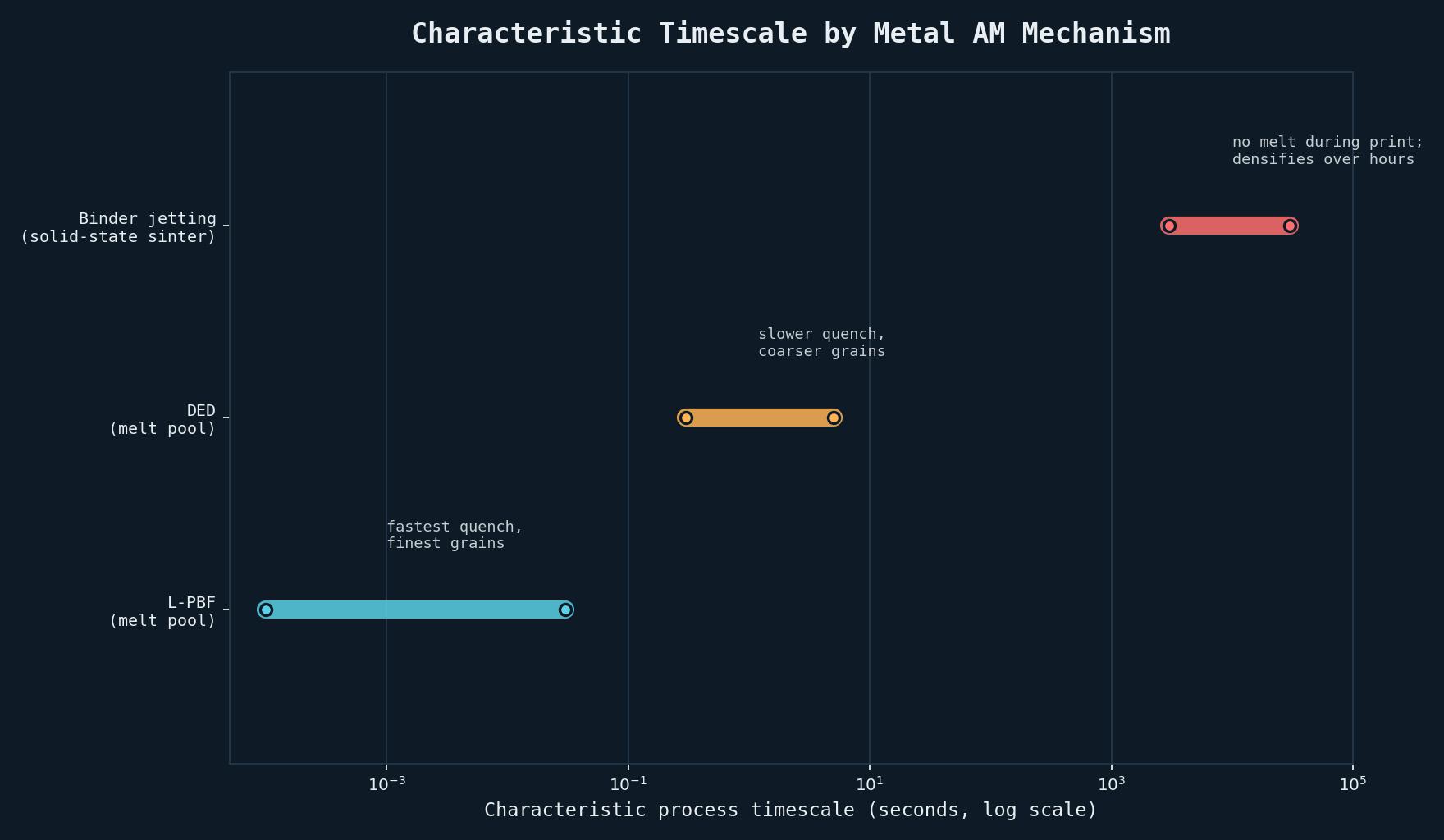 L-PBF’s small, rapidly quenched melt pool produces the fastest thermal cycle of the three routes; DED’s larger, longer-lived melt pool cools more slowly and yields coarser grains; binder jetting substitutes a slow, solid-state sintering cycle for any melting step during printing at all, shifting densification to a separate post-process entirely.
Binder jetting departs from both thermal routes entirely: a liquid binder is printed onto successive layers of loose metal powder at room temperature, producing a “green” part held together only by binder bridges between particles, with no melting during the print itself. This absence of a thermal cycle during printing is what eliminates residual stress and support structures in binder jetting, but it defers densification to a separate sintering step, and that step introduces its own physics-driven distortion. A study on sintering shrinkage in binder jetting measured green parts at roughly 42 percent of theoretical density prior to sintering, with linear shrinkage approaching 25 percent during the thermal densification cycle as pores collapse and particles coalesce by diffusion, and that shrinkage is measurably anisotropic, typically largest along the build direction, because gravity and layer-wise powder packing produce a green density gradient that sinters unevenly. Work on supersolidus liquid-phase sintering of binder-jetted steel shows that introducing a transient liquid phase during sintering can substantially accelerate densification and raise final density, but at the cost of tighter control over the sintering thermal profile to avoid slumping or shape distortion in unsupported geometries.
These divergent mechanisms map directly onto where each process earns its place in a manufacturing system. L-PBF’s steep thermal gradients justify its use where fine features and near-full density matter more than build rate, as in aerospace brackets or internal cooling channels, while DED’s larger, slower melt pool suits repair work and large-format builds where deposition rate outweighs resolution. Binder jetting’s decoupling of shape-forming from densification makes it the most throughput-favorable of the three for series production of moderate-complexity parts, provided the shrinkage and porosity introduced at sintering can be tolerated or compensated for in the original digital geometry. None of the three processes is displacing the others; the field is instead converging on a division of labor in which the underlying physics of each mechanism, rather than marketing distinctions, determines which parts should be built which way.
The recurring theme across all three routes is that thermal or chemical history, not the printer itself, is the primary determinant of final part quality, a reminder that process selection in metal additive manufacturing is fundamentally a materials science problem before it is an equipment problem.