
A spare part sitting on a shelf is not a neutral asset. It is a bet that a machine will eventually need it, made years in advance and paid for every year the bet doesn’t pay off. Global manufacturers were already spending upwards of $320 billion a year on warehousing before additive manufacturing entered the conversation, and a stocked part typically costs its owner another 20 to 55 percent of its own value annually just to sit on a shelf, in carrying cost, insurance, and the risk it goes obsolete before anyone ever needs it (World Economic Forum / 3YOURMIND; BigRep). Digital inventory offers a genuinely different answer to that bet: store the CAD file instead of the physical part, and print it only once a machine breaks.
The other side of that ledger is what happens when the part isn’t there. In oil and gas, where a facility outage can run close to $500,000 an hour, that hourly cost has more than doubled in two years, and a single facility can lose $149 million a year to downtime a faster parts pipeline could have prevented (World Economic Forum / 3YOURMIND). Equipment failures cost industrial manufacturers an estimated $50 billion annually industry-wide, and in oil and gas specifically, more than 13 percent of the 470 worker fatalities recorded between 2014 and 2019 happened during repair or maintenance, the kind of work that stalls while everyone waits on a part. That is the real argument for digital inventory: not that it stores data more elegantly, but that it collapses the distance between a machine breaking and a replacement being installed, from weeks to hours.
Run the numbers on a single $1,000 part and the case sharpens. Keeping it in traditional stock costs roughly $250 a year in carrying cost, $50 in warehousing, and another $75 in obsolescence risk, closer to $1,375 a year than the sticker price suggests. A digital-inventory version of the same part, printed only when ordered, can land at $1,000 or less with none of that standing overhead (BigRep). Scale that across a modest catalog of 150 digitized parts and traditional stock runs about $37,500 a year in inventory cost alone, before a single hour of downtime enters the picture. Weigh a $120,000 printer against $200,000 saved from ten fewer preventable outage-hours a year, and the printer pays for itself in roughly six months, the kind of return that gets a make-or-buy decision escalated past the maintenance department.
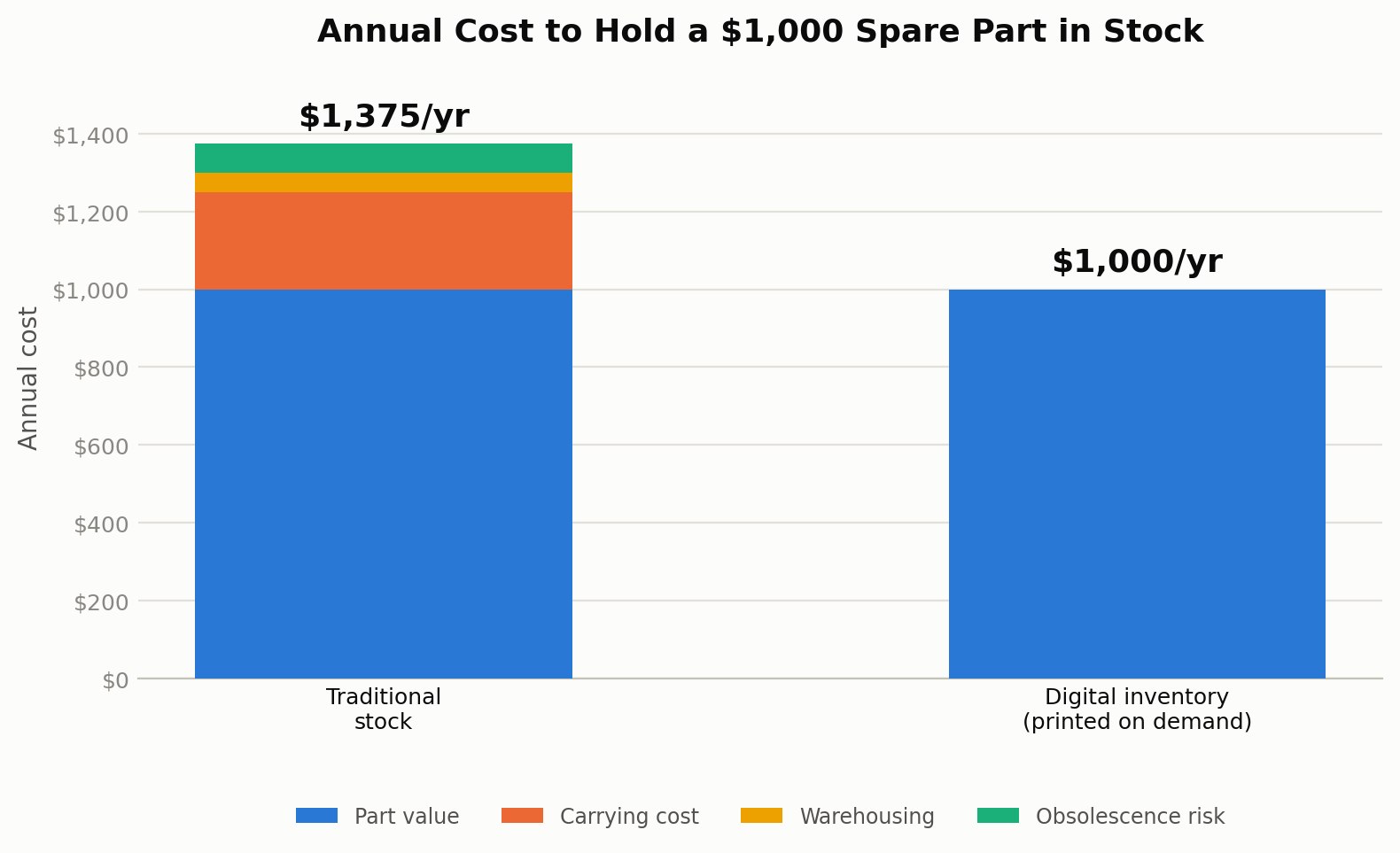 Traditional stock pays a standing premium every year a part sits unused. Digital inventory only spends money once a part is actually ordered.
None of that math holds for every part in a catalog, and a 2023 supply chain cost assessment out of Chalmers and Aalto put a number on exactly how narrow the window is (Ahlsell, Jalal, Khajavi, Jonsson, and Holmström, 2023). Studying fourteen real automotive spare parts end to end, production, transport, warehousing, and service costs included, the researchers found only three came out cheaper printed than manufactured the conventional way. Polymer parts fared better than metal ones, and the parts that won shared a specific profile: low demand, high minimum order quantities from a traditional supplier, and a high per-unit cost through conventional manufacturing to begin with. A steel bracket a supplier stamps out by the thousand for pennies apiece will never lose to a printer. A rarely-ordered polymer bushing for a twenty-year-old machine, bought in batches of five from a supplier who prices accordingly, is a different calculation entirely.
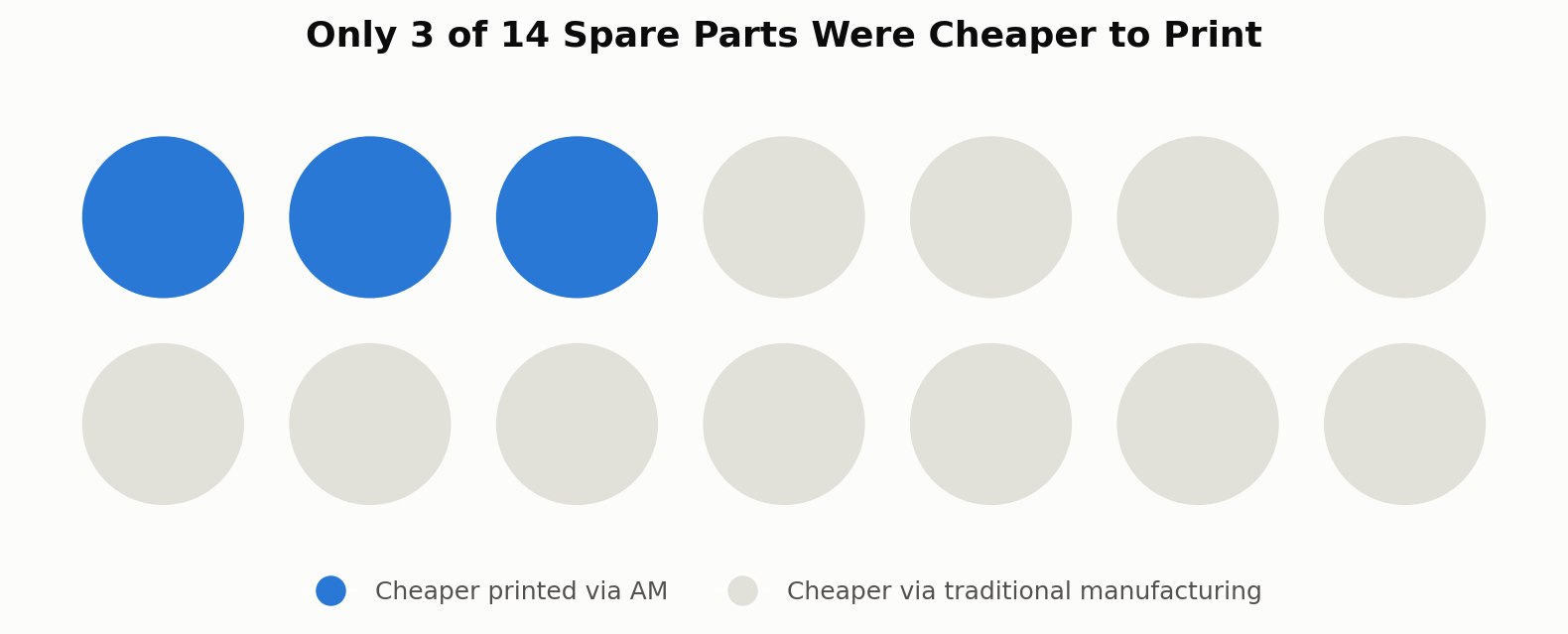 Even in a study designed to find additive manufacturing’s best case, most parts still lost to the traditional supply chain on cost alone.
Companies already running this playbook back up the narrower read. Azoth uses a Desktop Metal binder jet system to produce roughly 1,400 bolt-placement grippers a day, cutting what used to be an eight-week supplier lead time to ten days at about $4.15 a part (TCT Magazine), a case that fits the Chalmers/Aalto pattern closely: a low-cost, high-mix, slow-moving tooling part, not a commodity fastener competing against a stamping press. Deloitte’s Mark Cotteleer, who has tracked the sector for years, frames the appeal in operational rather than technological terms, describing distributed manufacturing’s ability to keep production near where a part is needed as, in his words, “a feature not a bug” rather than a workaround to be tolerated.
The honest version of this story isn’t that 3D printing is replacing the spare parts warehouse. It’s that it hands supply chain planners a second lever for a narrow but real slice of inventory, the slow-moving, expensive-to-stock, annoying-to-source parts a warehouse was always the wrong tool for anyway. The automotive spare parts logistics market is still projected to nearly double by 2034, from roughly $313 billion to $663 billion, because most of that inventory will keep moving the old way (BigRep). Digital inventory doesn’t need to win that whole market to be worth the printer. It just needs to keep winning the fraction that was already costing more to store than it was worth.