
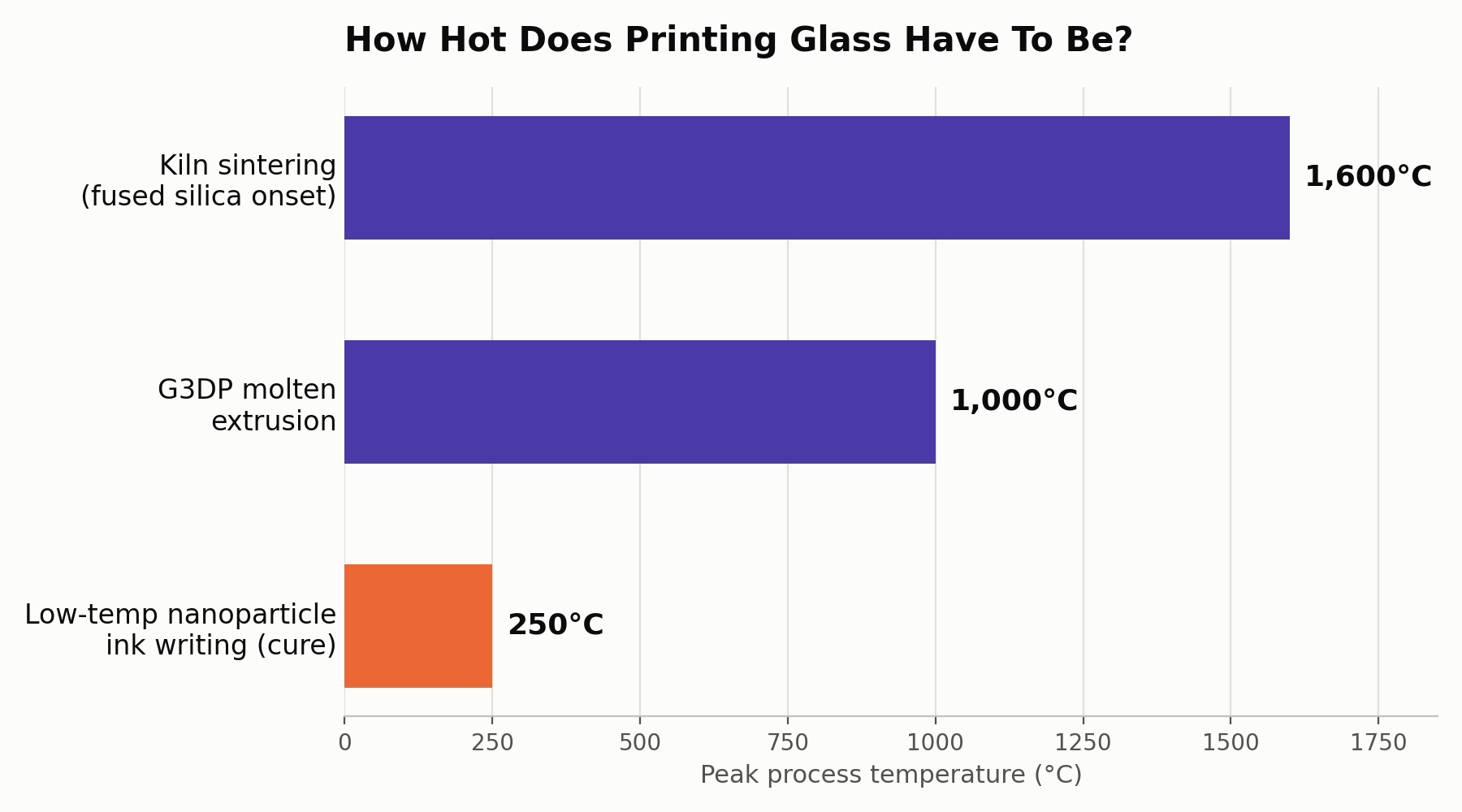
 Every glass printing method is really a negotiation with the same viscosity curve, fought at a different temperature.
Glass resists a 3D printer for one physical reason: its viscosity does not drop cleanly the way a thermoplastic’s does. A polymer filament softens over a narrow band and flows almost like syrup once it clears its melting point. Glass instead moves through a viscosity range spanning several orders of magnitude before it counts as printable at all, from roughly 10² to 10³ Pa·s for a continuous, stable extruded filament, and getting a specific composition into that window means finding its own precise temperature rather than a universal setpoint (Glass Additive Manufacturing Technologies, MDPI 2026). Fused silica does not soften until past 1,500 to 1,700°C. Soda-lime glass, the more forgiving composition most glass printers use, still needs 1,000 to 1,200°C before it flows at all.
MIT’s G3DP printer tackles that heat requirement head-on rather than working around it. A dual-chamber kiln holds molten soda-lime glass at roughly 1,000°C in the extrusion stage, then moves each printed layer into a second chamber held near 500°C, just above the glass’s annealing point, so residual thermal stress can relax out before the part finishes cooling to room temperature (American Ceramic Society). That staged cooling does real mechanical work. Skip the anneal step and the same thermal gradients that let glass flow when hot lock in stress that can crack the part later, without warning. The payoff for building the whole system around a genuine melt is precision that earlier glass printing never reached: filament centerlines deviated from their target path by only 0.18 mm on average, with a maximum deviation of 0.42 mm, a level of control that comes from moving a real connected fluid rather than sintering loose grains. The binder jetting and laser sintering methods researchers tried before G3DP never fully close the gaps between grains, which is exactly why they produced glass that was brittle and opaque instead of clear and structurally sound.
MIT Lincoln Laboratory took the opposite approach: instead of a hotter kiln, a cooler chemistry. Its process extrudes an ink of nanoparticles suspended in a silicate solution at room temperature, then cures the printed part in a mineral oil bath at just 250°C (MIT Lincoln Laboratory). That sidesteps the viscosity problem instead of solving it. Rather than pushing a fluid through its narrow printable window, the ink flows at room temperature because it never has to melt in the first place, and the low-heat cure only needs to drive off solvent and lightly bond the particles together, not force a full silica network to re-form. The tradeoff shows up in what that particle-bonded structure actually is. A part built this way is not fused, vitrified glass the way a G3DP piece is. It sits closer to a glass-particle composite, trading some of true glass’s density and optical purity for compatibility with the temperature-sensitive components, microfluidic channels, and embedded electronics that would never survive a 1,000°C kiln.
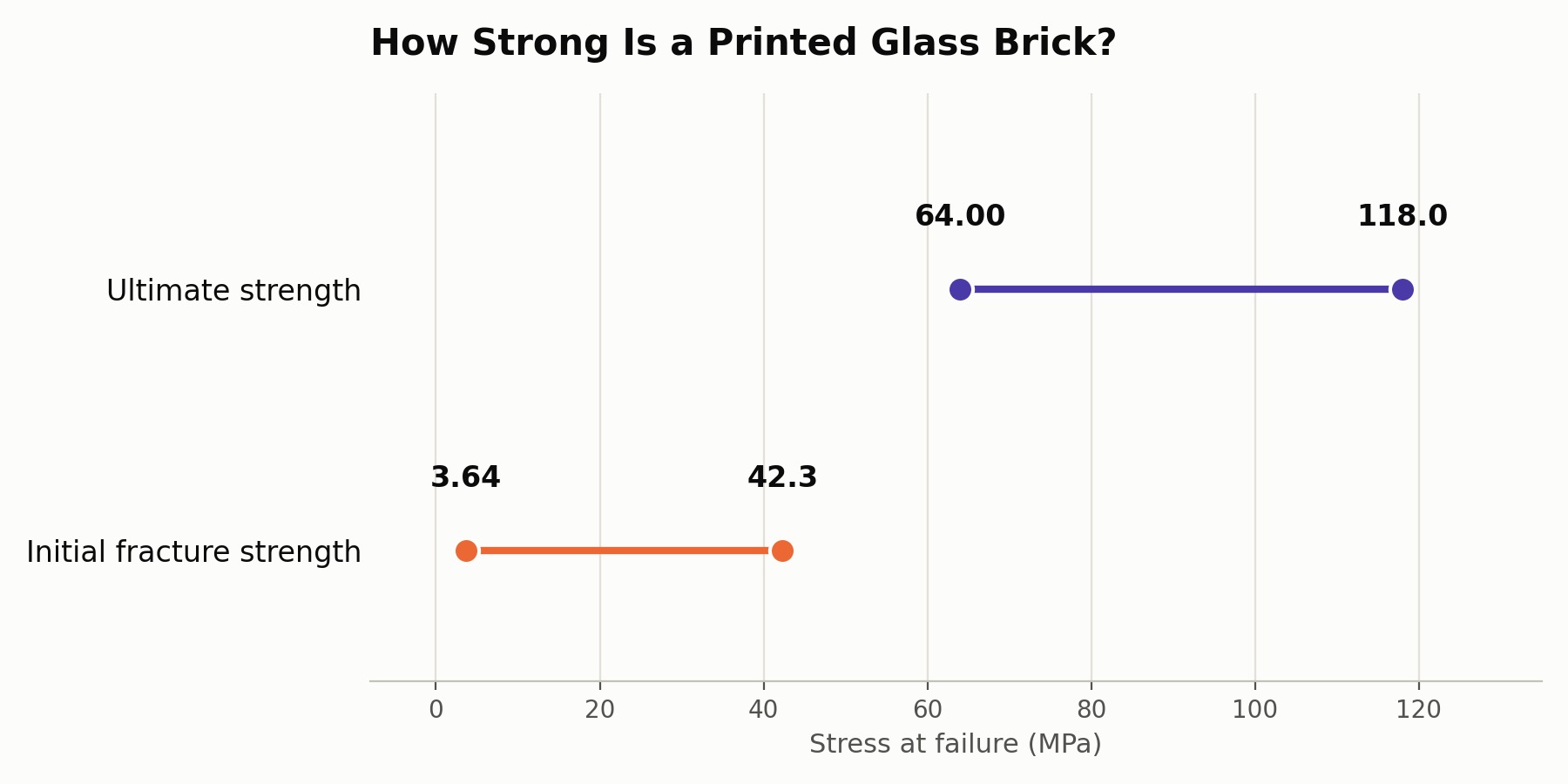 The wide spread at first fracture, next to the tighter cluster at ultimate failure, is the signature of a part breaking at its weakest seam rather than through the glass itself.
Where the mechanism still shows real cracks, literally, is at the interfaces between printed layers. MIT’s Mediated Matter Group and Evenline printed interlocking, LEGO-like bricks from recycled glass on the G3DP3 system and tested them for strength, and the spread in the results tells its own story (American Ceramic Society). Initial fracture strength ranged from 3.64 to 42.3 MPa across the bricks tested, more than a tenfold spread, while ultimate strength clustered much tighter at 64.0 to 118 MPa, comparable to a concrete block. That gap between where a part first cracks and where it actually fails is a signature of flaw-driven fracture. A printed brick doesn’t break because the glass itself is weak; it breaks because a void, an underfused seam, or a stress riser at a layer boundary reaches its limit first. The fully hollow bricks in the study, with fewer such internal boundaries to fail at, held up structurally better than the fully solid printed ones.
The two approaches trade the same problem back and forth rather than solving it outright. Push the temperature up and glass flows as a true connected melt, precise and eventually strong, but every joint between one extruded pass and the next is a place residual stress and porosity can hide until the part is loaded past its first-fracture point. Pull the temperature down and that risk mostly disappears, but so does the fully vitrified network that makes glass glass rather than a bonded particle composite. Neither route has eliminated the layer interface as glass printing’s weak point, and until one does, printed glass parts will keep behaving the way the Evenline bricks did: strong on average, but only as reliable as their least-fused seam.