
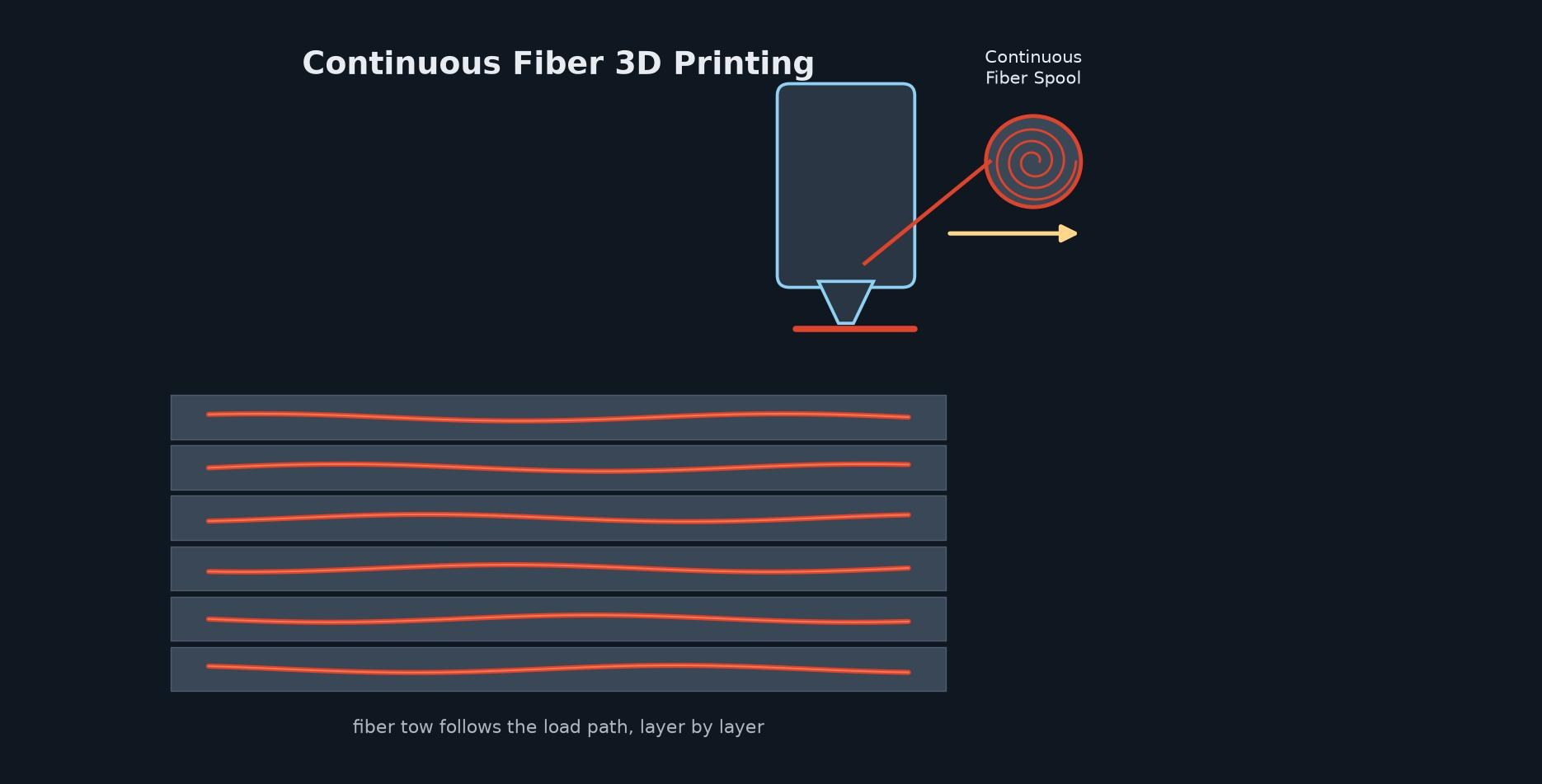
Fused deposition modeling normally reinforces a printed part with chopped fiber mixed into the filament — useful for stiffness, but the fibers are too short and randomly oriented to carry meaningful load along a defined path. Continuous fiber 3D printing changes that: a second nozzle lays an unbroken strand of carbon, glass, or Kevlar fiber alongside (or co-extruded with) the thermoplastic matrix, following the same toolpath as the print itself. Load-bearing capability follows the fiber path directly, in principle turning a 3D printer into a machine that can build composite parts with the same fiber-continuity advantage as hand layup or filament winding, without a mold (Polymer Composites review, Zhang et al. 2025).
The mechanical numbers back this up when fiber content and orientation are optimized. Unidirectional continuous-carbon-fiber composites printed via FFF have reported tensile strength around 390 MPa at roughly 16% fiber volume fraction — competitive with some traditionally manufactured composites — and tensile properties scale directly with the number of continuous-fiber layers included in the layup, with unidirectional (0°/0°) fiber orientation outperforming angled layups for both strength and stiffness at equivalent fiber content (PMC).
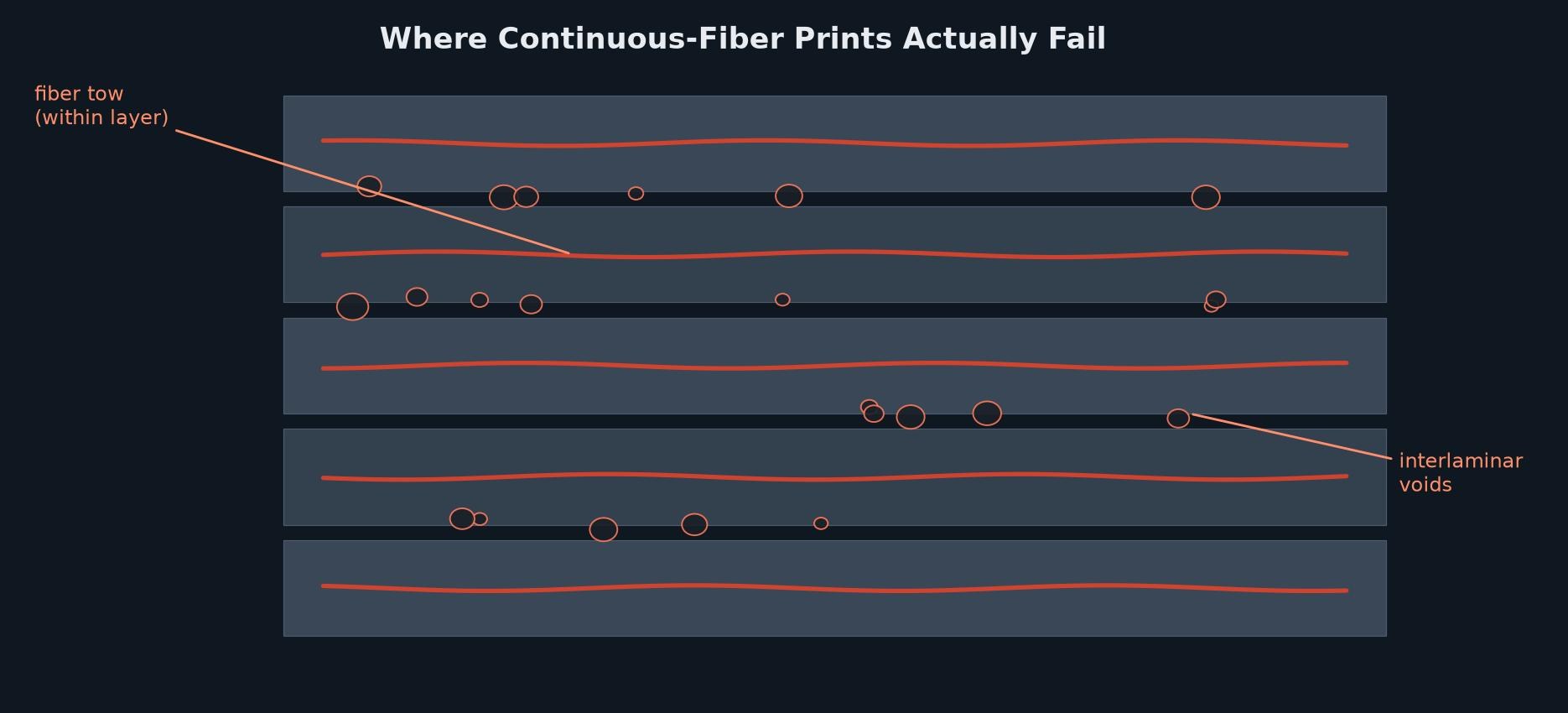 Figure 1: Voids in printed continuous-fiber composites cluster at the boundaries between layers, not within them — the interlaminar interface is where the process’s mechanical weakness actually concentrates.
What limits the process is not the fiber itself but what happens between fiber layers. Interlaminar bonding — the strength of the weld between one printed layer and the next — depends on the matrix polymer fully wetting and fusing the fiber tows, and that’s harder to achieve than in unreinforced FDM: reported void content in printed continuous-fiber composites runs around 16%, concentrated at layer interfaces, and interlaminar bond strength has been shown to decrease further as laminate thickness increases, since heat from each new layer has progressively less opportunity to re-melt and consolidate the layers beneath it (ScienceDirect). Those voids and weak interfaces are exactly where delamination initiates under load — the failure mode that separates a genuinely load-bearing composite part from one that merely looks like one.
The process fixes being explored are mostly about adding compaction and heat back into a process that, by default, only presses each layer down with a single nozzle pass. A layer-wise compaction approach that adds a heated roller behind the print head — mechanically pressing and re-heating each freshly deposited layer — has been shown to reduce voids and improve interfacial bonding compared to standard deposition alone (Advanced Composite Materials). Other approaches under study apply localized pressure, lasers, or infrared heating immediately behind the print head for the same reason: standard FFF extrusion simply doesn’t apply enough force or residence time at temperature to fully consolidate a fiber-reinforced layer the way an autoclave or heated press would in conventional composite manufacturing.
Despite the interlayer weakness, the parts are good enough to be finding real structural use. Drone airframes are a natural fit — one study of 3D-printed continuous-fiber Onyx composite drone components found the printed parts held up well under the specific vibration and impact loads drones actually see, and a separate optimized UAV shell design achieved a 25% structural weight reduction while sustaining a 600 N load, printed as a single continuous-fiber part rather than assembled from separate composite panels (Polymer Composites — UAV shell). Composite tooling is the other clear near-term use: printing a fiber-reinforced mold or jig directly, rather than machining one, cuts lead time from weeks to days, and the tooling doesn’t need to survive a part’s full service life the way a flight structure does — just enough load cycles to make it worthwhile.
That’s the current shape of the tradeoff: continuous fiber 3D printing already produces genuinely load-path-following composites, but the printed interlayer is still the weak point relative to autoclave-cured composites, and the compaction and heating hardware needed to close that gap adds cost and complexity back into a process whose main appeal was doing without a mold or autoclave in the first place.