
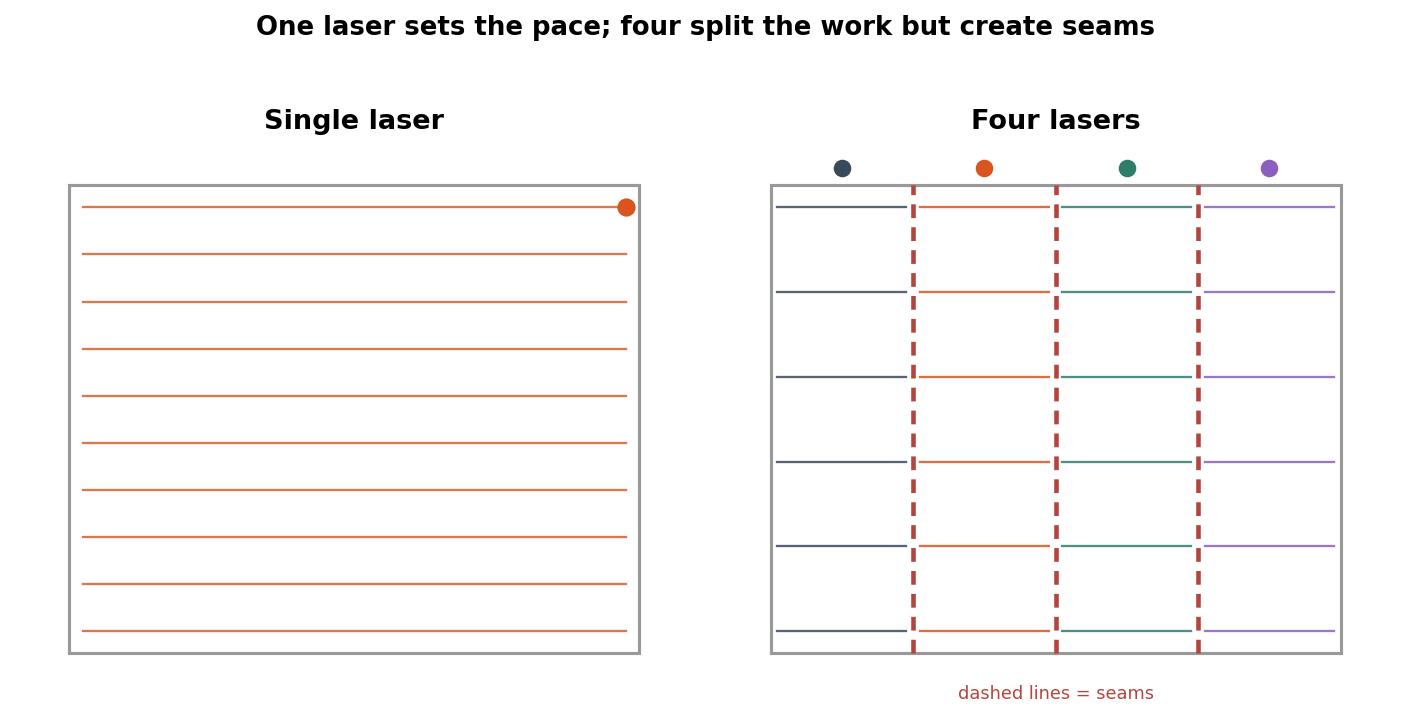
 One laser sets the pace for the whole bed. Four lasers split the work, but the seam where their zones meet becomes its own engineering problem.
A laser powder bed fusion machine has always had one obvious bottleneck: a single laser, tracing one melt pool across the build plate, sets the production rate for the entire part. For years, the industry’s answer to that limit was to make the laser faster. The more interesting answer turned out to be adding more of them, and the economics behind that shift say as much about how metal printing scales as any materials breakthrough does.
The first commercial twin-laser system, the SLM 280HL, arrived around 2015, and quad-laser machines followed. An analysis from Barnes Global Advisors put real numbers on what that bought a production line: a dual-laser machine cut total production cost by 63 percent relative to a single-laser build of the same part, and a quad-laser system cut it by 72 percent (Additive Manufacturing Media). Those savings do not come only from faster printing. Heat treatment, inspection, and machining run as batch operations downstream, so a furnace cycle that costs about the same for five parts as for ten gets cheaper per part the moment more parts come off the machine at once. The line’s whole cost structure falls with print time only if those downstream steps are sized to keep up, and the analysis is candid that they often are not.
Adding lasers also adds a seam, and that seam carries a real quality cost. A 2025 study in Metals found that builds split across multiple lasers generated more spatter than single-laser builds, because adjacent scan zones interact within a tight working area, and that reduced shielding gas flow around the zone boundary increased lack-of-fusion defects, porosity, and microcracking (Metals, 2025). Tensile strength and ductility came out lower for multi-laser builds, a gap the authors traced to those localized defects rather than to bulk density or microhardness, which the paper reports as negligible between the two. The fix was tighter gas-flow control at the seam, not fewer lasers: optimized multi-laser strategies closed the fatigue-performance gap to roughly single-laser levels once that variable was managed. For a part headed into an aerospace qualification file, that distinction is the entire ballgame.
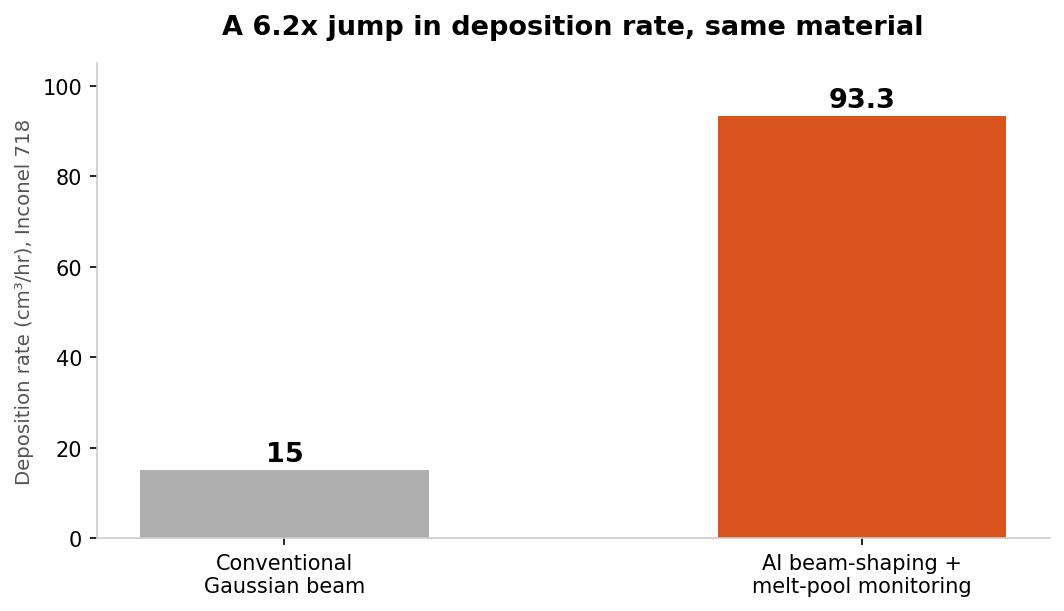 A 6.2x jump in deposition rate on the same Inconel 718 build, driven by shaping the beam and watching the melt pool in real time rather than by adding lasers at all.
The InShaPe project, a three-year, EUR 7.2 million Horizon Europe effort coordinated by the Technical University of Munich, shows what that control looks like when it is built in from the start rather than bolted on afterward. Instead of a conventional Gaussian beam, the project shaped the laser profile to the part’s geometry and material, including a ring-shaped beam that produced a more stable melt pool, and paired it with multispectral imaging that tracks thermal changes across several wavelength bands in real time, catching some defects early enough in the build to correct them mid-process. On an Inconel 718 build, that combination took deposition rate from 15 to 93.3 cubic centimeters an hour, a 6.2x increase, while cutting production cost by roughly half and reducing cracking, spatter, and condensate formation (3dprinting.com). The team validated the approach across five real industrial parts, including an aerospace impeller and a space combustion chamber component, not just coupons.
A more radical rethink of the bed itself points at where the ceiling sits. Oak Ridge National Laboratory’s rotary system replaces the standard flat build plate with a one-meter toroidal table that rotates continuously beneath an array of laser heads, so melting and fresh powder dispensing happen in parallel instead of in alternating steps. Its existing two-laser version already reaches 100.6 cubic centimeters an hour at a 4,000 mm/s scan speed, roughly triple its own output at 1,000 mm/s (3D Printing and Additive Manufacturing, 2024). A modeled retrofit to 20 lasers projects parts-per-quarter output rising from 27 to 294 on the same bed, with packing density climbing from 0.46 to 0.75. Push that model to hundreds of lasers on a larger bed and the authors’ estimated per-part cost falls from roughly $2,000 today toward single digits, a projection built on assumptions about future laser cost and downtime, not a demonstrated result.
Put the three findings together and the pattern is less about lasers than about which constraint moves next. More lasers buy cheaper parts only when heat treatment and inspection scale with them. More throughput per laser, the InShaPe result, buys the same gain without multiplying the seam problem at all. The rotary architecture’s real contribution may turn out to be proving that bed geometry, not laser count, is the next lever worth pulling once beam shaping and seam control are solved.