
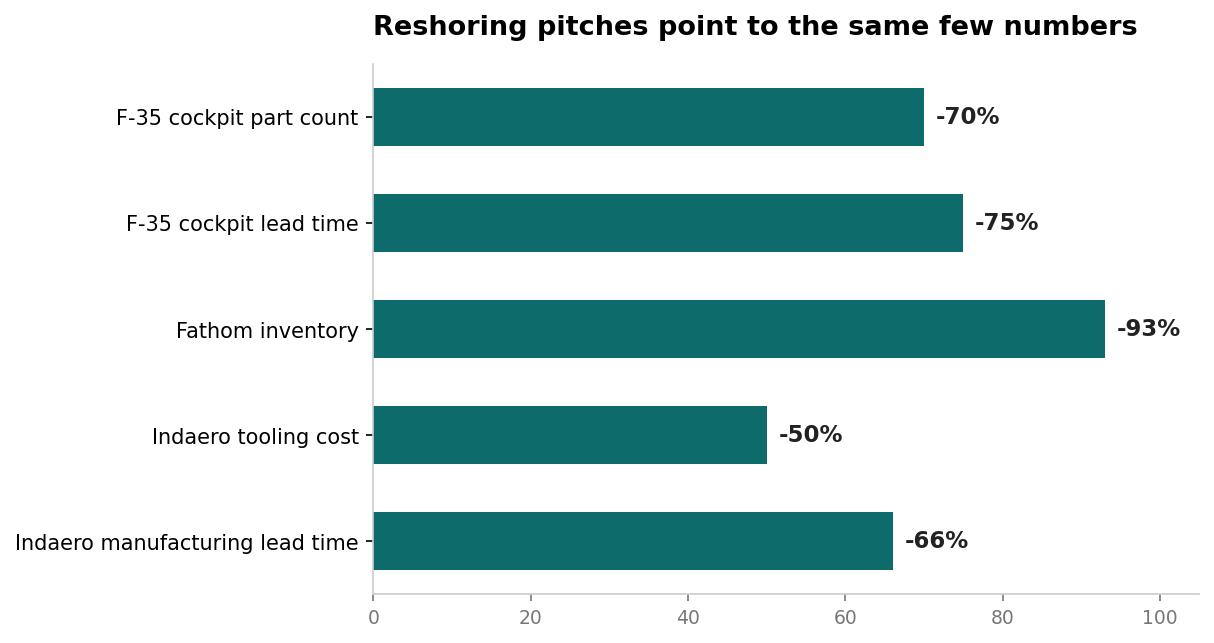
 The numbers the reshoring pitch has been built on since early 2025. None of them depend on a tariff rate.
A year before the ruling that would upend the premise, Stratasys CEO Yoav Zeif was making the industry’s pitch plainly: tariffs and trade uncertainty were handing additive manufacturing a tailwind it had been waiting for. In a February 2025 piece for IndustryWeek, Zeif pointed to concrete numbers: Northrop Grumman cutting rocket-motor tooling lead times from months to weeks, the Spanish aerospace supplier Indaero reporting a 66 percent reduction in manufacturing lead time and a 50 percent cut in tooling cost after adopting AM, and Fathom’s domestic operations trimming inventory by 93 percent through just-in-time printing instead of warehousing. The argument underneath all of it was simple: if importing costs more, printing it at home costs relatively less, and additive’s fixed-cost structure - no tooling, no minimum order quantity - makes that swap easier than it is for conventional machining or casting.
On February 20, 2026, the floor under that argument’s legal basis disappeared. The Supreme Court ruled 6-3 in Learning Resources v. Trump that the International Emergency Economic Powers Act never authorized presidential tariff power in the first place, striking down both the fentanyl-related tariffs on Canada, Mexico and China and the broader reciprocal tariffs applied worldwide (DLA Piper’s summary of the ruling). Chief Justice Roberts’s majority opinion turned on a narrow reading of the word “regulate,” which the Court held does not include the power to tax. More than 175 billion dollars in collected tariff revenue became, in theory, refundable, and nobody had fully worked out the mechanics of paying it back (Council on Foreign Relations).
For a sector that had spent a year telling customers to plan around tariff-driven cost gaps, that is the kind of ruling that should reset the whole conversation. It didn’t, and the reason is instructive.
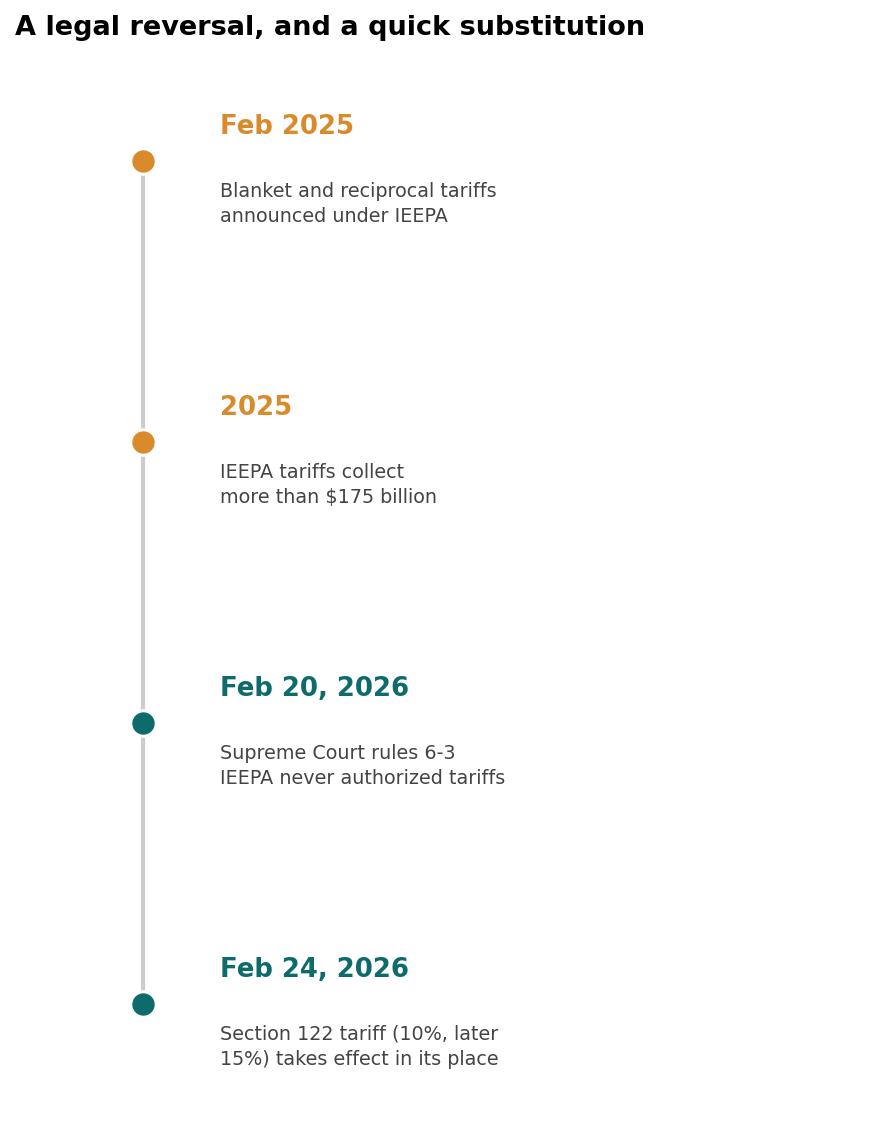 The legal theory changed completely in four days. The landed cost of most imported goods, largely, did not.
Within days, the administration had shifted the same pressure onto other statutory footing: a Section 122 balance-of-payments tariff, capped at 15 percent and limited to a roughly five-month window, plus existing Section 232 duties on steel, aluminum and automotive inputs and Section 301 duties on Chinese goods that the ruling never touched (Council on Foreign Relations). The legal theory changed completely. The landed cost of an imported bracket, for the most part, did not.
By September, the on-the-ground read from AM suppliers matched that. Stratasys had already relocated filament production out of Israel and opened a 200,000-square-foot regional headquarters in Minnesota that June. Protolabs’ Ryan Kees reported rising order volume specifically from customers whose competitors still depend on overseas partners. Velo3D’s Michelle Sidwell put it most directly: tariffs have had limited impact on her company because it built around domestic manufacturing well before the legal fight started (3dAdept, September 2026). None of those three data points depend on which statute happens to be doing the work this quarter.
That gap between legal volatility and business continuity is the real finding here, and it cuts both ways. A Wohlers Associates and ASTM International analysis of 2024 import data found that AM equipment itself is exposed to the same policy swings it is supposed to help customers escape: Germany, China and Israel supplied roughly 625 million dollars of 3D printers into the United States that year, with projected tariff revenue on that trade swinging by nearly 60 percent in a single ten-day stretch back in May 2025, well before any court got involved (Wohlers Associates and ASTM International, via TCT Magazine). A printer bought on the expectation of a 30 percent cost advantage over imported parts can become a printer bought on the expectation of a 10 percent advantage, or no advantage at all, within a single budget cycle, with no printing error involved anywhere in the chain.
The companies that treated tariffs as the value proposition itself are the ones exposed to that kind of whiplash. The ones that treated tariff exposure as a forcing function for an argument that was true anyway - shorter lead times, no tooling amortization, inventory held as a file instead of a shelf - came through a Supreme Court reversal with little to report. That is the distinction worth drawing from this episode. Additive manufacturing’s reshoring case was never really about the tariff rate. It was about which costs disappear when a company stops importing a part, and that math didn’t change on February 20th, even though the law underneath it did.