
Additive manufacturing arrived carrying an environmental promise almost by default. Build only where material is needed, skip the tooling, ship electrons instead of parts, and the energy savings would presumably follow. For most of the 2000s that promise ran ahead of any real accounting. The people making it were largely extrapolating from the idea of the technology rather than measuring what a printer actually consumed.
The first serious attempt to close that gap came from Megan Kreiger and Joshua Pearce, whose 2013 study in ACS Sustainable Chemistry & Engineering compared desktop RepRap printers against conventional factory production with shipping, for a set of common polymer products. Their finding, that distributed 3D printing could cut cumulative energy demand by 41 to 64 percent, and up to 74 percent when the printer ran on solar power, was the first time the sustainability case had a number attached to it rather than an intuition. It came with an asterisk the field would spend the next decade unpacking: the savings depended heavily on which polymer was printing. PLA at low infill looked good. ABS, which needs a hotter nozzle and a heated bed to avoid warping, looked considerably less good, and the gap between the two materials was the study’s real lesson. Energy performance wasn’t a property of 3D printing as a category, it was a property of a specific process running a specific material.
Metal AM inherited that same ambiguity, and for longer, because a metal life cycle assessment has to account for powder or wire production, which is itself energy-intensive, on top of the build. A representative modern example, a cradle-to-gate LCA of wire arc additive manufacturing against conventional forging for an ER-90 flange, published by Guimarães and colleagues in 2025, found WAAM used 18,847 megajoules against 52,111 for forging, a 63.8 percent reduction, alongside a 90.5 percent cut in greenhouse gas emissions and 31.6 percent less solid waste. The forging process’s heating and pressure requirements, not any single dramatic factor, accounted for most of that gap. It’s a result that would have looked almost too favorable to trust in 2013; a decade of methodology refinement is most of why it doesn’t.
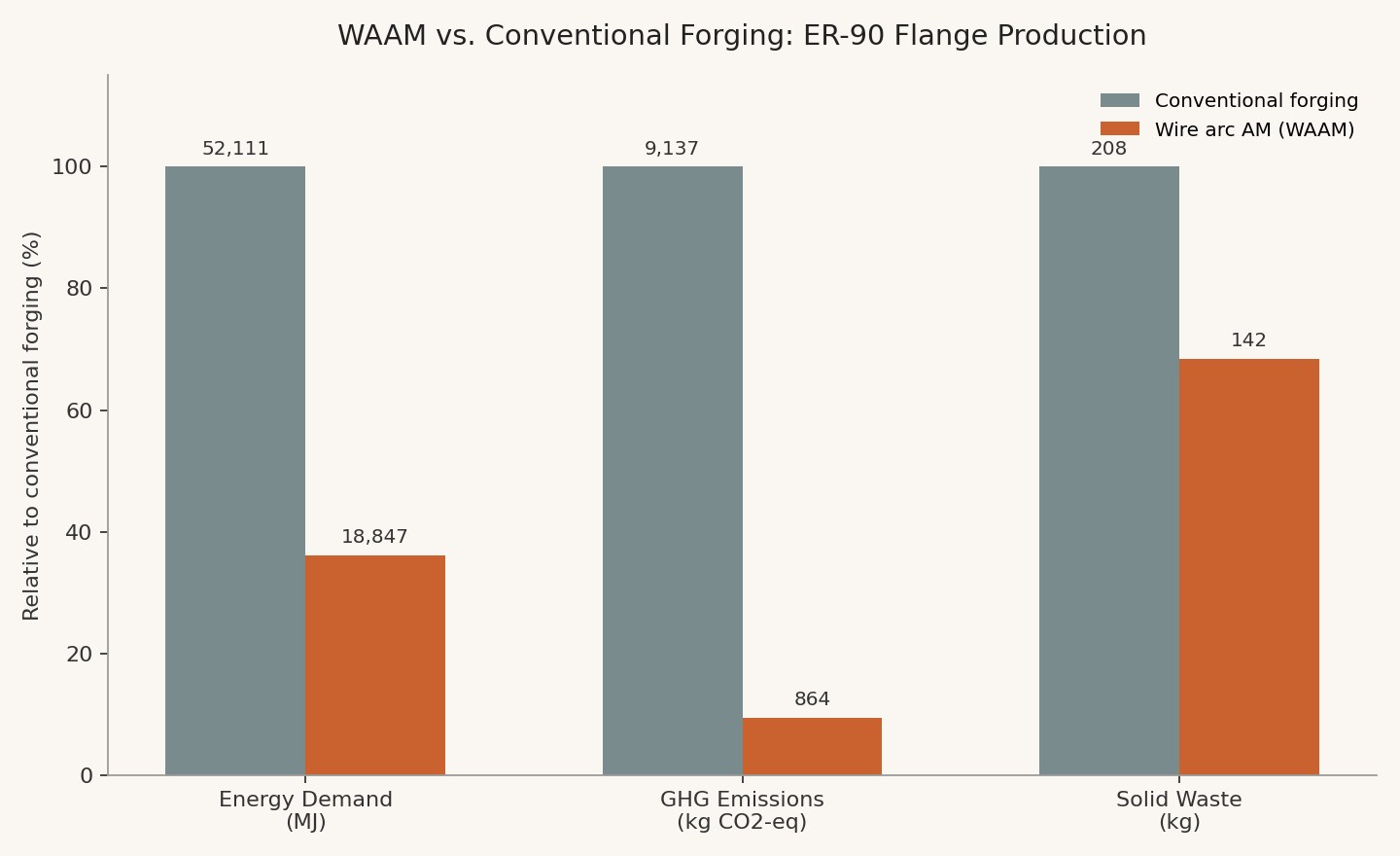 Figure 1: Cradle-to-gate energy demand for an ER-90 flange, comparing wire arc additive manufacturing against conventional forging.
What’s changed most since Kreiger and Pearce isn’t the direction of the finding so much as its texture. A 2026 study in Progress in Additive Manufacturing by Clemens and colleagues, comparing additively manufactured and conventionally machined 316L stainless steel food-filling nozzles, found AM ahead in 15 of 18 measured impact categories, including a 56.3 percent reduction in carcinogenic human toxicity and a 21.74 percent reduction in climate change impact, the latter more modest than the material savings alone would suggest, because manufacturing electricity demand ate into the gain. The same study surfaced a category where AM lost outright: ionizing radiation impact ran roughly 43 percent worse than the conventional process, traced to the German grid mix’s share of nuclear generation. Powder atomization for 316L ran about 6 kWh per kilogram in their accounting, a real cost that an assessment measuring only greenhouse gases would have missed entirely.
That trade-off is the more interesting inheritance from the field’s earlier, cruder comparisons. Early LCA work on AM tended to report one headline number, energy or carbon, and call it the verdict. The current generation of studies increasingly reports across a dozen or more impact categories, and what they’re finding is that additive manufacturing’s environmental advantage is real but not universal. It follows the electricity grid a facility draws from, the material system in question, and how much of the process’s cost lives in a single, easy-to-report metric versus scattered across categories nobody used to ask about. The direction of travel seems less like a settling on one verdict and more like a maturing habit of asking the more specific question in the first place, and that shift, from “is AM greener” to “greener at what, exactly, and compared to what” is arguably the more durable result of the last decade’s work than any individual percentage.