
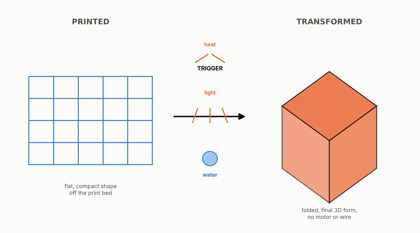
A part can come off a 3D printer’s bed finished in geometry but not yet finished in function. It still has to fold, stiffen, or close its grip before it does its job, and nothing drives that last step but the material itself. No motor, no wire, no second machining pass. That delayed, built-in transformation is what Skylar Tibbits named “4D printing” in a February 2013 TED talk, when he and Stratasys’s R&D group printed a flat lattice that curled itself into a cube the moment it touched water. The fourth dimension was time: a shape change programmed into the material during the print, released later by heat, light, or moisture rather than by an actuator, as Tibbits explained at the time.
The mechanism behind that delayed release is usually a mismatch, not a single material property. Take a scaffold designed to pass through a catheter and then expand to hold tissue open, described in a 2024 Nature Communications paper by Liu and coauthors. The print is a two-layer laminate of a dynamic thermoset polyurethane: one layer swells fast in water, the layer beneath it swells slowly. Printed flat and rolled into a narrow temporary tube, the laminate first springs back to its flat, programmed pattern once it reaches body temperature, roughly 37°C. Water uptake then does the rest. Because the two layers absorb water at different rates, the faster-swelling layer expands against the slower one, and that strain mismatch bends the whole laminate into its final three-dimensional form within about ten minutes. Most hydrogels go soft when they take on water. This one does the opposite: water drives microphase separation between its hydrophilic and hydrophobic segments, which stiffens the hydrated material to roughly 2.9 times its dry modulus. A dry test stent collapsed under a 100-gram load; the same stent, hydrated, held 200 grams without failing. The deformation is driven by osmotic pressure and polymer-chain rearrangement, not by any applied force, which is exactly why it can happen after the part is already inside something too narrow to reach with tools.
Shape-memory polymers aren’t the only route to a delayed transformation. Researchers at the University of Queensland’s Australian Institute for Bioengineering and Nanotechnology took a different physical path, printing resins loaded with spherical liquid-metal nanoparticles that respond to near-infrared light rather than heat or water directly. The nanoparticles absorb the infrared and convert it to localized heat, which drives the bending; aim the laser elsewhere and the heat source moves with it, giving the structure directional control a bulk thermal bath can’t. The resulting parts stayed solid and durable rather than going soft at the hinge, lifted roughly five times their own weight, and returned to their original printed shape once the light source was removed, all without any wiring or circuitry built into the structure. Dr. Liwen Zhang and Dr. Ruirui Qiao, who led the work, described it as adding, in Zhang’s words, “a new dimension, the dimension of time” to an otherwise ordinary print.
Both mechanisms share one tradeoff. A focused infrared beam buys directional control at the cost of needing line-of-sight access. Ambient water needs no targeting at all, but gives up control over where or how fast the change propagates once it starts. Tibbits’s own lab has since moved past single-shot folding into what he calls programmable materials: active textiles that open their pores under heat, shown in a knitted dress built with Ministry of Supply, and furniture printed from molten liquid metal that solidifies in seconds. His framing is blunt about where the real work lies: “there’s nothing magic about the material,” he has said. “Every material is active.” The engineering problem is guiding that latent activity toward something useful, not discovering some exotic new compound.
That’s also where the mechanism meets its real limits. The strongest demonstrated results so far are slow, wet, or thermally driven transformations in soft, low-load structures: scaffolds, textiles, grippers. The Queensland and MIT work is explicitly early-stage, and the Nature Communications scaffold’s safety evidence comes from a three-rat pilot, not a clinical trial. Pushing the same self-folding logic into stiff, load-bearing parts means solving a harder version of the same problem: the stimulus has to penetrate a thicker cross-section uniformly, and the strain mismatch has to stay within elastic limits as geometry gets more complex. The mechanism gets slower and less predictable as the part gets larger and stiffer. Until that scaling problem is solved, 4D printing’s near-term future looks like Tibbits’s own demonstrations: parts meant to stay soft and small, not parts meant to hold weight.