
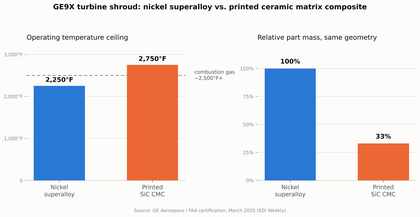
 Inside a jet engine’s hottest section, 500 degrees Fahrenheit of extra headroom and two thirds less mass are not cosmetic gains. They are what let a part survive where it sits.
A turbine shroud sits in the single hottest, most hostile location inside a jet engine, wrapped directly around the spinning blades and blasted continuously by combustion gas above 2,500 degrees Fahrenheit. For decades the only material that survived there was a single-crystal nickel superalloy, cast as a solid metal ring and kept alive only by routing cool air through internal channels machined into its body. That changed when the FAA certified a shroud for GE Aerospace’s GE9X engine, the engine that powers Boeing’s 777X, built instead from a 3D-printed silicon carbide ceramic matrix composite (EDI Weekly). It is the first additively manufactured CMC part to clear that bar, and the physics behind why it can survive there at all is worth tracing step by step.
Ceramic matrix composites get their heat tolerance from the same mechanism that makes any ceramic resist melting: strong, highly directional covalent bonds in the silicon carbide lattice that require far more thermal energy to break than the metallic bonds holding a nickel alloy together. That bond strength is also why CMCs resisted shaping for so long. The conventional routes, polymer infiltration pyrolysis and chemical vapor infiltration, build up a ceramic matrix around woven fiber by soaking or depositing it layer by layer over weeks, a process that locks designers into simple shapes because the infiltrating gas or resin has to reach every fiber evenly. Additive manufacturing breaks that constraint by building the geometry first and letting the ceramic chemistry follow the printed form, which is what makes the GE9X shroud possible with internal cooling passages that curve to match the gas flow rather than being limited to straight-line machining.
Two consequences follow directly from swapping a dense metal for a fiber-reinforced ceramic at the same wall thickness. Mass drops to roughly one third of the nickel alloy equivalent, because silicon carbide is simply a lighter lattice than a nickel-based crystal packed with heavy alloying elements like cobalt and tungsten. And the part’s temperature ceiling rises by about 500 degrees Fahrenheit, which means the engine needs to divert less compressor air just to keep the shroud alive, air that can instead go toward combustion or thrust (EDI Weekly). Less cooling air pulled from the core also means a cleaner combustion profile, which is the quieter half of the efficiency story.
Certifying a printed ceramic meant proving a negative: that no microporosity or fiber misalignment from the print process survived as a hidden flaw. Engineers leaned on micro-CT scanning to see inside the part in three dimensions and resonant ultrasound spectroscopy, which excites a part and reads its vibration signature for the kind of internal defect that standard visual inspection cannot catch.
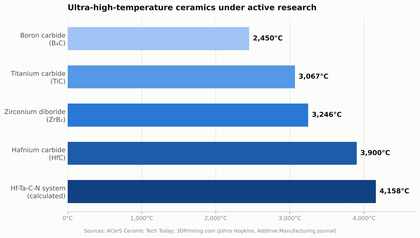 The GE9X shroud runs hot by jet engine standards. These compositions are being engineered for an entirely different thermal regime, the one a hypersonic vehicle’s surface sees on the way through the atmosphere.
The same bond-strength mechanism that got silicon carbide into a jet engine is being pushed much further for vehicles that fly faster than Mach 5, where surface temperatures climb well past anything a turbine ever sees. Purdue University researchers are now 3D printing boron carbide and other ultra-high-temperature ceramics from resin slurries, working around the fact that dark ceramic particles absorb the UV light that digital light processing printers rely on to cure each layer. At North Carolina State, a 120-watt laser deposits hafnium carbide coatings directly in open air in seconds, skipping the furnace entirely through a reaction called selective laser reaction pyrolysis (ACerS Ceramic Tech Today). Machine-learning simulations out of Beijing have meanwhile calculated a melting point near 4,431 Kelvin, about 4,158 degrees Celsius, for a hafnium-tantalum carbonitride system, a temperature where plasma from hypersonic flight would vaporize a nickel superalloy outright.
Earlier work at Johns Hopkins showed the general path these UHTC efforts are converging on: print a titanium and polymer binder “green” part on an ordinary SLS printer, then convert it to titanium carbide by baking it in a methane furnace, a two-step route that reached 98.2 weight percent conversion at sub-millimeter resolution (3DPrinting.com). Direct ink writing, the robocasting technique already used to extrude complex alumina and zirconia geometries, is following the same trajectory toward denser, more exotic ceramic chemistries (KU Research Hub). The mechanism scales. Whether the printers and furnaces chasing it can hold tolerance at those temperatures is the next certification this field has to earn.