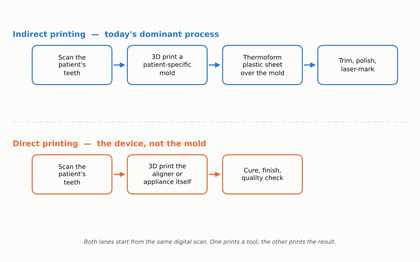
 Both lanes start from the same digital scan. One prints a tool; the other prints the result.
Dentistry did not set out to become 3D printing’s biggest customer. Align Technology got there by solving a packaging problem: every patient’s teeth are shaped differently, so every aligner needs its own mold, and injection molding only pays for itself when the same shape repeats by the thousands. Stereolithography, the one manufacturing process built from the start to make a different object every time at no extra tooling cost, was the obvious fit. That bet now runs the largest 3D printing operation in the industry, turning out more than a million custom appliance parts a day, according to Align’s own head of manufacturing speaking to Orthodontic Products. As recently as 2021 that figure was 700,000 a day, TCT Magazine reported, which means the operation has grown by nearly half in under five years without most of its patients ever knowing a printer was involved.
Getting there took more than buying printers off a shelf. No commercial system in the early 2000s was built to run thousands of units a day at dental tolerances, so Align’s engineers spent two decades modifying hardware, writing their own automated workflows, and formulating their own resins, work Align describes as having to “invent several pieces of technology and workflows” because nothing existing could mass-produce a one-off medical device. That history matters for what comes next, because the thing all that infrastructure actually prints is still a mold. The aligner a patient wears is vacuum-formed plastic sheet pulled over that printed shape, a thermoforming step that traces back to mid-twentieth-century dentistry and hasn’t fundamentally changed since.
Closing that gap, printing the device instead of the tool that shapes it, is what the field has been working toward since the early 2020s. Align acquired the Vienna-based printing company Cubicure in 2023 specifically for its Hot Lithography process, built to handle the viscous, functional resins a worn appliance needs rather than the thinner resins that suffice for a disposable mold. Align has already shipped one result: the Invisalign Palatal Expander System, described as the company’s first commercialized directly printed appliance. A rival, 3D Systems, announced in 2024 that it was aiming to commercialize its own direct-printed aligner by late 2025 or early 2026, and TCT Magazine’s reporting names at least two other organizations chasing the same goal. None of that was realistic a decade ago, when dental printers couldn’t hit the geometric accuracy a clinical device demands.
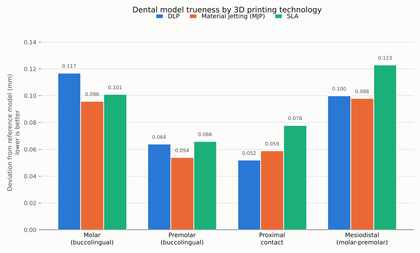 Material jetting’s edge held across most measurement positions, though the technologies stayed close enough that the authors called all three clinically usable.
That accuracy bar is measurable, and a 2021 study in the journal Materials measured it directly. Yoo and colleagues printed dental models on DLP, SLA, and material-jetting systems and compared each against a reference scan. Material jetting came out ahead on most positions tested, deviating by as little as 0.052 mm at a proximal contact point, while DLP and SLA trailed by fractions of a millimeter depending on where on the arch the measurement was taken. The differences were real but small enough that the authors judged all three technologies clinically usable for working models, the kind of finding that quietly cleared a technical obstacle direct printing would otherwise have run into.
Accuracy alone doesn’t let a resin into someone’s mouth for three weeks at a stretch. A material worn against the gums that long falls under what regulators classify as long-term mucosal contact, which triggers a specific battery of biocompatibility testing under the ISO 10993 standard: cytotoxicity, sensitization, irritation, and systemic toxicity, among others. Formlabs cleared that bar in 2024 when its nano-ceramic-filled Premium Teeth Resin received FDA 510(k) clearance for temporary crowns, bridges, and veneers, the kind of regulatory milestone that didn’t exist for 3D printed dental materials a few years earlier.
Put the three threads together and the shape of the last twenty years comes into focus: an industrial-scale printing operation built to solve a tooling problem, a slow accumulation of accuracy data proving the geometry could be trusted, and a regulatory pathway finally catching up to materials meant for the mouth rather than a mold. Whether 3D Systems or Align is first to ship a true direct-printed aligner at scale is still an open question. That the printer, not the thermoforming line, ends up making the device a patient actually wears looks less like a bet now and more like where this was always headed.