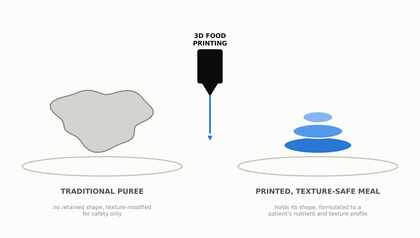
Between 2012 and 2015, a European consortium led by the German food company Biozoon spent just over 4 million euros, with close to 3 million of that from the EU, building a supply chain to 3D print meals for frail, elderly people. The project, called PERFORMANCE, worked. Pureed carrots, chicken, and potatoes went in; a jet-printed, gelled meal that held its shape on a plate and still broke down safely in the mouth came out. More than ten years later, that meal still isn’t something you can order for a relative in care.
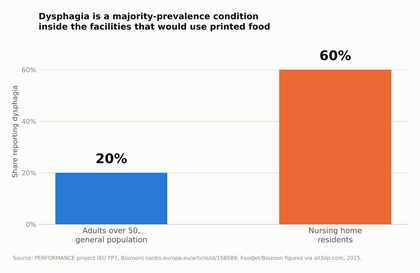
That gap is the interesting part. The target market was never small. PERFORMANCE’s own figures put dysphagia, difficulty chewing or swallowing, in more than one in five people over 50, and food-tech coverage of the follow-on commercial effort using FoodJet’s printers put the share among nursing home residents as high as 60 percent. A technology that solves a problem affecting most of a facility’s residents, with hardware that already exists, should not need a decade to reach procurement. The reason it has is the same reason a lot of additive manufacturing stalls after a successful pilot: the engineering cleared the bar years before the business case did.
Printing a texture-safe meal is genuinely hard in a materials sense. A 2026 review from researchers at Jiangsu University frames it correctly as a formulation problem as much as a print problem: getting the ratio of puree, gelling agent, oil, and protein right so the material is firm enough to hold a layer and loose enough to extrude without clogging a nozzle. That part got solved. What didn’t get solved is who pays for it, and that’s a procurement question, not a chemistry one. Conventional pureed meals for care facilities are made on mash-and-extrusion lines that already run at industrial scale, amortized across thousands of institutional contracts. A printed meal, by contrast, is a batch process: one nozzle, one tray, one patient’s nutrient profile at a time. Compared against a mash line, that’s not a marginal cost difference, it’s a different manufacturing category entirely, closer to a one-off casting than a stamped part.
That cost structure only clears if something on the revenue side changes to match it, and for a decade nothing has. There’s no reimbursement code that pays a care facility more for a texture-modified meal that’s also personalized, so the facility has no budget line to absorb the premium, however clinically justified. Compare that to 3D-printed titanium implants and dental aligners: they didn’t scale because printing got cheaper first, they scaled once insurers and regulators built a path to pay for the validated outcome a printed part delivered. Qualification came before volume, not after.
The 2026 review’s proposed framework, which it calls “sense-model-print-evaluate-learn,” is really an argument for exactly that kind of qualification path: printed food justified by measured nutritional and clinical outcomes in a specific patient, not by novelty. That’s a slower, less exciting story than a printer that makes dinner, but it’s the one with a business model attached to it, eventually. It is not, however, the only path, and the more interesting development of the last two years is a company that skipped it entirely.
The Dutch startup Gastronology announced industrial production of its printed dysphagia line in April 2024, with a stated target of 2,500 kilograms a day, enough food for roughly 15,000 people. The move that matters isn’t the printer, it’s the structure around it. Gastronology doesn’t sell a printer to a care home and ask it to run a one-tray-at-a-time batch process on site. It freezes the meals centrally, the way any industrial frozen-food maker does, and licenses the process to manufacturing partners like Budelfood rather than operating point-of-care hardware itself. That single choice removes the cost comparison that sank the PERFORMANCE pilot: a care facility isn’t buying a printer and a technician, it’s buying a frozen case of food that happens to have been printed upstream, priced and stocked the same way every other specialty frozen product already is.
That’s the more plausible near-term path, and it says something sharper than the clinical-validation argument: dysphagia food printing was never really stuck on reimbursement, it was stuck on treating the printer as the product. Once the printer became a factory asset instead of a bedside one, the economics stopped requiring anyone upstream to change how they get paid. Point-of-care personalization, a meal tuned to one patient’s exact nutrient targets at the moment it’s made, still needs that harder reimbursement case built. Centralized, frozen, licensed production doesn’t, and that’s why it’s the version reaching facilities first. Until a payer has a reason to prefer the fully personalized meal over the merely texture-safe one, the industrialized version will keep eating the market the bedside version spent a decade failing to reach.