
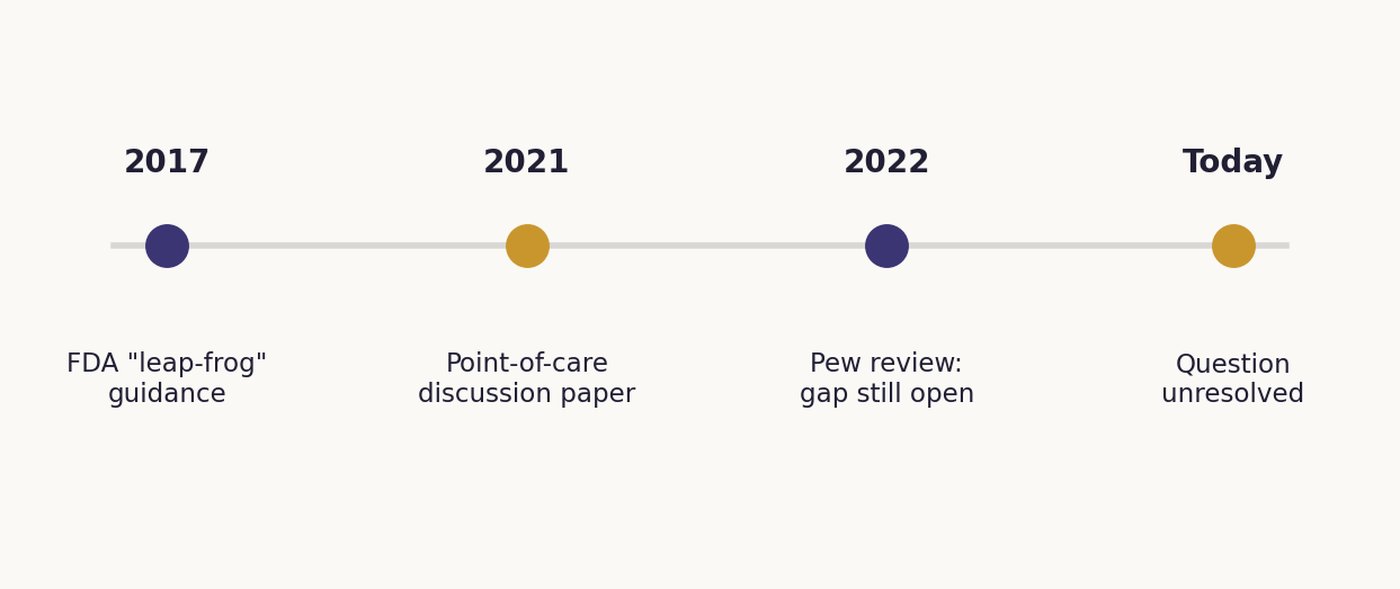
 Two regulatory tracks moving at different speeds: one that had nearly a decade to mature, and one still sitting where the agency’s own questions left it.
For most of the 2010s, a hospital that wanted a 3D-printed skull plate or a patient-matched knee replacement had to get it cleared the same way it would clear a milled titanium one. There was no dedicated regulatory category for additive manufacturing, so each device worked its way through the FDA’s existing pathways one submission at a time. By the agency’s own count, more than 100 devices manufactured on 3D printers had already reached the market before there was a single guidance document written specifically for how they should be reviewed, according to FDA’s 2017 announcement. Patient-matched knee implants, skull plates for facial reconstruction, dental restorations, and airway splints small enough for an infant with a collapsing windpipe were already clinical reality, each one reviewed piecemeal against standards written for conventionally manufactured parts.
That changed on December 4, 2017, when the FDA issued “Technical Considerations for Additive Manufactured Medical Devices,” the first guidance to treat 3D printing as a manufacturing process with its own review logic rather than a novelty bolted onto existing rules. Then-Commissioner Scott Gottlieb called it “leap-frog guidance,” meant to bridge where the technology already stood with the innovations still coming, per PlasticsToday’s coverage of the announcement. The guidance did not invent new legal categories; it mapped the additive process onto the review FDA already ran. What it gave manufacturers for the first time was a documented sequence to design against: device design and software workflow, material controls, the print itself, post-processing steps like cleaning and stress-relief annealing, process validation, and finally the testing submitted to demonstrate the finished device is safe. Two devices printed from the same file could still need different justifications, because the guidance treats material behavior as a property of a specific device and build, never a blanket approval for a printer or a powder lot.
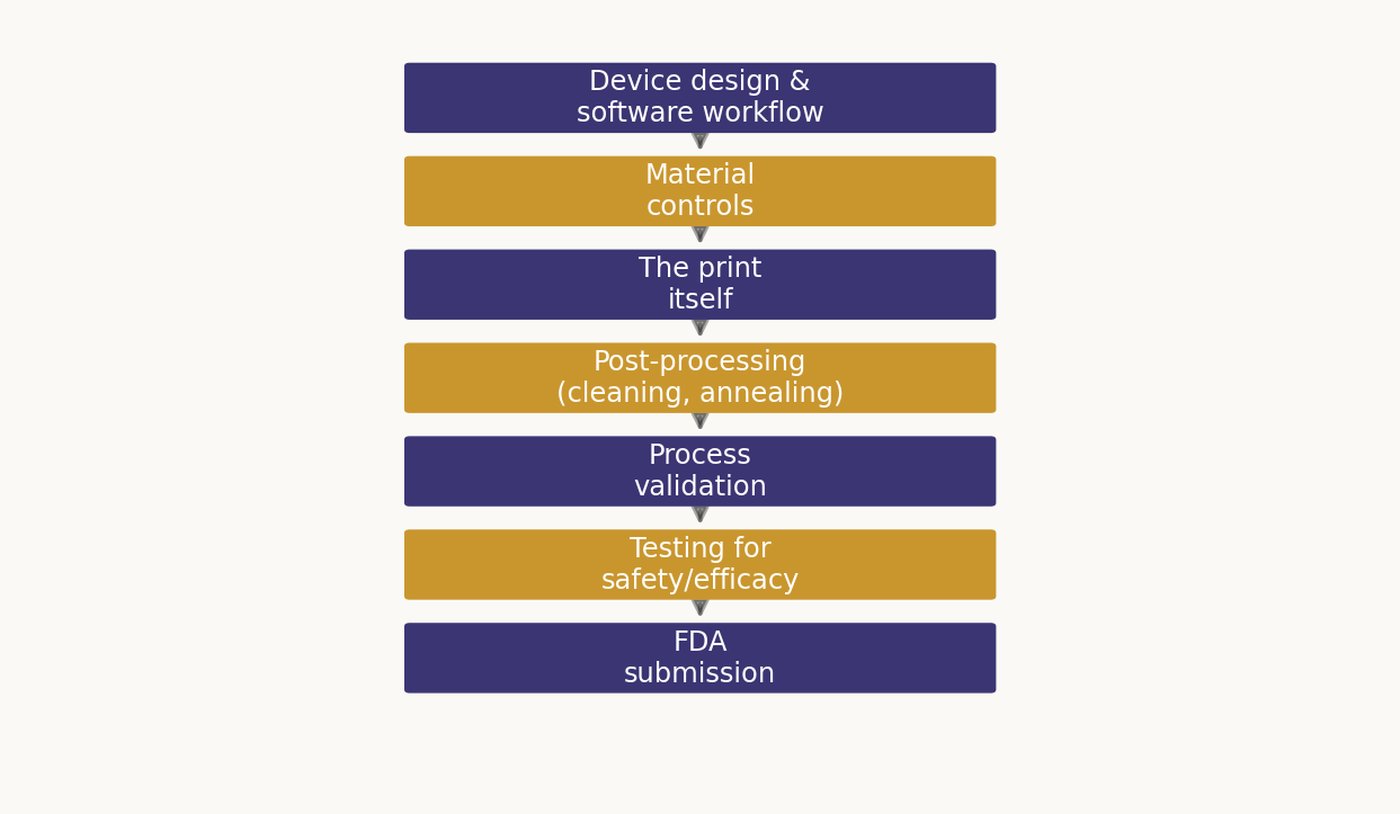 The same seven-step sequence applies to every printed device, but the material and process evidence submitted at each step is specific to that device and that build.
The 2017 guidance answered how a factory should get a printed device cleared. It did not answer what happens when the factory is a hospital. By 2021, health systems were printing their own anatomical models, surgical guides, and in some cases implants inside their own facilities, closer to the point of care than any FDA-regulated manufacturer had ever operated. The agency’s response was unusually candid about not having an answer yet. Rather than issue binding rules, it published a discussion paper posing sixteen questions to the field about how responsibility, risk, and oversight should be split between a hospital, a device designer, and a printer manufacturer when all three roles can now sit inside one building.
That paper drew public comment through February 2022 and, as far as the public record shows, has not yet hardened into a rule. A few months later, the Pew Charitable Trusts reviewed the gap it left open and found the same ambiguities still standing. There was no clear tiering of risk across different point-of-care scenarios, no settled line between a hospital practicing medicine and a hospital manufacturing a device, and an inspection system Pew’s interviewees worried was already stretched too thin to oversee a population of makeshift device manufacturers that could eventually run into the hundreds.
Seen end to end, the arc looks less like one regulatory story than two, moving at different speeds. The traditional-manufacturer pathway the 2017 guidance formalized has had nearly a decade to mature, long enough that additive manufacturing is now treated as a known, if still material-specific, category rather than an edge case requiring special pleading. The point-of-care question the FDA raised itself in 2021 is still sitting close to where it landed: a set of questions the agency asked the field rather than answered for it. Whether that gap eventually closes with a formal rule, or simply gets absorbed the way the earlier ad hoc devices were, folded into precedent one clearance at a time, is the part of this history that has not been written yet.