
 A decade of orbital manufacturing, one unsolved problem at a time.
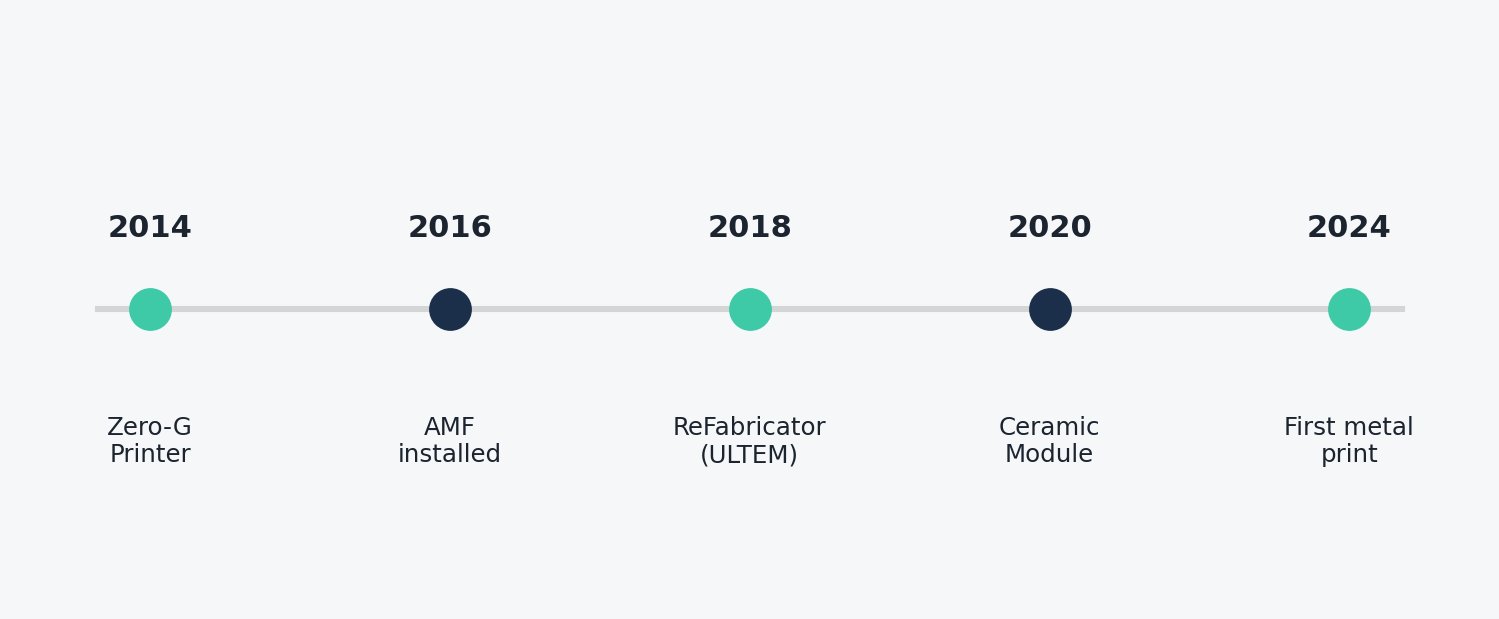
In September 2014, a modest plastic printer called the Zero-G Printer arrived aboard the International Space Station on a SpaceX cargo run, built by a startup named Made In Space for NASA. Its first job was almost too fitting: astronauts used it to print a replacement front panel for its own housing, a piece that had gone missing somewhere between the factory floor and the launch pad (Max Polyakov: How 3D Printing in Space Has Transformed in the Last Decade). A machine fixing itself was a strange way for orbital manufacturing to introduce itself, but the real proof of concept came a few months later, when engineers on the ground designed a socket wrench, emailed the digital file up to the crew, and had it printed in orbit rather than waiting for the next resupply flight. It was a small tool and not a particularly strong one, but it demonstrated the idea the whole field has been chasing since: that hardware could travel as data instead of cargo.
Plastic has limits no amount of clever printing gets around, and the decade that followed reads as a series of attempts to push past them. The Additive Manufacturing Facility, installed as a permanent fixture in 2016, turned printing from a one-off demonstration into working infrastructure: by 2019 it had produced more than two hundred functional parts, tools, and mechanical components for the station’s own use (Additive Manufacturing in Space: Technologies, Flight Heritage, and Materials). The ReFabricator, delivered in 2018, tried a different angle: recycling printed plastic back into feedstock while introducing ULTEM polymers tough enough to survive the temperature swings a structural or life-support part actually has to endure. Redwire’s Ceramic Manufacturing Module pushed further still in 2020, using stereolithography to grow ceramic components, a single-piece turbine blisk among them, that no plastic process could approach.
What none of this solved was metal, and for a specific technical reason. The powder bed methods that dominate metal printing on Earth rely on loose particles that settle fine under gravity and become an unacceptable contamination hazard the moment they float free inside a crewed module. So when the European Space Agency and Airbus finally flew a metal printer to the station’s Columbus module, the design wasn’t a shrunken version of an Earth machine, it was a wire-fed system built around that constraint from the start: a laser near 1200 degrees Celsius melting stainless steel wire and depositing it layer by layer, with Cranfield University supplying the melting and feed process behind it (Astronauts 3D-print 1st metal part while on ISS). The team spent months tuning the hardware before the first successful print in August 2024, because molten metal in microgravity doesn’t behave the way it does on Earth.
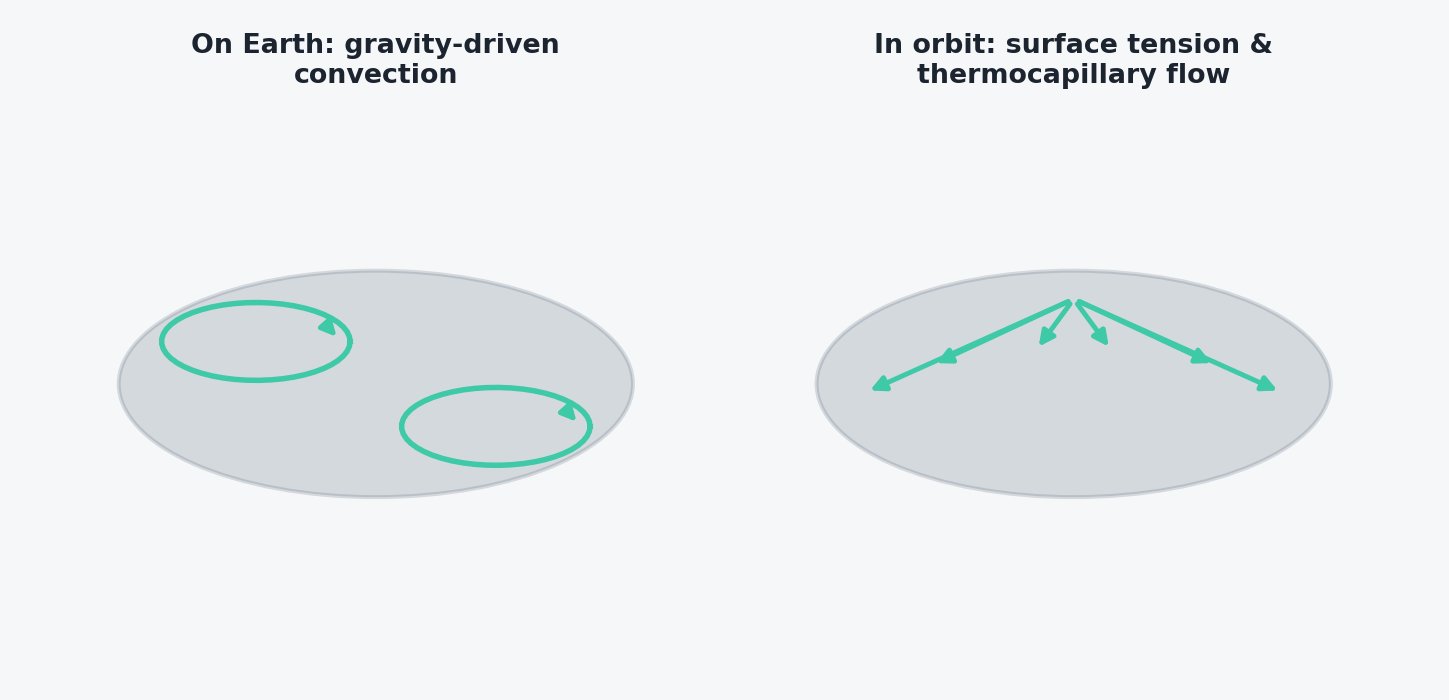 Without buoyancy pulling the melt around, other forces take over the shape of the pool.
Without buoyancy-driven convection to stir it, the melt pool is instead governed by surface tension, thermocapillary flow, and recoil pressure, forces present on Earth too but ordinarily overwhelmed by gravity’s pull (Additive Manufacturing in Space: Technologies, Flight Heritage, and Materials). One side effect may work in the technology’s favor: the slower, conduction-dominated cooling that results appears to extend how long the metal stays molten before it sets, which researchers suspect could reduce the porosity that has long dogged metal AM parts made under ordinary gravity. That’s still a suspicion rather than a finding. The first printed sample returned to Earth in March 2025, headed for ESA’s technical centre in the Netherlands and a parallel lab at the Technical University of Denmark, where it’s being tested for mechanical strength and examined under a microscope against identical parts printed the ordinary way, on the ground (First metal 3D printed part from space returns for testing). Results were not yet public as this went to press. ESA has said plainly that the real payoff is further out than one bracket: on-demand spare parts and tools become essential once missions are too far from Earth for resupply to be practical, as exploration director Daniel Neuenschwander put it.
It is a slow arc, from a printer fixing its own faceplate to a metal bracket the field still isn’t sure how to fully explain, but it has moved in one direction only. Each generation of hardware solved specifically the problem the last one couldn’t touch: plastic printing proved the concept, the AMF proved it could run at production scale, the ReFabricator and the ceramic module stretched what materials were possible, and the metal printer finally broke the assumption that off-world manufacturing had to stop at plastic. NASA’s Olympus program is now aiming at printing with lunar regolith before the decade is out. If that timeline holds, in-space manufacturing will have gone from repairing its own housing to building with the ground beneath a different world entirely, in barely fifteen years.