
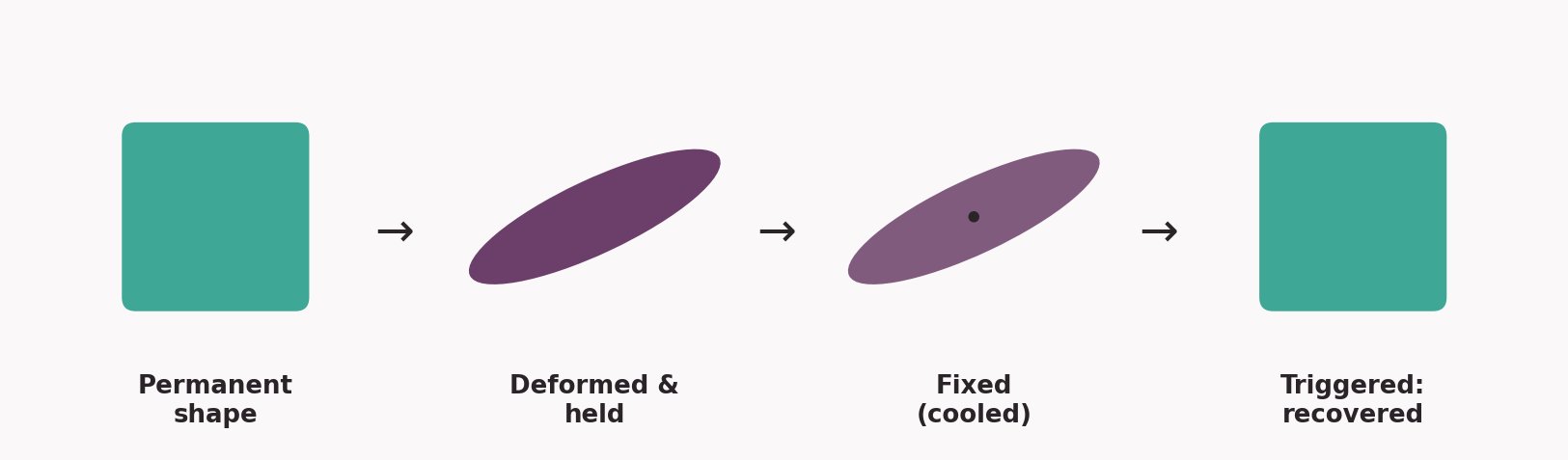
 The same printed part, four different moments: designed, deformed, held, and released back to what it was always meant to be.
Think about a foam mattress that arrives compressed flat inside a box small enough to carry up a stairwell. Cut the plastic wrap and it swells back to its full thickness in minutes, no pump or motor involved, just foam doing what foam does once nothing is holding it down anymore. Shape memory polymers, the materials behind what the additive manufacturing world calls 4D printing, work on a version of that same idea, except the “unfolding” is programmed into the material during printing rather than left to chance.
The fourth dimension in 4D printing is simply time. A part comes off the printer in what researchers call its permanent shape, the geometry it was designed and printed to hold. Deform it while it is warmer than its transition temperature, hold the new shape while it cools, and the polymer chains lock into that temporary configuration, according to a recent review of shape memory polymer techniques and applications in Progress in Additive Manufacturing. The part will sit in that folded, compressed, or twisted state indefinitely. It only moves again once something reactivates it, at which point the chains relax back toward the original, energetically comfortable arrangement the printer gave them in the first place.
What actually flips that switch? It depends entirely on the polymer chemistry chosen at design time. The same review describes systems triggered by plain heat, by absorbed moisture, by light, and by magnetic fields in composite formulations, with fused deposition modeling handling thermoplastic blends like PETG and PLA, vat photopolymerization (SLA and DLP) handling photopolymer and hydrogel formulations, and selective laser sintering used for polyamide elastomers and dynamically cross-linked polyurethanes. Picking the trigger is picking the use case: a magnetically activated soft robot gripper needs a very different formulation than a stent meant to open once it reaches body temperature.
The stent example is not hypothetical. One widely cited study designed a vascular stent around a negative Poisson’s ratio structure, a geometry that gets narrower, not wider, when compressed, then used a genetic algorithm to optimize that structure before 4D printing it, according to the Science China Technological Sciences paper on personalized shape memory stents. Compressed down for delivery through a narrow blood vessel, the printed stent held that temporary shape through insertion, then recovered its full diameter once activated, expanding a simulated narrow vessel in the researchers’ in vitro testing without any balloon catheter or mechanical expansion tool doing the work.
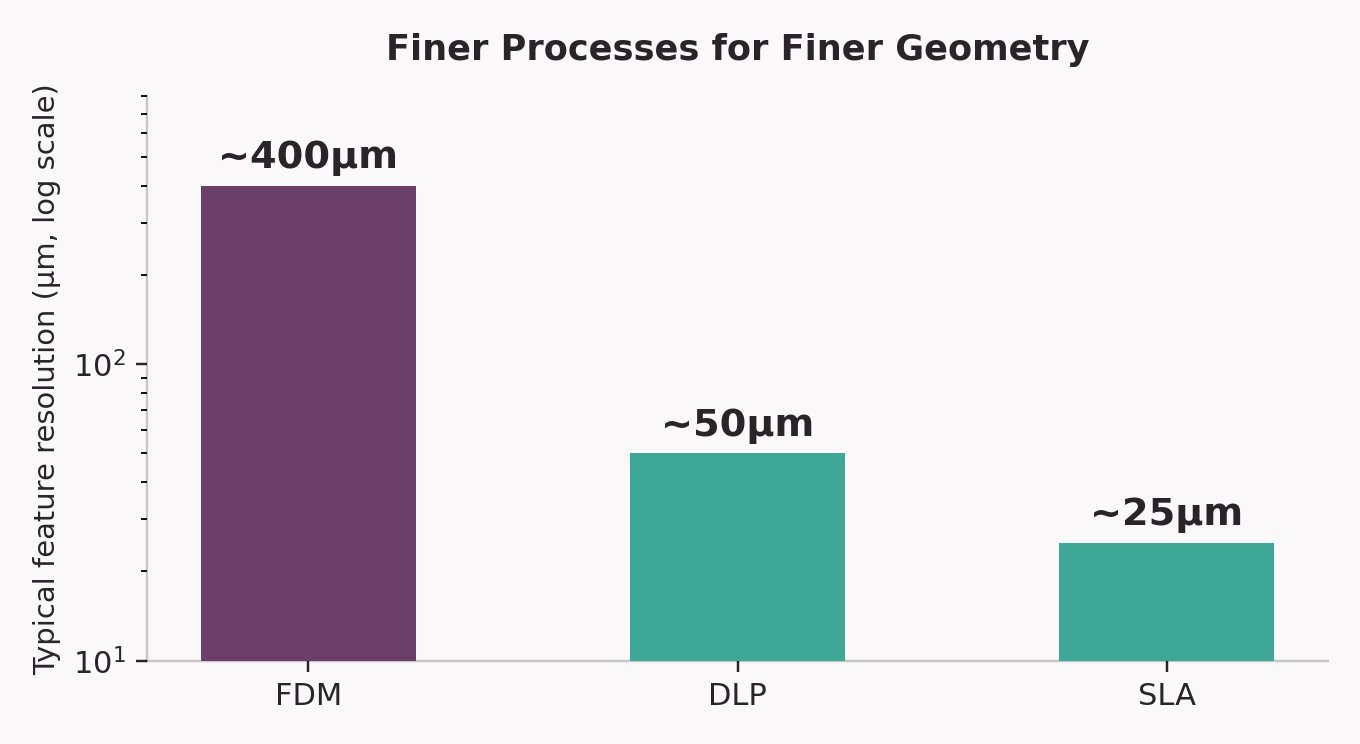 Why the stent above was never going to come off an FDM printer: the geometry that makes it fold flat and spring open needs finer features than a typical desktop nozzle can lay down.
That level of geometric detail is exactly why the finer processes matter here. A review of DLP and SLA approaches to biomedical shape memory devices in Polymers puts SLA resolution around 25 microns and DLP around 50 microns, an order of magnitude finer than a standard FDM nozzle, fine enough to fabricate microneedles and micro-stents that would simply be too coarse to print any other way. The same review points to a light-triggered stent design using gold nanorods that recovered its shape in about 40 seconds when exposed to near-infrared light inside porcine intestinal tissue, with the printed material holding up to 4.3 megapascals of tensile stress and stretching 124 percent before breaking. Triggering with light rather than bulk heating matters clinically, since it means the surrounding tissue does not need to be warmed to activate the device.
None of this is finished technology. The same review is candid that the biocompatibility of the nanocomposite fillers used to make polymers heat- or light-responsive is still not well understood, that solvent washing during post-processing can strip embedded drug payloads out of drug-delivery designs before they ever reach a patient, and that sterilization and shelf-life behavior for these materials are still open questions rather than settled engineering.
What is worth sitting with is how ordinary the underlying mechanism is. Every shape memory polymer part, however sophisticated its trigger, is running the same four-step cycle as that mattress in a box: shape, deform, hold, release. The printer’s job is just to make sure the “release” step lands exactly where the design called for it, geometry and all.