
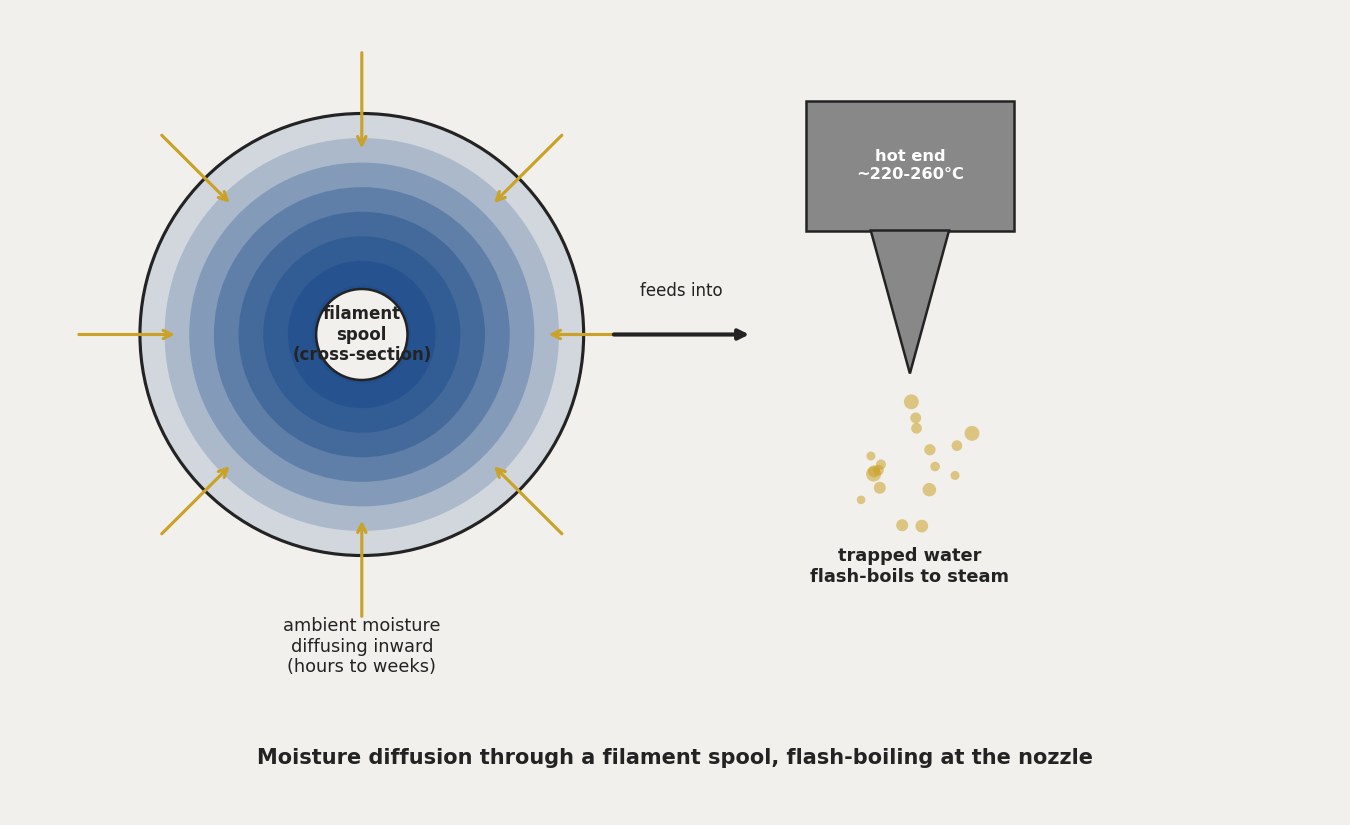
 Ambient moisture diffuses into a filament spool over hours to weeks, then flash-boils the moment it reaches nozzle temperature.
Ask a room full of FDM practitioners what “dry filament” means and most will describe a single event: a few hours in a dehydrator, done. That answer is now measurable, and the measurements are less reassuring than the ritual suggests.
Start with what the failure actually sounds like. Wet nylon in a hot end pops and crackles as trapped water flashes to steam faster than it can escape through the nozzle orifice, and the symptoms compound from there: stringing, rough surfaces, visible bubbles, and layers that separate under load rather than fuse (FilamentFeed). None of that is cosmetic. It is water doing chemistry to the polymer, not just getting in its way.
The chemistry is well characterized for polyester and polyamide backbones alike: water molecules attack the ester linkages directly, and each successful attack severs the chain and produces a fresh carboxyl end group. That end group is acidic, which accelerates the next attack, so the reaction is self-perpetuating once it starts. Critically, this hydrolytic pathway becomes significant at temperatures as low as roughly 100°C, and in the 100-120°C range it proceeds around 10,000 times faster than ordinary heat-driven thermal degradation (Rongxin Chen, IntechOpen). A typical nylon or PETG nozzle runs at 220-260°C. Any moisture that made it into the filament is not merely inconvenient at that temperature; it is reacting on a timescale that thermal degradation alone never reaches.
A 2025 study gives that mechanism actual numbers instead of a warning label. Researchers exposed PA6 nylon filament to 40°C and 80% relative humidity for up to 72 hours, tracking moisture uptake with an exponential model, M = 5.65 × (1 - e^-0.045t), that rose from roughly 1% moisture content dry to about 5.5% at 72 hours (Gong et al., 2025, MDPI Technologies). Tensile strength and elongation both fell over the same window, and some 72-hour specimens ruptured immediately past the yield point rather than deforming normally. The shape of that curve matters as much as the endpoint: an exponential rise front-loads most of the damage into the first day, which cuts against the comfortable assumption that a spool left out overnight is still basically fine.
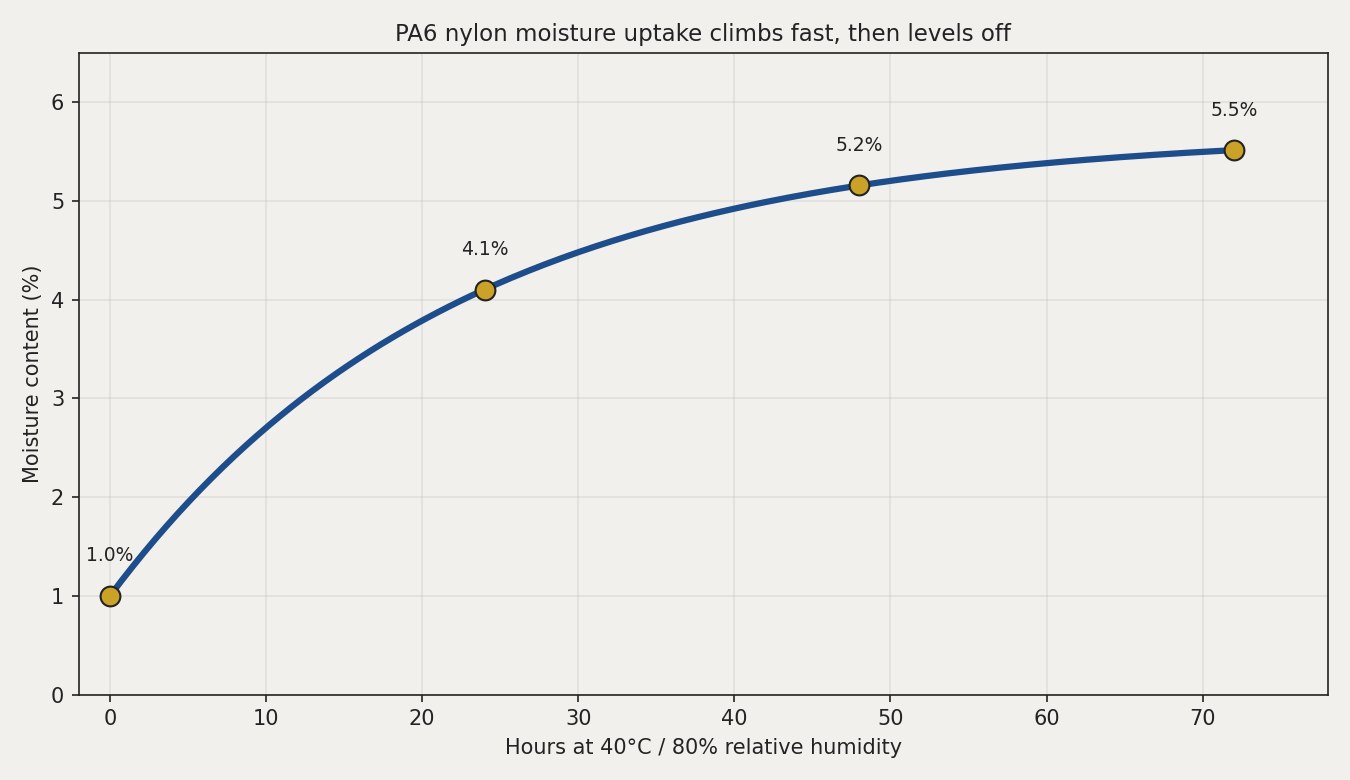 Illustrative reconstruction of the reported PA6 absorption curve; exact study data points are not shown.
Nylon is the extreme case, not the exception that proves a rule. It can take on close to 10% of its own weight in water, roughly ten times the moisture PLA absorbs under the same conditions (Wevolver), which is why nylon dry boxes and vacuum bags get so much more attention than anyone gives a spool of PLA. But PETG shares the same ester backbone that the hydrolysis mechanism above describes, and it is not immune, only slower to show it, which is a distinction worth testing rather than assuming.
The part most guides skip is what happens after the dryer. Once removed into an ordinary 45% relative-humidity room, PLA and ABS take two to four weeks to reabsorb meaningful moisture, PETG about one to two weeks. Nylon does it in hours (printpal). A single pre-print drying cycle, run at the commonly recommended 70-80°C for eight to twelve hours (FilamentFeed), buys nylon an afternoon of dryness, not a print job’s worth, unless the spool goes straight into sealed storage with fresh desiccant afterward.
What actually holds moisture out long-term is boring by comparison: a vacuum-sealed bag or dry box kept under roughly 15% relative humidity, with silica gel desiccant that can be regenerated in an oven at 120°C for three hours once it turns from blue to pink (printpal). Filament stored that way is reported to last six months or longer without redrying. The dryer fixes a spool for one job. The vacuum bag is the only step in this whole chain that actually keeps it fixed.