
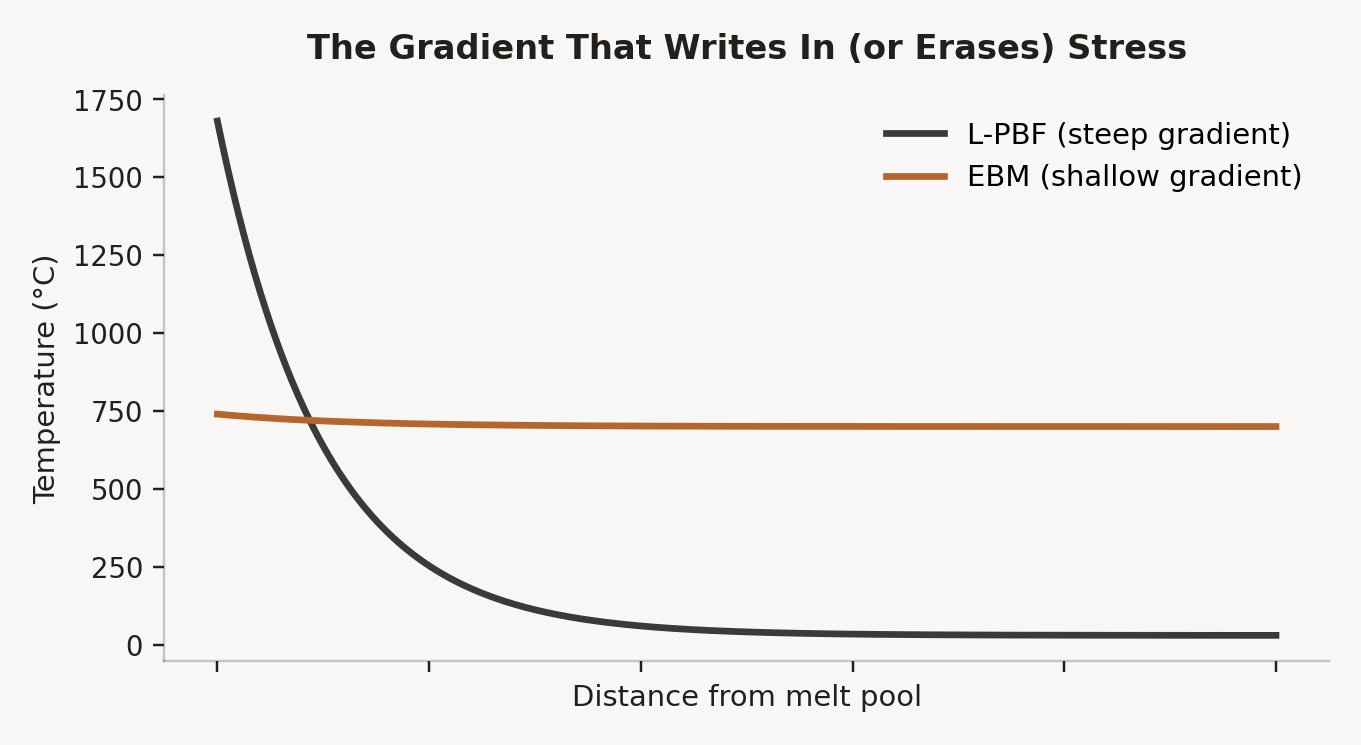
 The gradient a process leaves behind, not the peak temperature it reaches, is what determines whether a part comes off the machine stressed.
Fire an electron beam into a bed of unprepared titanium powder, and the beam doesn’t melt it so much as scatter it. Each particle sits nearly isolated from its neighbors, and an electron beam deposits charge into the bed as fast as it deposits heat. With nowhere for that charge to go, the powder builds a static field strong enough to repel its own particles, an effect operators call smoking. The layer disperses before it can fuse.
Electron beam melting (EBM) solves that problem before it ever tries to build a part. A defocused beam rasters across the entire layer first, not to melt it but to lightly sinter the particles together, binding them just enough to bleed off charge and hold position under the pass that follows. That preheating step runs hot: the whole build chamber climbs to somewhere between 700°C and 750°C and stays there for the rest of the print, according to process data compiled by Method and by KY Automation in a direct comparison against laser powder bed fusion. The entire process runs in a vacuum on the order of 10⁻⁴ millibar, which keeps the beam column stable and keeps a reactive metal like titanium from oxidizing the instant it melts.
That bulk temperature is the whole point, and it is where EBM actually diverges from its laser-based cousin. Laser powder bed fusion (L-PBF) melts the same alloys with a fiber laser, but per the same KY Automation comparison, it leaves the surrounding powder bed at roughly 30°C throughout the build. A molten track cooling against a bed that cold builds a steep thermal gradient with every single pass, and steep gradients are exactly what generate residual stress: the solidifying metal contracts, the cooler material around it resists, and the mismatch locks in as tension. L-PBF parts commonly carry 300 to 500 MPa of residual tensile stress at the surface, enough that a separate stress-relief anneal at 650°C to 800°C is standard practice before the part is allowed to leave the machine.
EBM never builds that gradient in the first place, because the material surrounding the melt pool already sits close to the temperature the melt pool is cooling toward. A NIST study on EBM-built Ti-6Al-4V used neutron diffraction to look for that residual stress directly, and largely didn’t find it: fatigue endurance limits landed at 200 to 250 MPa whether or not the parts went through a separate stress-relief step, because the elevated build-plate temperature (NIST measured a minimum of 600°C during the print) had already done that job.
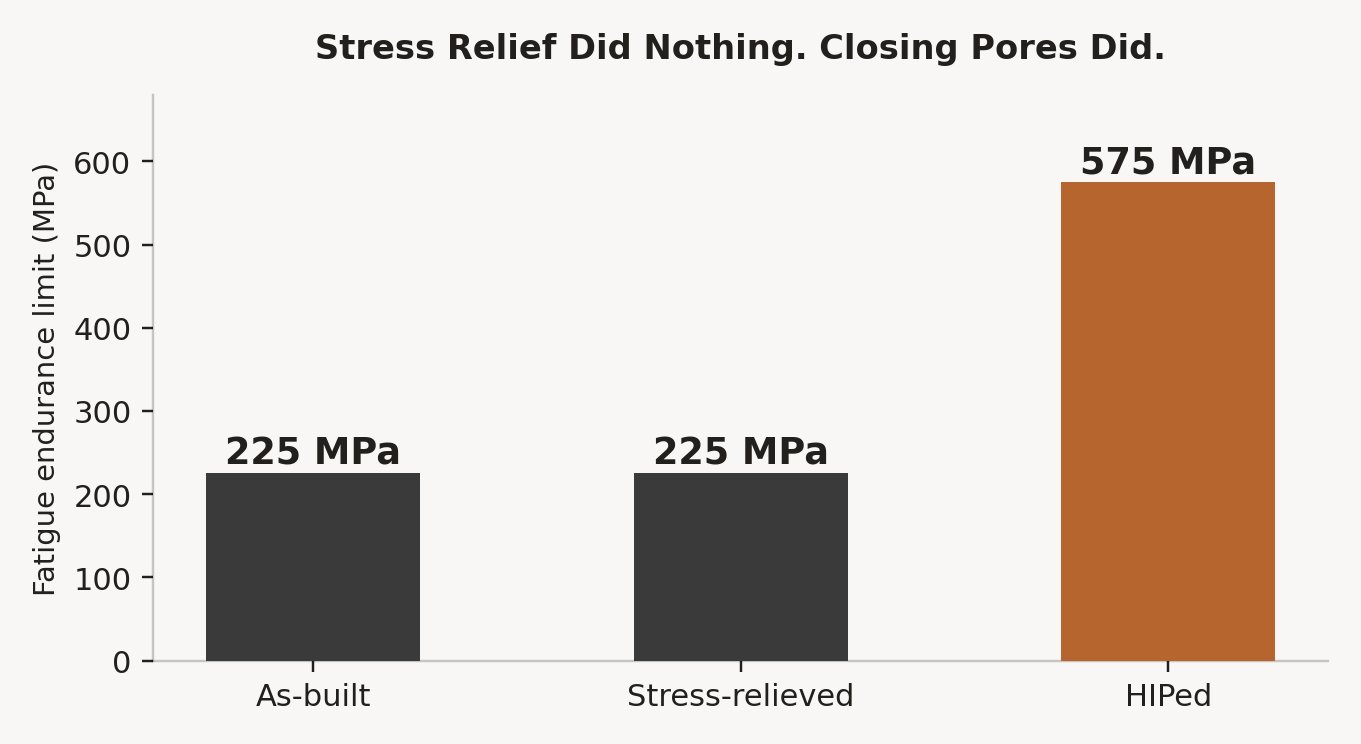 Stress relief changed nothing measurable. Closing the pores underneath the stress did.
Removing residual stress from the equation didn’t make the fatigue problem disappear, though. It just exposed the mechanism sitting underneath it. The same NIST fractography traced fatigue crack initiation back to internal pores left by incomplete melting, spots where a given beam pass hadn’t fully fused the powder into the surrounding solid. Hot isostatic pressing, which applies heat and pressure together to physically collapse those voids, pushed the endurance limit past 550 to 600 MPa, more than double the as-built figure. Porosity, not thermal history, was doing almost all the damage.
The preheated bed buys that stress relief at the cost of resolution. Because the whole layer sinters before it melts, and because an electron beam is inherently harder to focus as tightly as a laser, EBM parts come off the machine rougher: 25 to 35 micrometers Ra against L-PBF’s 5 to 10 micrometers on a vertical wall, per the KY Automation figures. For an orthopedic implant, that roughness is close to a free head start on the surface texture bone actually likes to grow into. For a fatigue-critical aerospace bracket, it is an argument for machining the surface afterward regardless of what the stress state underneath it looks like. The alloy list is narrower too, running to titanium alloys, cobalt-chrome, and nickel superalloys that tolerate the vacuum and the sustained bulk heat, a materials shortlist that amazemet notes is genuinely tighter than what laser-based processes can reach.
The mechanism holds up cleanly right up until the part has to survive cyclic loading without further processing. Preheating erases the thermal gradient that would otherwise write stress into the build, and that part of the physics is settled. But a hot bed does nothing about a beam pass that missed full fusion, which is why every EBM Ti-6Al-4V component destined for fatigue-critical service gets HIPed as a matter of course, not as an option held in reserve. The honest way to describe electron beam melting isn’t that it solves metal printing’s stress problem. It trades a problem you can see coming, a thermal gradient measured in real time, for one that stays invisible until a part is cut open or run through a CT scanner: porosity that never announces itself until someone goes looking for it.