
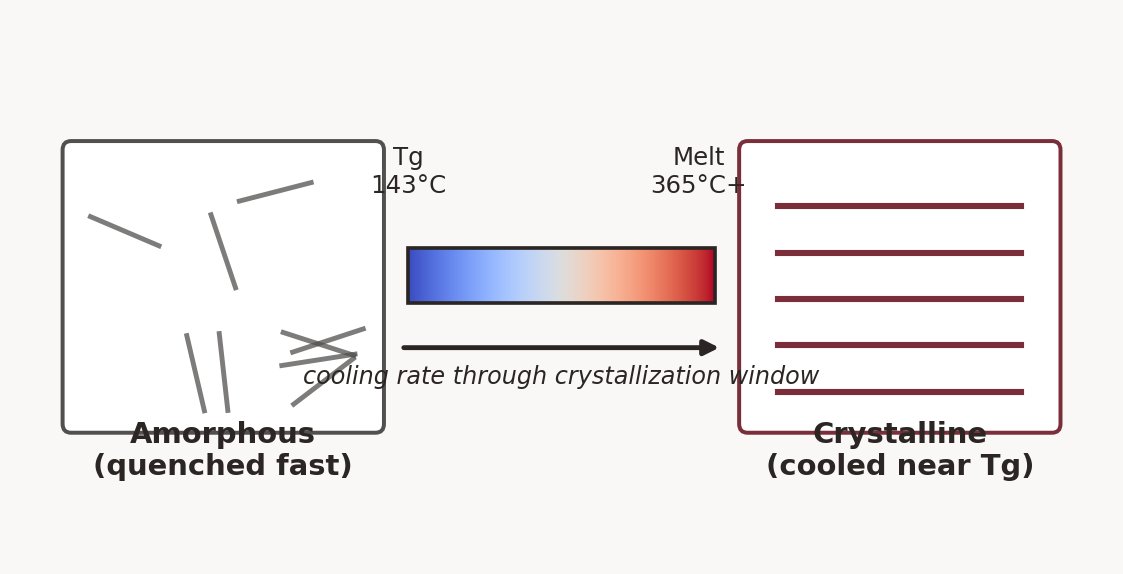
Most polymers used in fused deposition modeling cool the way a puddle dries: molecules lock into whatever disordered arrangement they happen to hold when the temperature drops below their glass transition point. PEEK does not cool that way, and understanding that difference is what lets a printer coax out the material’s full crystalline strength.
PEEK, or polyetheretherketone, is semicrystalline. Above its glass transition temperature of roughly 143°C, polymer chains have enough mobility to fold themselves into ordered lamellar structures as they cool, provided they cool slowly enough for that folding to happen before the chains freeze in place (AON3D). That folding is crystallization, and it is not optional if the part is going to do useful work. Semicrystalline PEEK holds mechanical performance up to roughly 240°C. Push the same polymer through a print that quenches too fast, and it comes out amorphous instead, with reduced tensile strength, flexural performance, chemical resistance, and heat deflection, and a service ceiling that drops to around 150°C (AON3D).
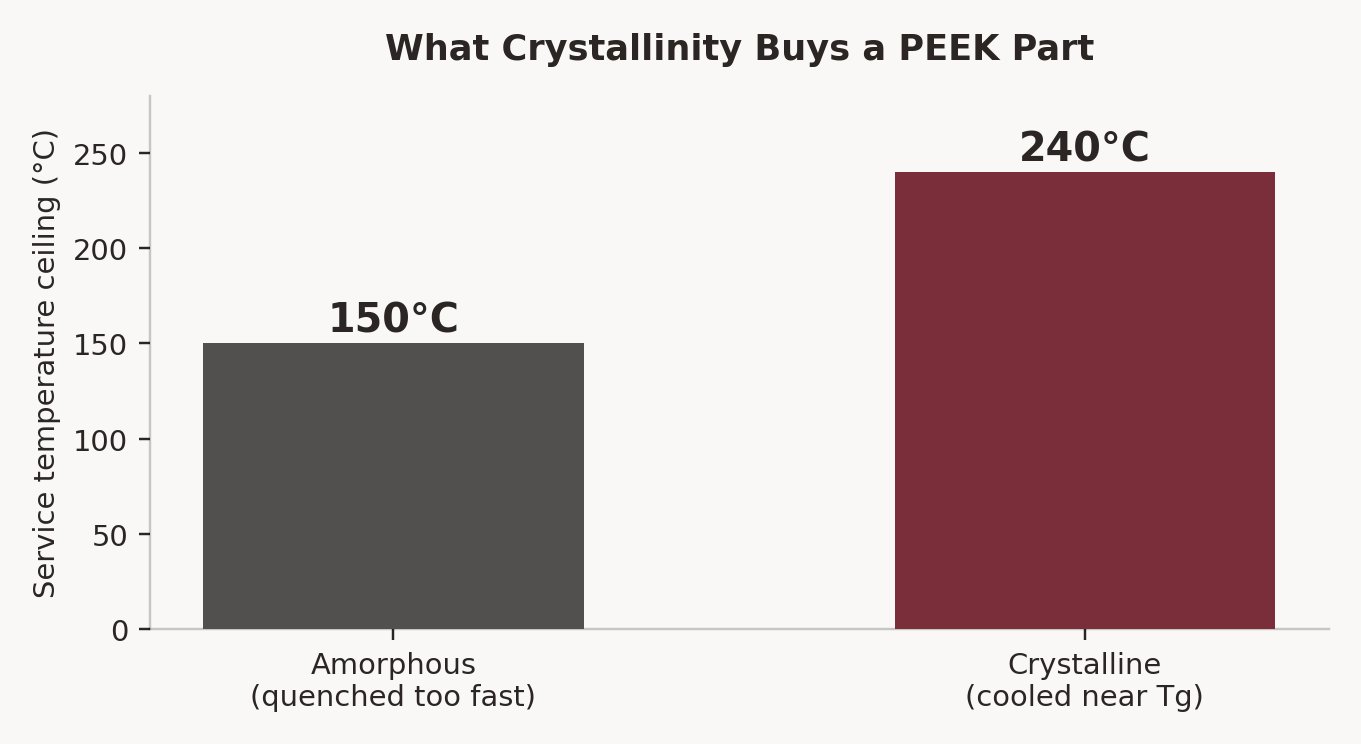 Ninety extra degrees of service temperature, entirely a function of how slowly the part cooled.
The mechanism that gets the crystallization right, or wrong, is entirely about the thermal environment surrounding the part, not just the nozzle. Extrusion happens at 365-440°C to melt the polymer in the first place, but that number is almost beside the point. What actually determines the final microstructure is how slowly the deposited material passes back down through the crystallization window between melt and glass transition. A build chamber and bed held at 133°C or higher, ideally within about 10°C of the glass transition itself, gives newly deposited layers enough residence time above Tg for chains to organize before they lock up (AON3D). A recent study tracking temperature history through the AM process directly ties the specific thermal profile a layer experiences, not just peak temperature, to the resulting crystalline morphology, which is why two printers running identical nozzle settings can produce mechanically different parts (ScienceDirect).
Uneven cooling does more than change crystallinity locally. It changes it unevenly across the part. Layers near the chamber walls or the last bead deposited cool faster than layers buried in the interior of a thick section, so a single print can end up with a crystallinity gradient baked into it. Each layer that crystallizes also shrinks slightly more than the amorphous layer it was a moment earlier, and a part built from layers that shrank by different amounts accumulates internal stress the same way a bimetallic strip does when its two halves expand at different rates. That stress is what shows up macroscopically as warping, delamination at layer interfaces, or in the worst case, cracking after the print has already cooled and looks finished.
This is also where PEEK diverges mechanically from its two closest competitors. ULTEM, or PEI, sidesteps the crystallization problem entirely because it is fully amorphous. Its chains can fuse across layer lines without any competing phase-change stress, which gives ULTEM parts more isotropic properties for a given print, but it still needs a chamber above its own 200°C glass transition to avoid warping, and industry practitioners describe it as “cranky” to print for exactly that reason (Additive Manufacturing Media). PEKK, the third material in this family, is semicrystalline like PEEK but crystallizes more slowly, which lets it behave more like an amorphous polymer in chambers below 200°C while still recovering roughly 90 percent of the strength a full high-temperature build would give it (Additive Manufacturing Media). PEKK’s advantage is entirely kinetic: the crystallization mechanism is the same physics, just running on a slower clock, which buys the printer more forgiveness before residual stress accumulates past what the part can absorb.
None of this makes PEEK a bad material choice. It makes PEEK a material that punishes any printer without real thermal control over the whole build volume, not just the hot end. The mechanism holds up cleanly as long as the chamber can actually sustain a temperature near Tg for the full build; below that threshold, no amount of nozzle tuning recovers the crystallinity the part needed, because by then the chains have already stopped moving.