
Topology optimization has moved from a purely digital design exercise into a manufacturing discipline in its own right, largely because additive manufacturing is one of the few processes capable of building the free-form, cellular geometry the algorithm actually proposes. Left unconstrained, a topology optimization solver distributes material wherever strain energy is highest and removes it everywhere else, producing organic, lattice-like structures that subtractive or molding processes cannot realize. A recent review of topology optimization methods for additive manufacturing frames this as a genuine convergence: design and fabrication constraints are no longer treated separately, with printability increasingly built directly into the optimization problem rather than checked afterward.
That convergence is most visible in how lattice topology governs mechanical performance. Triply periodic minimal surface (TPMS) lattices, which follow zero-mean-curvature surfaces rather than the strut-and-node geometry of conventional cubic or octet lattices, have become a preferred output of optimization routines because their continuous, doubly curved walls distribute stress more evenly than sharp strut junctions do. Work comparing topological and mechanical properties of different lattice structures fabricated by additive manufacturing found that relative density and unit-cell topology, more than base material alone, control the stiffness and failure mode of a lattice, with strut-based designs concentrating stress at nodes and failing abruptly while TPMS designs deform more progressively. A related study on topology-optimized lattice structures fabricated by additive manufacturing reported that optimized lattices achieved higher modulus, yield strength, and specific energy absorption than conventional octet or body-centered-cubic infill at equivalent density, and that elastically isotropic variants retained mechanical performance across loading directions where conventional lattices did not, a property that matters directly for parts loaded unpredictably in service.
The physics of the build process itself, however, pushes back against whatever shape the optimizer would otherwise choose freely. Unsupported overhangs beyond a critical angle, commonly cited near 45 degrees from vertical, accumulate heat in the powder bed rather than conducting it into solidified material below, producing localized over-melting, dross formation, and dimensional drift on the underside of the feature. Embedding that constraint mathematically, rather than adding supports after the fact, was the contribution of an early and widely cited method for topology optimization considering overhang constraints, which compares the local structural gradient against a critical reference slope during the optimization loop itself, so that self-supporting geometry emerges as a byproduct of the solution rather than a downstream fix. The tradeoff is that gradient-based overhang checks are inherently local: a region can satisfy the slope criterion pointwise while still lacking a continuous load path to the build plate, which is why practical implementations pair the overhang constraint with a separate minimum-length-scale filter to suppress both isolated thin features and isolated unsupported voids.
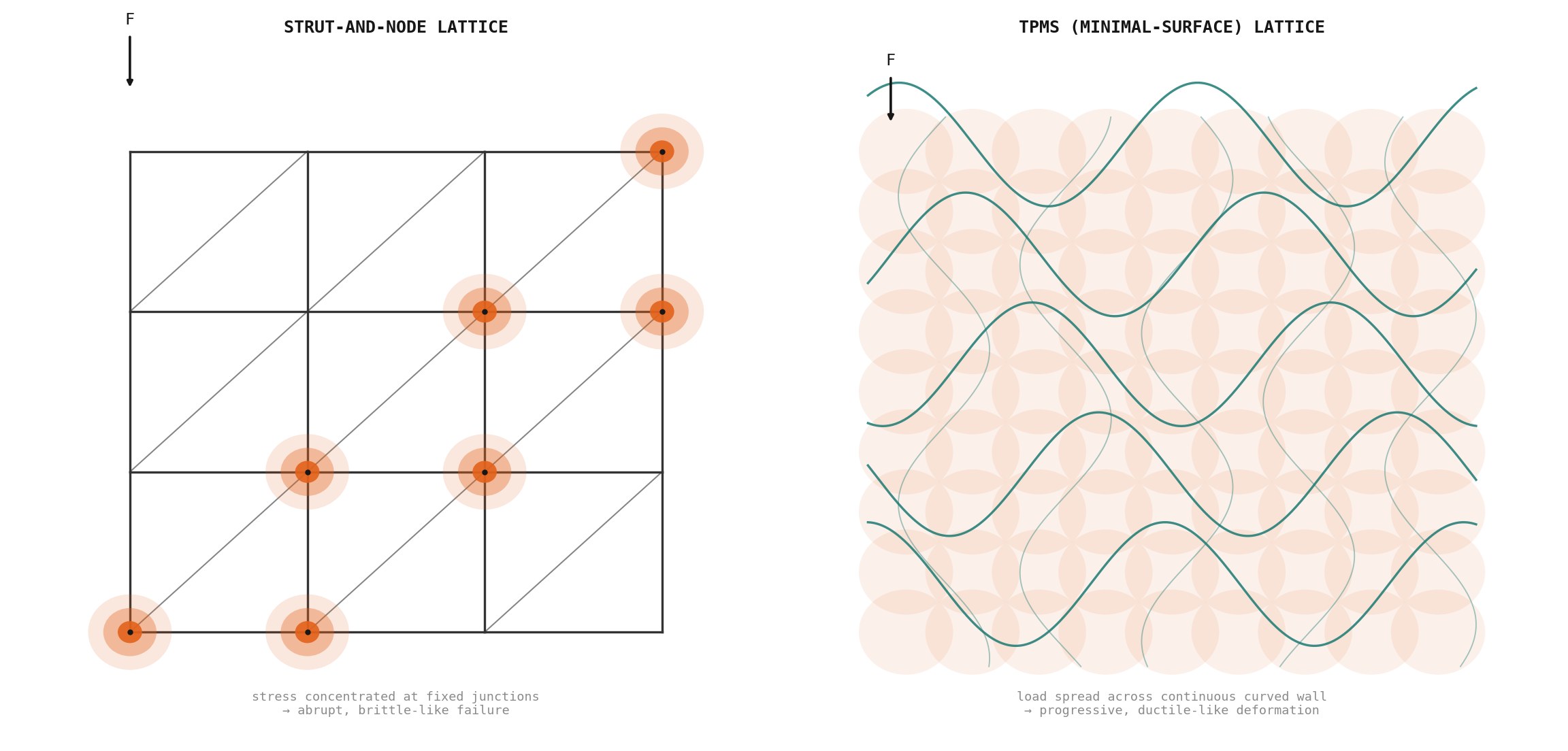 Strut-and-node lattices concentrate stress at fixed junctions and tend to fail there abruptly; triply periodic minimal surface lattices spread the same load across a continuously curved wall, which is why optimization routines converge on TPMS-like topologies when stiffness-to-weight is the objective.
For manufacturers, this shift changes what a design file actually represents. A topology-optimized, overhang-constrained lattice part encodes assumptions about build orientation, thermal history, and post-processing capability at the moment it is generated, so the same nominal geometry is not necessarily reusable across different machines or metal powders without re-running the optimization against new process constraints. That coupling raises the stakes on qualification: a part validated for one combination of alloy, layer thickness, and orientation cannot be assumed structurally equivalent if any of those inputs change, even though the STL file looks identical. As lattice-bearing components move from brackets and heat exchangers into more safety-relevant structural roles, the traceability of which process constraints were baked into a given optimization run is becoming as important to document as the resulting geometry itself.
None of this makes topology optimization a substitute for engineering judgment. The algorithm proposes a structurally efficient distribution of material under the constraints it is given, but those constraints, load cases, manufacturing angle limits, minimum feature size, still have to be specified correctly by an engineer who understands both the part’s service environment and the physical realities of the machine that will build it.