
Every layer of a laser powder bed fusion (LPBF) build passes through a molten pool that exists for a few milliseconds before it solidifies, and inside that brief window is most of the information about whether the part will be sound. Post-build inspection — CT scanning, sectioning — can find the defects that resulted, but it can’t say when or why they formed, and it can’t stop a bad build from continuing. In-situ melt pool monitoring tries to close that gap: sensing the melt pool itself, in real time, while the laser is still moving.
The physical basis for this is keyhole dynamics. Below a certain power density, the laser melts powder in conduction mode — a shallow, comparatively stable pool. Above a threshold (commonly cited as keyhole depth exceeding roughly half the melt pool depth), the beam bores a vapor cavity into the melt, and that cavity is not stable: high-fidelity synchrotron imaging work has characterized keyhole pore formation as a three-stage process — fast pressure-driven growth of a vapor bubble, partial shrinkage as the vapor condenses, and then capture by the advancing solidification front before the bubble can escape — with fluctuation frequencies peaking near 10 kHz in the transition regime between conduction and deep keyhole modes (Nature Communications). That fluctuation is the signal monitoring systems are trying to catch: a melt pool that flickers between shallow and keyhole-deep states within a single track is one that’s leaving pores behind it, whether or not the operator sees anything wrong on the surface.
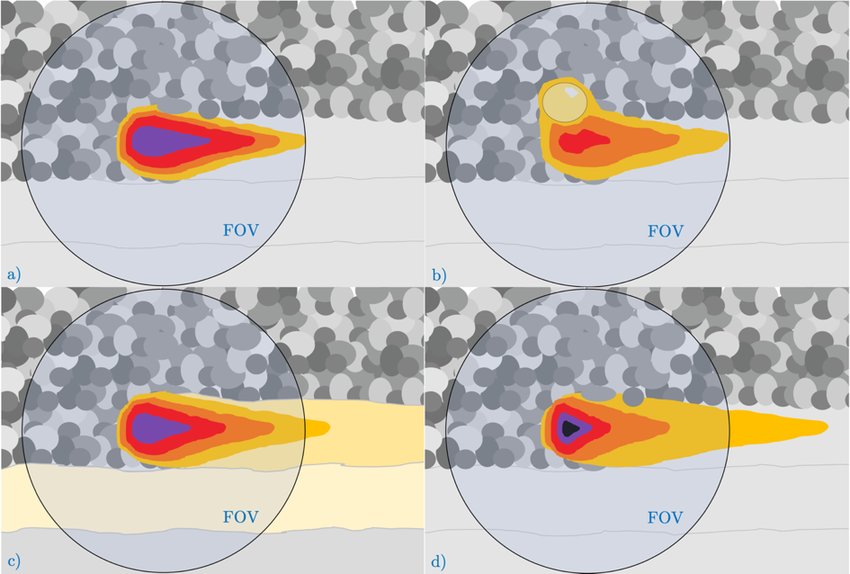 Figure 1: A selection of different melt pool states in top view, with the colours as arbitrary. Source: ResearchGate.
The instrumentation has converged on a few sensor families, usually mounted coaxially with the laser optics so they observe the same spot the beam is heating: photodiodes tuned to specific wavelength bands, high-speed cameras, and near-infrared pyrometry. Multi-sensor studies combining these with X-ray radiography as ground truth have shown that melt pool geometry and intensity signatures are genuinely predictive of subsurface defects, not merely correlated with surface appearance (Scientific Reports / PMC). Photodiode-based systems in particular have been pushed toward practical sensitivity limits — one recent defect-detection platform reported reliably resolving pores down to roughly 300 μm from photodiode signal alone, and single-track melting-state classifiers built on photodiode data have reached recognition accuracies above 99% at sub-millisecond inference times, fast enough to flag a defective region layer by layer rather than only after the whole build finishes (PMC).
The harder problem is turning detection into control. A recent review of in-situ monitoring and machine-learning platforms for LPBF quality assurance is candid about the gap: most published systems still stop at flagging a suspect layer for post-build review, rather than closing the loop by adjusting laser power or scan speed on the fly, because the sensor-to-defect models are trained on specific machines, powders, and geometries and don’t transfer reliably to new setups (ScienceDirect). Near-infrared pyrometry systems evaluated against reference thermocouple and CT data show the same pattern — good agreement with ground truth under controlled conditions, but sensitivity to laser incidence angle and part geometry that complicates using the raw signal as an absolute qualification tool across an entire build volume (Taylor & Francis).
That gap is why melt pool monitoring today functions mostly as a documentation and screening layer rather than a replacement for CT or destructive testing: it tells a build operator where in a part to look harder, and it generates the kind of per-layer process record that aerospace and medical qualification frameworks increasingly want to see, even where it can’t yet certify a part on its own. The near-term trajectory in the literature is less about better sensors — photodiodes and cameras are already fast and cheap enough — and more about models that generalize across machines and alloys well enough to make closed-loop correction routine rather than experimental.