
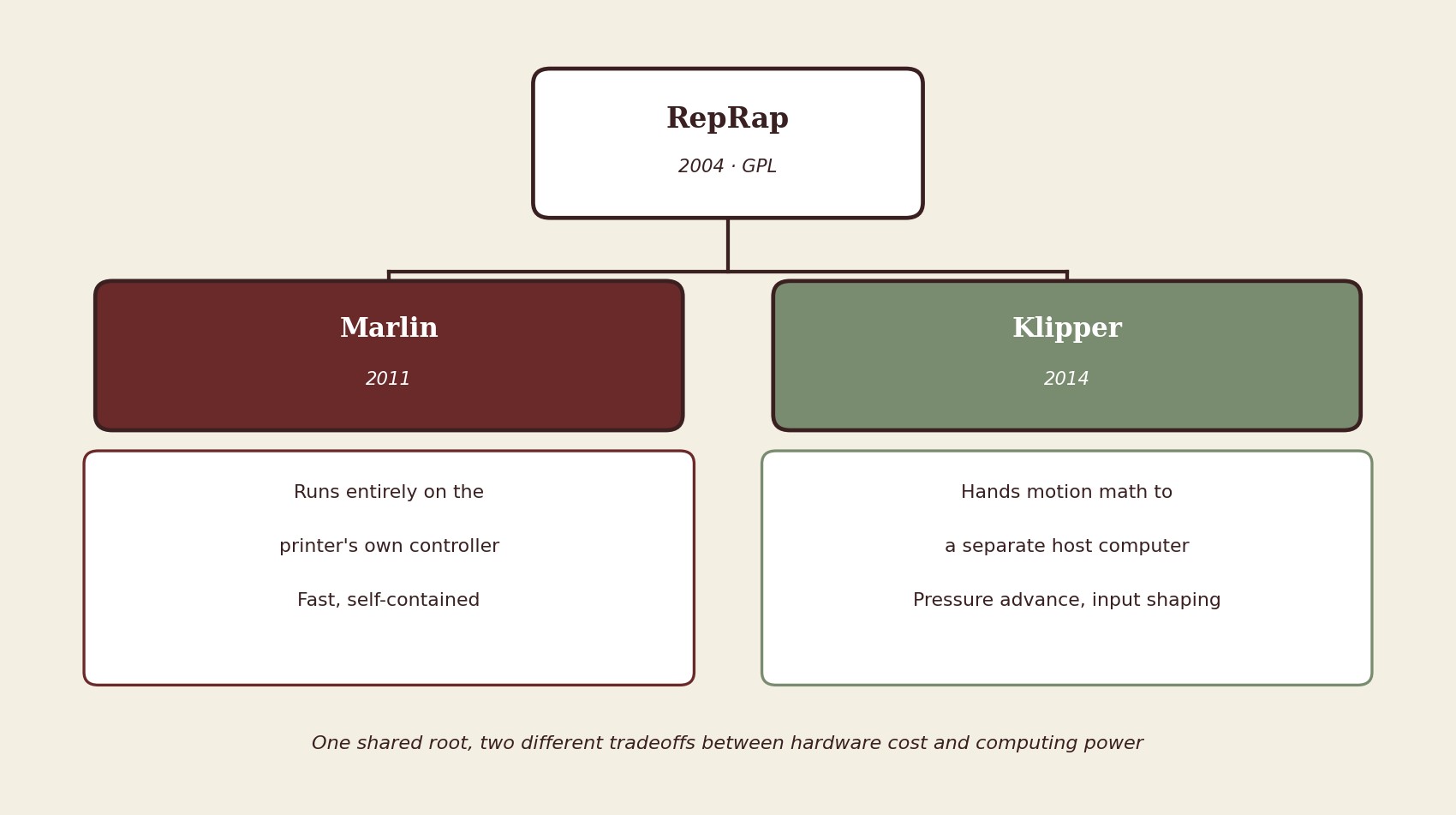
 Two open-source lineages, one shared root: RepRap’s original firmware split into Marlin’s self-contained approach and Klipper’s host-assisted one.
A thermostat is a simple idea: a strip of metal that bends with heat and opens or closes a circuit. Versions of that same idea sit quietly inside furnaces, ovens, and water heaters with no brand name attached to the concept itself. Desktop 3D printers carry a similar quiet inheritance. The code deciding how fast a nozzle moves, how much plastic to push through it, and when to stop was, for most machines on the market, not written by the company whose logo is on the case. It came from a small group of volunteers who gave it away.
That code is firmware, and its family tree traces back to the RepRap project, which Adrian Bowyer launched in 2004 with a goal that sounded almost like a stunt: a 3D printer that could print most of its own replacement parts. RepRap released its designs and code under the GNU General Public License, and by 2008 a RepRap machine had successfully printed enough of its own components to build a working child machine, achieving roughly 70 percent self-replication by parts count. The point was never novelty. Free hardware plans paired with free firmware meant a printer that cost a few hundred dollars in materials could do work that, at the time, required a machine costing tens of thousands.
Out of that RepRap lineage came Marlin, created in 2011 by combining pieces of two earlier open-source projects, Sprinter and grbl. Marlin handles everything on the printer’s own small controller board: it converts each line of sliced instructions into precise stepper-motor pulses, manages the hot end’s temperature through a feedback loop, and coordinates every axis so corners come out square instead of rounded. Released under the GPLv3, it became, by its own maintainers’ account, the most widely used 3D printing firmware in the world, running underneath machines from Prusa, Creality, LulzBot, and Ultimaker alongside a long list of kit-built hobbyist printers.
So why did a second open-source firmware need to exist at all? Marlin’s limitation isn’t a bug, it’s a consequence of running all its math on a chip cheap enough to put inside a $200 printer. Klipper, written by Kevin O’Connor starting in 2014, solves this by splitting the job in two: a full computer, typically a Raspberry Pi, handles the complex motion planning, while a much simpler microcontroller just executes the resulting timed pulses. That extra horsepower unlocks features Marlin’s hardware genuinely cannot afford to compute in real time.
Two of those features solve problems any hobbyist printer owner has seen firsthand. Pressure advance corrects for the fact that molten plastic in the nozzle behaves like a compressed spring: pressure builds while extruding and doesn’t release instantly, so the nozzle keeps oozing slightly after a move ends and blobs at corners where it should be slowing down cleanly. Klipper adjusts extrusion timing continuously to cancel that lag out. Input shaping tackles a different symptom: the faint repeating “echo” of an edge, called ringing or ghosting, caused by the printer’s frame vibrating every time it changes direction quickly. Rather than stiffening the machine physically, Klipper can use data from a small accelerometer clipped to the print head to measure exactly which frequencies the frame resonates at, then generates a motion signal engineered to cancel those vibrations before they ever reach the nozzle.
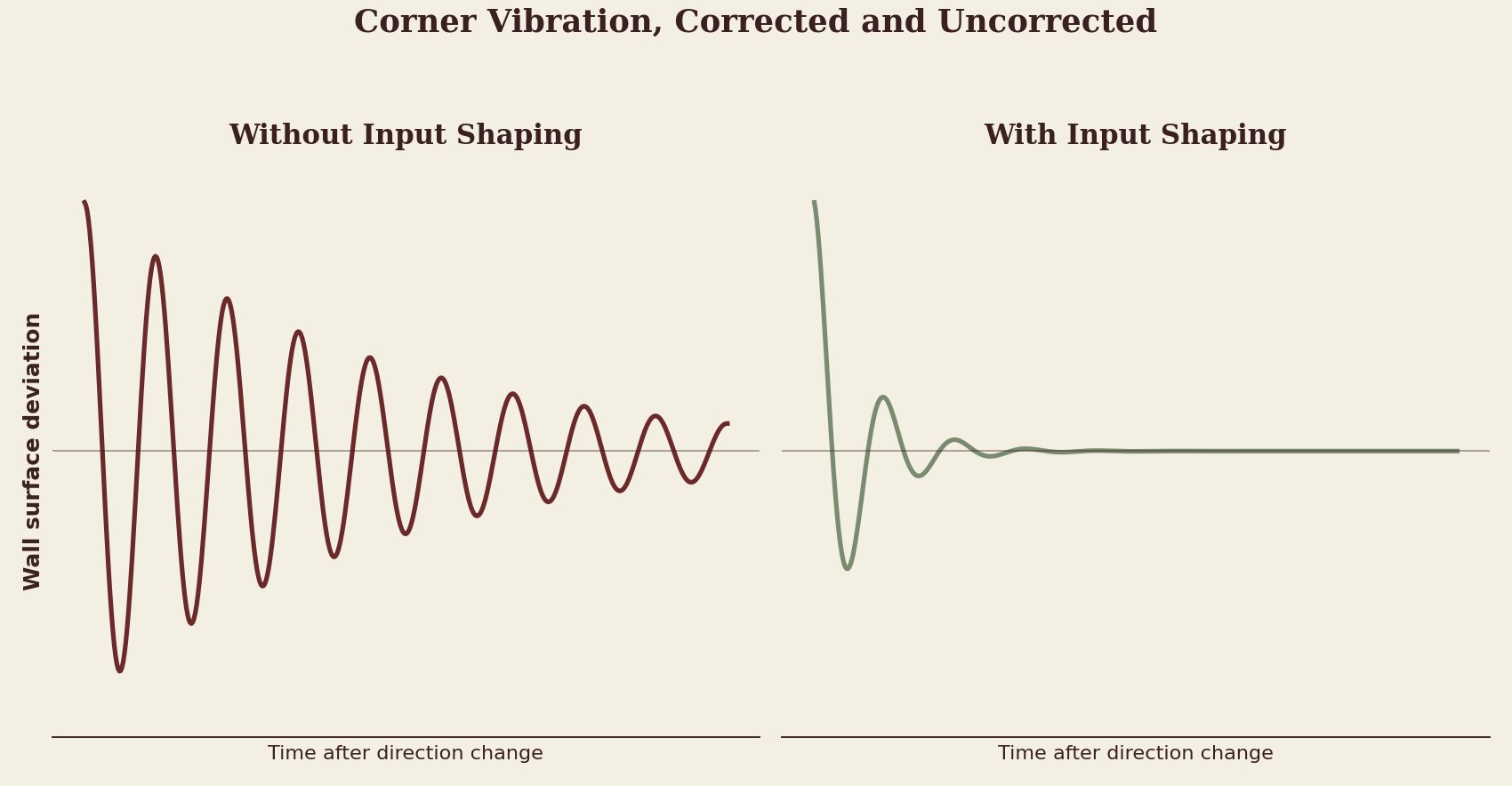 Left uncorrected, frame vibration prints as a faint repeating “echo” near sharp corners; input shaping cancels most of it before the nozzle ever gets there.
Because both projects are free to copy, study, and modify, manufacturers never had to build motion-control software from scratch to compete on speed. Elegoo’s Neptune 4 Pro, Sovol’s SV07 Plus, and Creality’s K1 all ship from the factory with Klipper already installed, and BigTreeTech, a major controller-board manufacturer, formalized a partnership with the Klipper project in 2022 to support it directly in hardware. A kit-built machine like the Voron 2.4 runs the identical open codebase a hobbyist could clone from GitHub for nothing.
Anyone who has typed a pressure-advance number into a slicer profile or run an input-shaper calibration test on their own machine has, in effect, edited the same code quietly doing the same job inside printers costing many times more.