
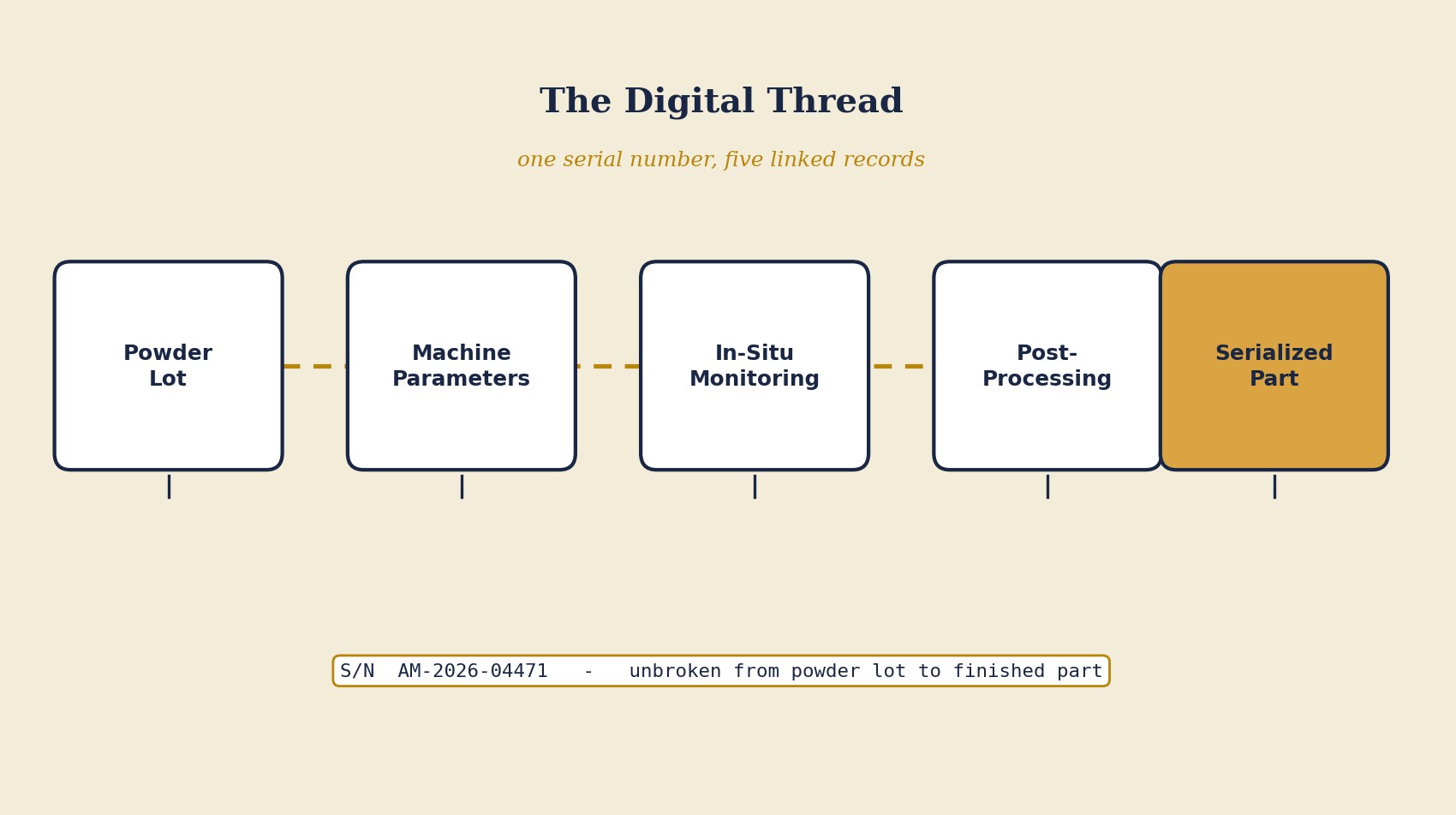
 Every stage of a printed part’s build is tied back to the same serial number.
A forged titanium bracket for an aircraft carries a material certificate, a heat number, and a routing sheet. That paperwork answers three questions: what alloy, what process, what inspection. A printed titanium bracket has a longer list to answer, because in additive manufacturing the process and the part are the same event. There is no separate forging step to certify once and move on from. Every layer of powder that gets melted is itself a manufacturing decision, and regulators and prime contractors increasingly want all of those decisions on record.
That record is what the industry now calls a digital thread, a term NIST researchers formalized in a 2017 paper on metals additive manufacturing, arguing that AM’s real production gaps were data manageability, traceability, and accountability, not geometry. Geometry, the paper noted, additive manufacturing had already solved. Repeatability, and proof of repeatability, were the open problems, and both required a documented history for every individual part, not a periodic audit of the process in general.
In practice that history starts before the build even begins. Siemens’ additive manufacturing group describes part serialization as tying a unique serial number, even to parts printed side by side on the same tray, to its exact build-plate location, the specific machine parameters used, the support-structure strategy, and the original design file it came from. When a part is pulled for field failure analysis years later, that serial number is what lets an engineer walk backward through the entire production decision chain instead of reconstructing it from memory.
The economics of that walk-back are what make this a systems problem, not a paperwork problem. A machined part’s traceability lives in a handful of documents: a mill certificate, an inspection report, maybe a heat-treat log. A printed part’s traceability wants to include the powder lot and its reuse history, the laser or electron-beam parameters across potentially thousands of layers, whatever in-situ melt-pool or thermal-imaging data the machine captured during the build, and the post-processing steps that followed. On a production line running several machines across three shifts, that is a meaningfully larger volume of data to capture, store, and retrieve on demand, and someone in the organization has to own that system end to end.
Authentise’s traceability guide for AM manufacturers is blunt about what happens when nobody does: teams relying on manual, spreadsheet-based tracking routinely cannot answer which exact material batch went into a given part. That gap does not surface until it matters most, during an audit or a quality investigation, at which point it becomes a certification delay or a root-cause analysis that dead-ends for lack of a record.
Standards bodies have started catching up to this reality. ISO/ASTM 52920:2023, published in July 2023, goes past the general quality-system language of ISO 9001 or ISO 13485 and sets AM-specific requirements for what an industrial production site has to monitor and control, aimed at aerospace, automotive, and medical manufacturers trying to qualify a process rather than just a single part. It is a sign that the digital thread is moving from best practice to audit checklist.
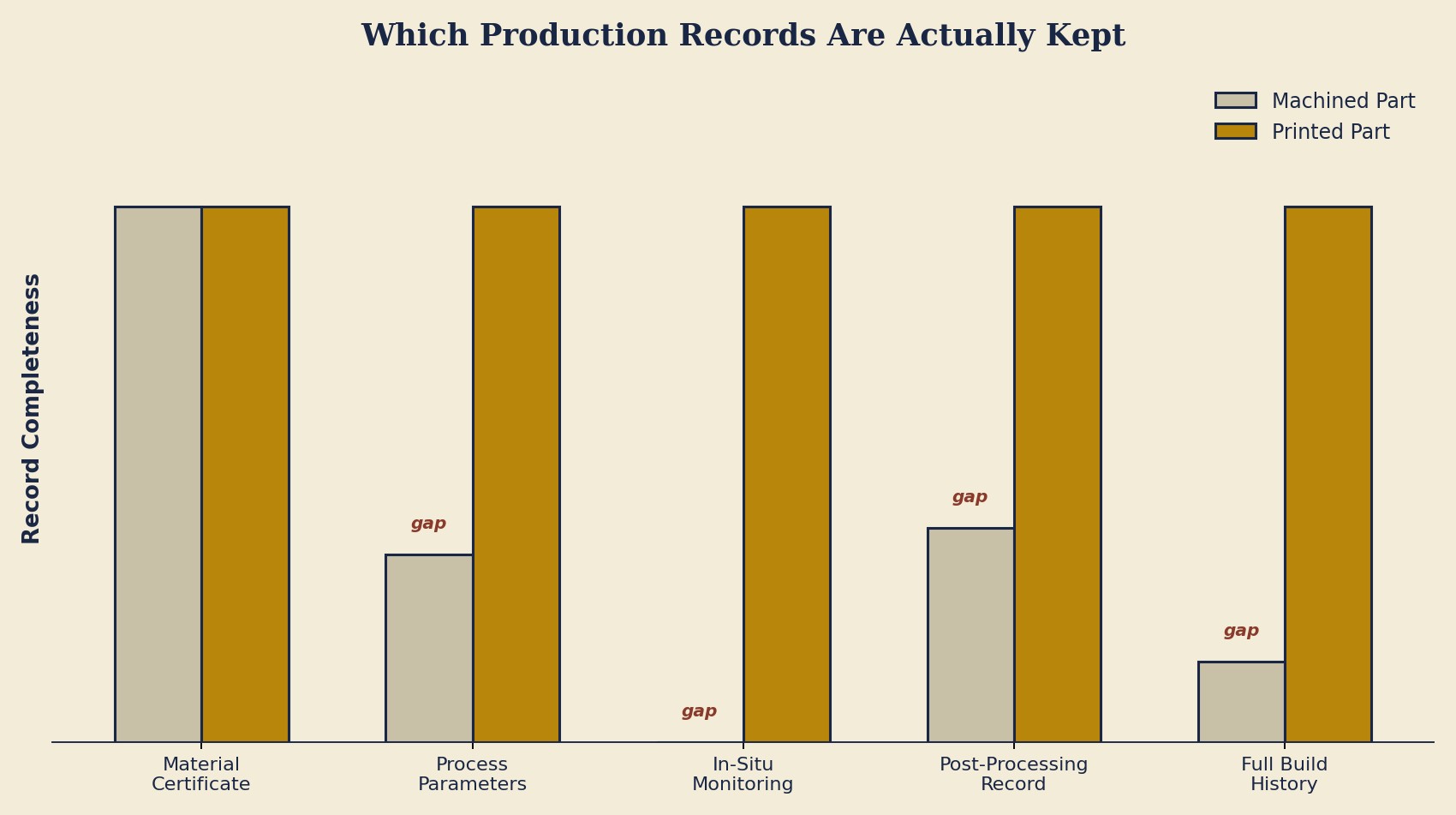 A machined part’s paperwork can afford gaps a printed part’s cannot.
For a shop trying to win aerospace or medical work, that shift changes what the actual product is. The printer itself is close to a commodity now; the differentiator is whether a shop can hand a customer an unbroken record from powder lot to finished, inspected part on request, in a format an auditor accepts without a follow-up meeting. That is infrastructure, not hardware, and it is expensive to build after the fact, once a customer is already asking for it. Shops that treat data capture as core to the process, not an afterthought bolted on for one audit, are positioned to take the qualification work that is coming. The ones still relying on an operator’s notebook are going to learn the difference at exactly the wrong moment, when a customer asks for the thread and there isn’t one.