
For most of stereolithography’s history, curing a resin meant committing to it permanently. UV light triggers a network of crosslinks that lock a liquid into a rigid part, and those bonds, once formed, don’t come back apart. That permanence is exactly what gives SLA and DLP parts their strength and solvent resistance, but it also means a failed print, a support structure, or an obsolete prototype has nowhere to go but a landfill. Researchers working on thermoset recycling ran into this same wall decades earlier with epoxies and rubber, and largely accepted it as the price of a crosslinked network.
The turn away from that assumption started with vitrimers, a class of polymer first described in the 2010s that swaps some of a network’s permanent bonds for exchangeable ones. Instead of a fixed lattice, a vitrimer’s crosslinks can swap partners under heat or catalysis, so the material holds its shape at room temperature but can be reshaped, healed, or fully reprocessed when pushed past a transition threshold. Bringing that chemistry into photopolymer resins took longer, mostly because vitrimer exchange reactions and fast UV curing don’t naturally cooperate. One early solution paired glycerol- and vanillin-derived building blocks, both cheap and renewable, with a transesterification network that could be photocured directly and later reprocessed under heat and pressure, an approach detailed in research on glycerol- and vanillin-based vitrimer resins. A related line of work built resins around dynamic imine bonds instead of ester exchange, using vanillin again alongside a dimer fatty diamine, and found the resulting 3D-printed parts could be fully reprocessed in as little as five minutes at elevated temperature, as reported in work on imine-based biobased photopolymers.
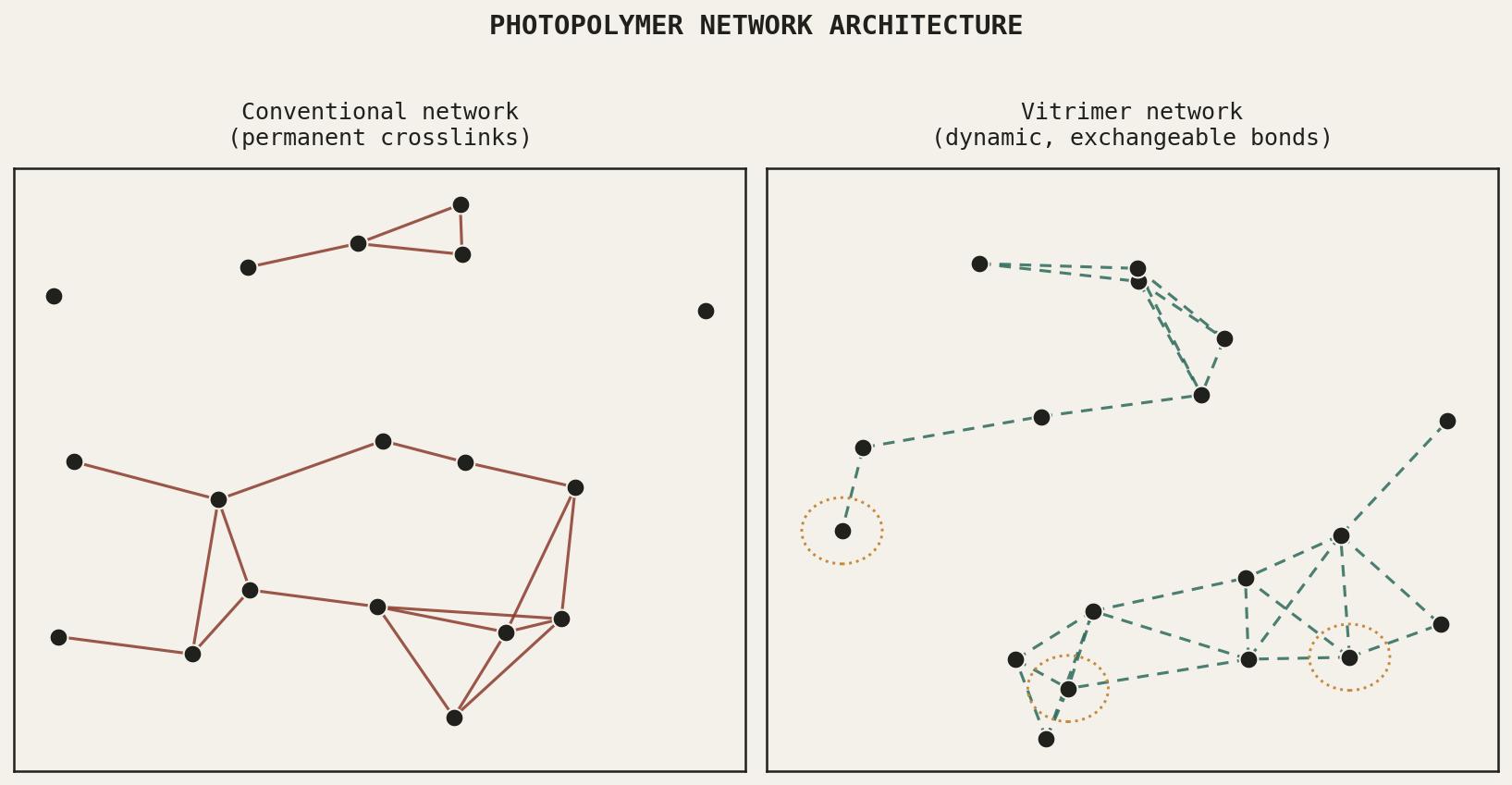
Image 1: A cross-section schematic contrasting a conventional permanently crosslinked photopolymer network with a vitrimer network, where dynamic bonds allow the same material to be reshaped and reprocessed.
What’s changed more recently is durability across repeated cycles, which is the part that actually determines whether any of this is useful outside a lab. A 2026 study using what its authors call a mixed-monomer assisted recycling strategy reported strong recovery of mechanical performance across at least three reprocessing cycles, narrowing the gap between recyclable resins and the high-resolution, high-performance resins that dominate commercial SLA and DLP printing, according to recent work on high-performance recycling biobased photopolymers. Separately, a 2025 paper described a solvent-free, purification-free route to biomass-derived photoresins aimed specifically at DLP printing of objects designed to degrade, trading some of that durability deliberately for end-of-life breakdown rather than reprocessing, a distinction worth noting because “recyclable” and “degradable” solve different problems and are often conflated, as laid out in research on biomass-derived DLP photoresins.
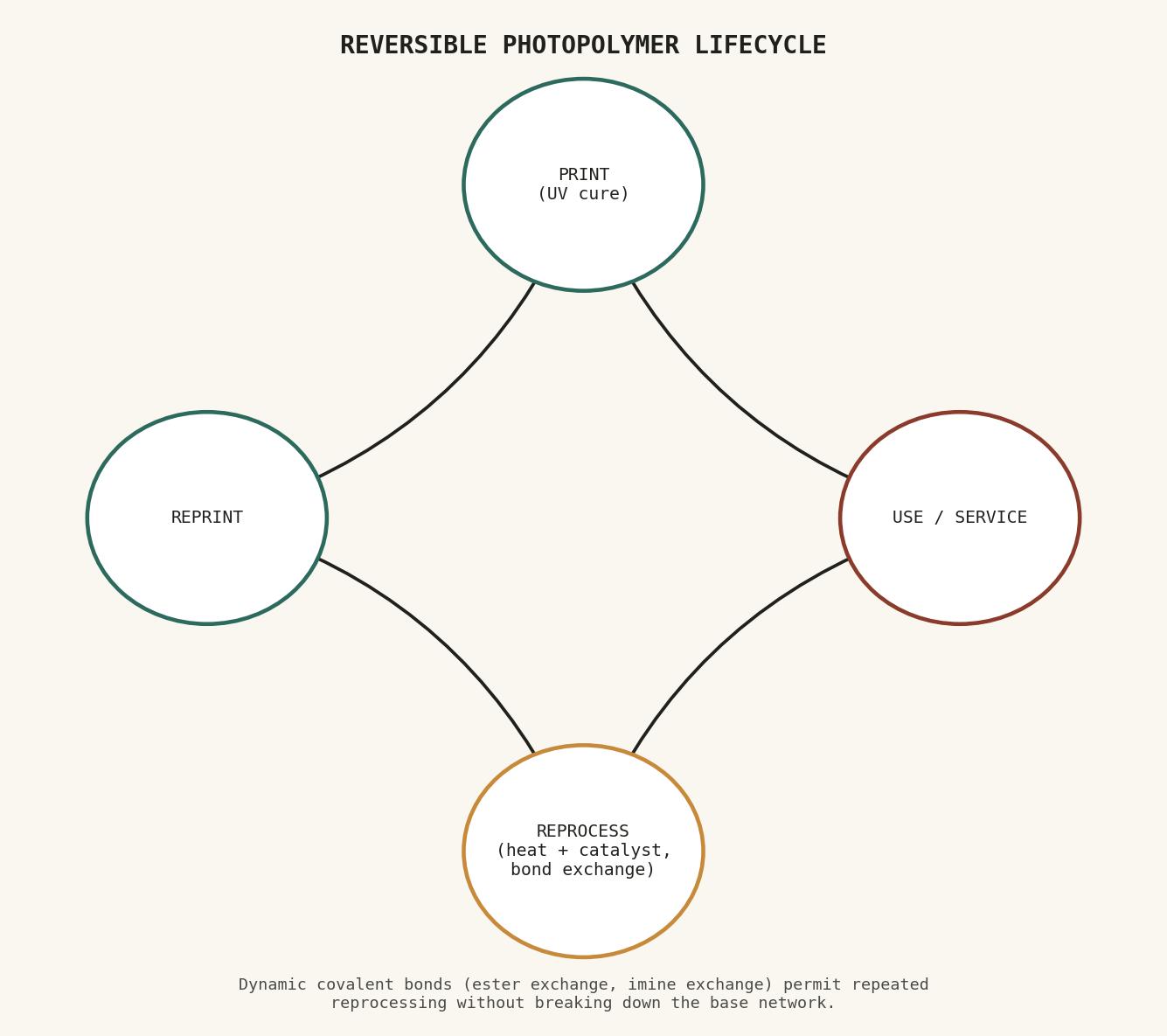
Image 2: A cycle diagram showing a photopolymer part moving through print, use, reprocessing via heat or catalysis, and reprinting, annotated with the dynamic bond types enabling each stage.
None of this has reached the resin bottles most makers and manufacturers buy today. Commercial SLA and DLP formulations are still overwhelmingly conventional acrylates and epoxies, chosen because they’re well characterized, cheap, and predictable. The vitrimer and dynamic-bond resins coming out of these labs still lag on cure speed, shelf stability, and the fine mechanical tuning that industrial users expect, and getting from a published synthesis to a bottle on a shelf has historically taken these material classes the better part of a decade. But the trajectory across this body of work is fairly consistent: each generation trims a little more of the tradeoff between reprocessability and performance, and the newest formulations are closer to matching conventional resins than anything published five years ago. Whether that curve keeps bending the same way, or whether high-resolution photopolymer printing simply turns out to need permanent crosslinks after all, is still an open question. But for a field that spent its first decades treating “cured means forever” as a fixed law of chemistry, even a contested path toward reversibility counts as real movement.