
If someone asks you to name polymer additive manufacturing techniques, how many can you list at once? If you are only familiar with the ASTM/ISO 52900 classification, now is the best time to expand your knowledge. AMPOWER, a leading strategy consultancy and thought leader in industrial additive manufacturing, has identified over 16 different polymer 3D printing processes.
Before exploring their categorisation, let’s briefly review the ASTM/ISO 52900 classification and why it was introduced.
A Brief History of Additive Manufacturing Standards
The first AM technology, stereolithography (SLA), was commercialised in the 1980s. As the industry evolved, new technologies emerged, creating a need for standardised terminology and classification. To address this, the ISO/ASTM 52900 standard was established to define key terms in additive manufacturing, a process where 3D objects are created by adding material layer by layer.
Initially published in 2015 and revised in 2021, this standard was developed by ISO/TC 261, Additive Manufacturing, in collaboration with ASTM International Committee F42, along with contributions from various other organisations.
 Front page of the ASTM/ISO 52900 standard document
ASTM/ISO 52900 Classification
According to ISO/ASTM 52900, AM processes are grouped into seven main categories:
- Binder Jetting
- Directed Energy Deposition (DED)
- Material Jetting
- Material Extrusion
- Powder Bed Fusion (PBF)
- Sheet Lamination
- Vat Photopolymerisation
While this classification provides a structured framework, many additional AM techniques exist beyond these seven categories.
AMPOWER’s Expanded Polymer AM Classification
The AMPOWER Technology Map for Polymer Additive Manufacturing expands on the ASTM/ISO 52900 classification by further categorising AM techniques based on:
- Material type - thermoplastics, thermosets, elastomers
- Energy source - UV light, lasers, thermal extrusion
- Unique vendor-specific processes
Many new and evolving AM methods do not fit neatly into the standard categories. Some are in early development stages but have the potential to transform the polymer AM industry.
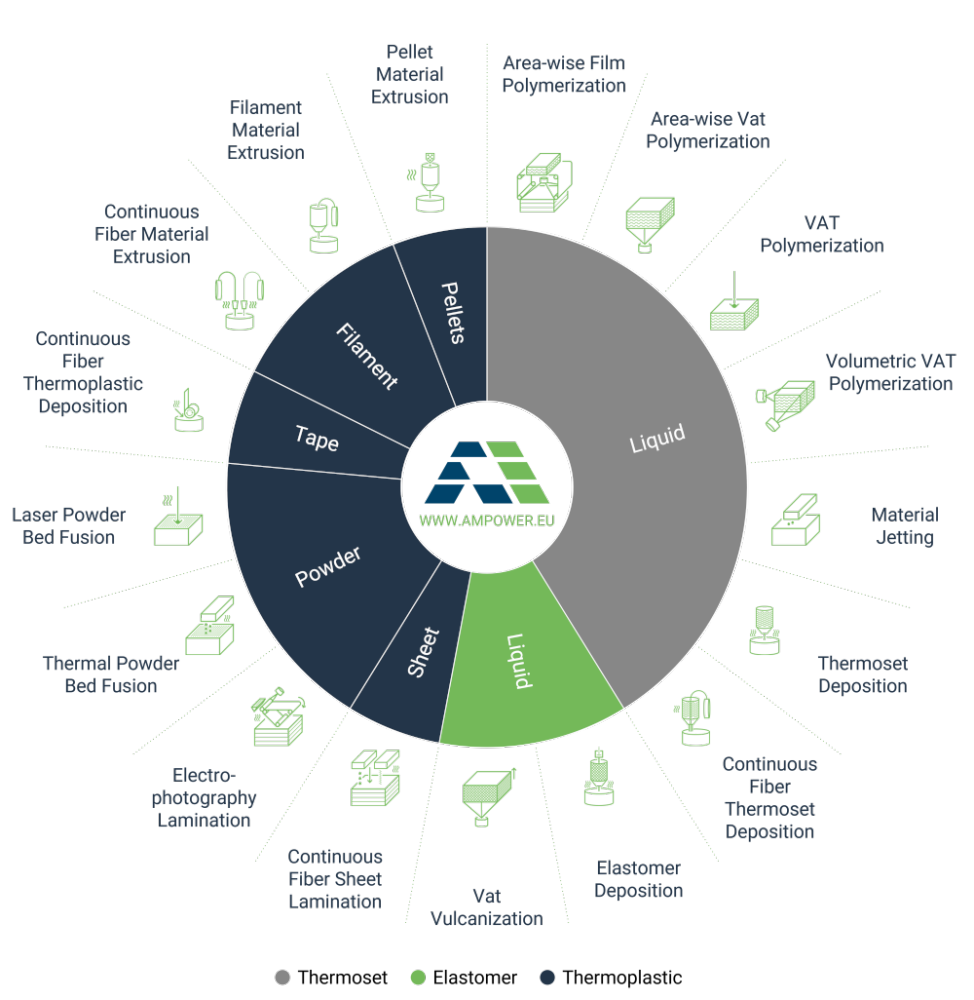 Picture credit: Polymer Additive Manufacturing Technology Overview - AMPOWER
Material Options in Polymer AM
Polymer AM technologies use a variety of materials, including:
- Thermoplastics - commonly used in filament-based material extrusion (FDM/FFF)
- Thermosets - primarily used in vat photopolymerisation (SLA, DLP, etc.)
- Elastomers - used in flexible applications such as soft robotics and medical devices
The Expanding Polymer AM Landscape
The growing variety of technologies, materials, and applications in polymer AM offers significant benefits for end users, who can now select the most suitable and cost-effective technique for their specific needs.
For manufacturers, however, this rapid diversification presents real challenges. Competing in niche markets outside mainstream AM techniques can be risky, as sustaining long-term viability requires continuous innovation and adaptation.
The AMPOWER Technology Map offers an insightful and well-structured overview of emerging polymer AM processes. Even as an industry expert, I found a few new techniques that I had not explored before.