
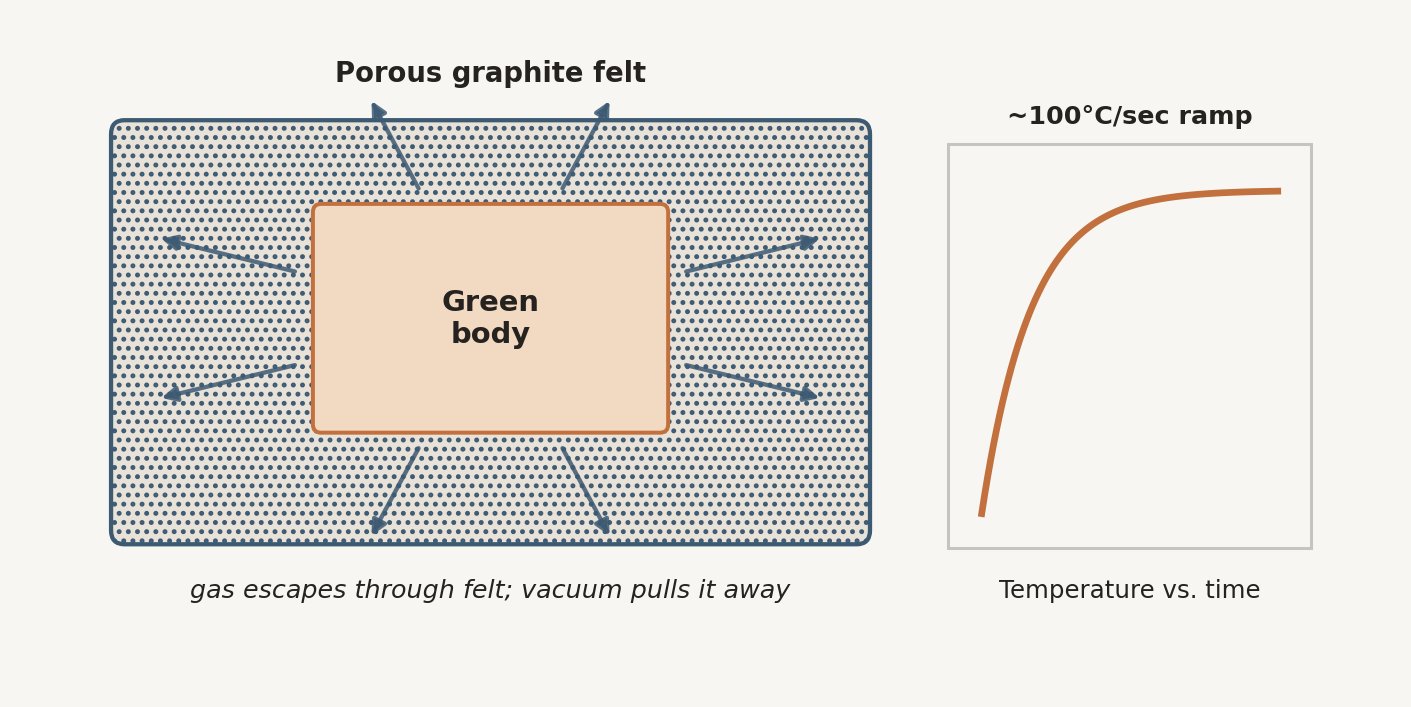
 Debinding never had a speed problem so much as a gas-escape problem. Give the gas somewhere to go, and the clock changes by two orders of magnitude.
A ceramic part fresh off a vat photopolymerization printer is not actually ceramic yet. It is a green body: roughly half ceramic powder, half photopolymer resin, held together by whatever cured under the printer’s UV light. Before that part can be sintered into something hard and dense, the resin has to come out entirely, and the way it comes out is by heating the part slowly enough that the resin decomposes into gas without tearing the part apart on its way out. That single constraint is why thermal debinding has been the slowest step in ceramic additive manufacturing, routinely taking 20 to 100 hours for a single batch (ScienceDaily).
The mechanism is straightforward once you trace it through. As temperature rises, the polymer binder pyrolyzes, breaking down into volatile gas that has to migrate through the pore network of the still-fragile green body and escape at the surface. Heat the part too fast and the binder decomposes faster than the gas can diffuse out. Pressure builds internally, and because the green body has essentially no strength yet, no sintered ceramic bonds, no metal ductility, that trapped pressure finds the path of least resistance: a crack straight through the part. Dr. Majid Minary, the University of Texas at Dallas mechanical engineering professor who led the team behind a new debinding process, put it plainly: “If you speed it up, the polymer being burned off turns into gas, and if that gas cannot escape, the crown may crack or fracture” (ScienceDaily). The slow ramp rates that define conventional debinding schedules exist entirely to keep the internal gas generation rate below the rate at which gas can diffuse out through the part’s pores.
That constraint is a transport problem, not strictly a thermal one, and the UT Dallas team, led by doctoral student Mahdi Mosadegh alongside Minary and materials scientist Golden Kumar, attacked it as one. Their process, described for 3-yttria zirconia parts printed on ceramic stereolithography systems, surrounds the green body in a porous graphite felt heated past 1,400 degrees Celsius, more than 2,550 degrees Fahrenheit, while a vacuum system actively pulls the released gas away from the part rather than letting it accumulate (Interesting Engineering). The felt does two jobs at once: its porosity gives decomposing gas a low-resistance path out of the part, and its high thermal conductivity lets heat ramp far faster than a still-air furnace would allow without overshooting the part’s own temperature. Reporting on the underlying method (branded ultrafast thermal debinding, or UFTD) describes heating rates near 100 degrees Celsius per second, with the part reaching a full sintering temperature of 1,450 degrees Celsius in roughly two and a half minutes total, and the entire debinding stage collapsing to under 30 minutes, a 40- to 200-fold reduction over conventional schedules (VoxelMatters).
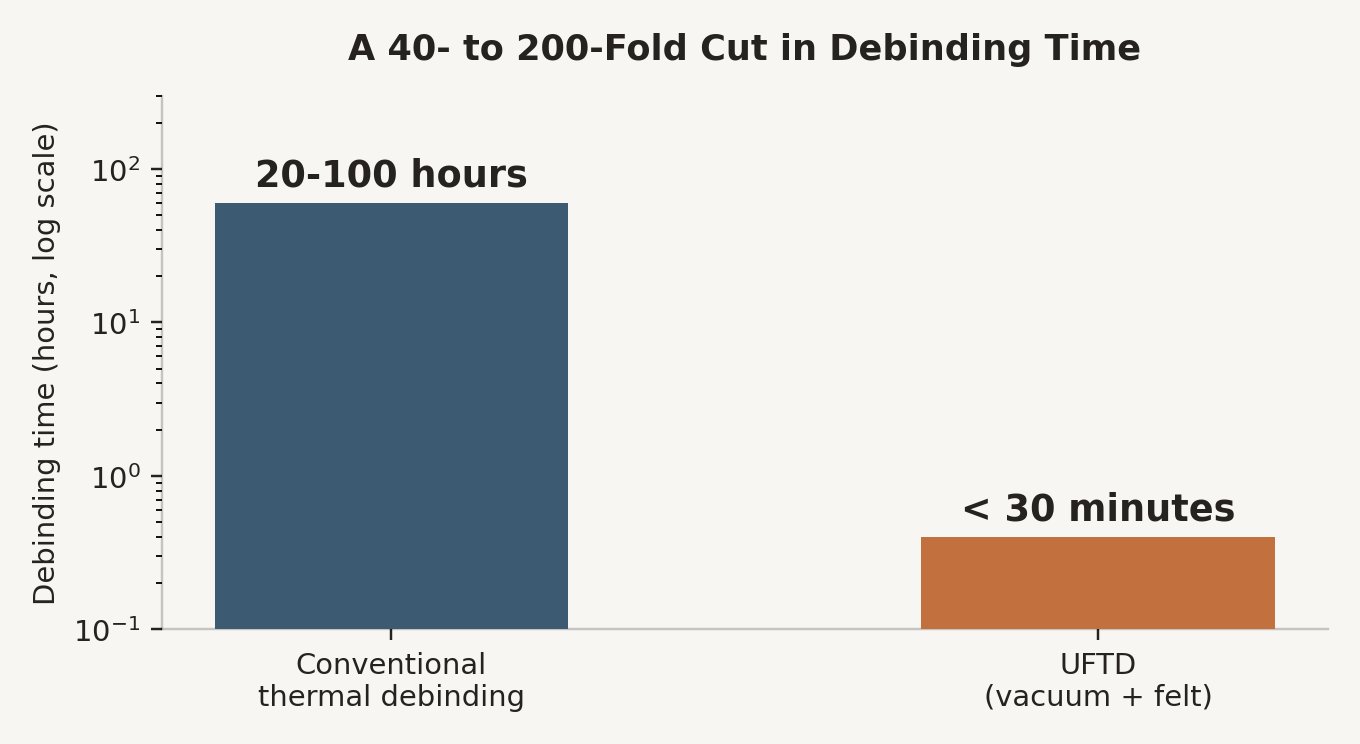 Widening the gas-escape route, rather than slowing the heat, is what collapses the timeline.
What makes this result worth taking seriously rather than filing as a lab curiosity is that speed did not come at the cost of the part. Reported porosity for UFTD-processed zirconia lands at 4.2 to 4.3 percent and Vickers hardness at 15.5 GPa, both in the same range as parts run through conventional multi-day debinding cycles (VoxelMatters). That is the whole trick: the mechanism that usually forces a slow ramp, gas outrunning its own escape route, gets solved by widening the escape route instead of by simply going slower. Vacuum-assisted gas removal and a high-conductivity felt jacket don’t change how fast the binder pyrolyzes; they change how fast the resulting gas can leave, which is the actual rate-limiting variable the whole schedule was built around.
The first application target is dental: a same-day, chairside zirconia crown workflow, in which impression to sintered restoration could plausibly fit into a single office visit instead of a lab turnaround measured in days (Interesting Engineering). Zirconia crowns are small, geometrically simple, and thin-walled, which is close to the best-case geometry for this kind of process, high surface-area-to-volume ratio means gas has a short path to any exposed surface. Where the mechanism should start to strain is on larger, thicker cross-sections, structural ceramic components with several centimeters of solid material between the core and the felt, where even a fast escape path at the surface can’t keep pace with gas generated deep in the part’s interior. Whether porous-felt vacuum debinding scales past dental-sized geometries into industrial ceramic parts is the question that will decide if this stays a dentistry story or becomes a manufacturing one.