
In a typical selective laser sintering build, the laser only touches about a fifth of the powder in the chamber. The rest sits at sintering-adjacent temperatures for hours, unused but not unaffected, and gets scooped up afterward to feed the next job. Whether that leftover powder is still worth using is one of the more practical questions in polymer additive manufacturing, and it turns out to have a fairly precise answer.
The material at the center of this is polyamide 12, the workhorse nylon powder behind most SLS parts. PA12 doesn’t melt and resolidify cleanly the way a thermoplastic in an injection molder does. Held near its melting point during a build, it undergoes slow post-condensation and thermo-oxidative reactions that raise its molecular weight and shift its crystallization behavior, and a 2024 aging-dynamics study found that build time in the chamber drove those changes more than the nominal build temperature did. Powder sitting through a long print ages more than powder in a short one, even at the same thermostat setting. That’s a subtler mechanism than “the powder got hot,” and it’s part of why two shops running what look like identical process parameters can get different results from their recycled stock.
The consequence shows up directly in part strength. A 2025 study in Scientific Reports tracked PA12 through five successive reuse cycles and measured a 30.6 percent drop in Young’s modulus, from roughly 823 MPa down to 571 MPa, alongside measurable shifts in dimensional accuracy. Coalescence behavior degrades too: aged particles fuse less completely under the laser, leaving more residual porosity at the same energy input, a pattern documented in earlier work on PA12 reuse that this newer research largely confirms rather than overturns.
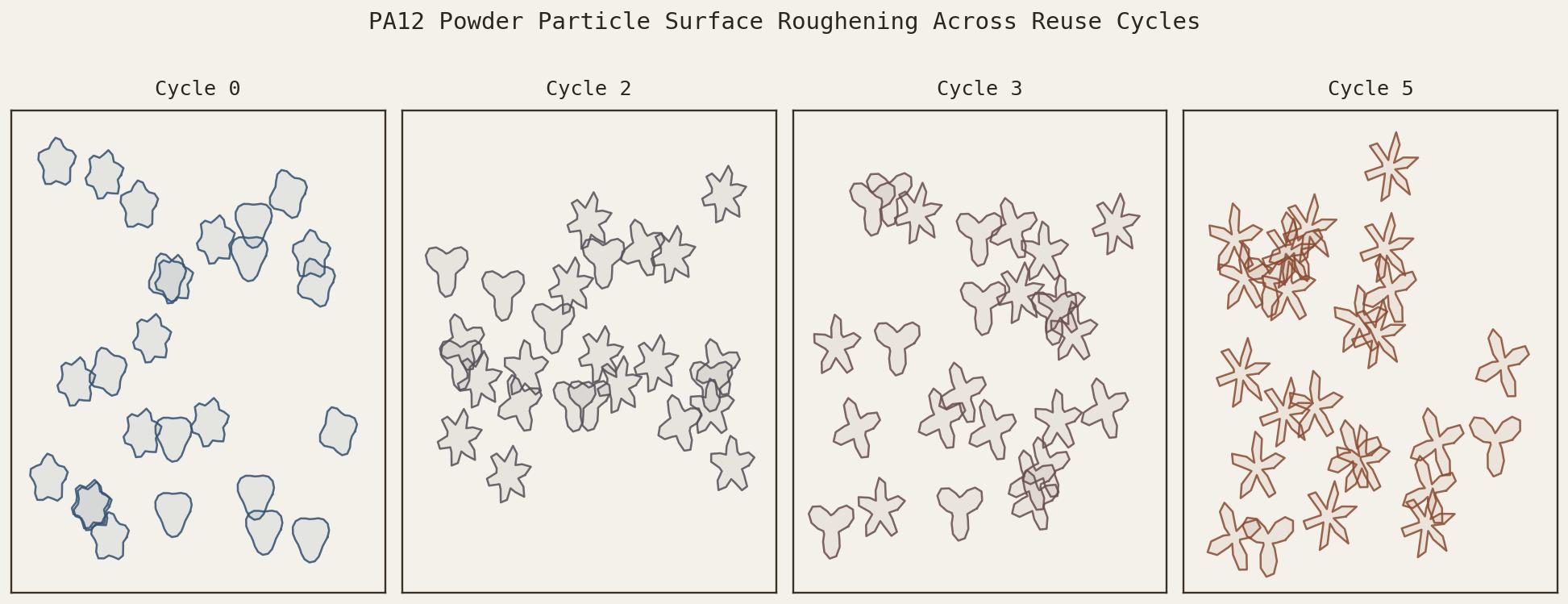 Image 1: Repeated thermal cycling roughens PA12 particle surfaces and weakens how cleanly they fuse under the laser.
None of this means reused powder belongs in the trash, and this is where the industry’s answer gets more interesting than “just use it less.” Machine makers and material suppliers converged, largely independently, on blending fresh and used powder at a fixed ratio rather than retiring aged stock outright. Refresh rates cluster around 30 to 50 percent depending on the material system, with reinforced grades like carbon-fiber-filled PA11 needing closer to 40 percent fresh powder to hold their properties steady. It’s a workable compromise, not a perfect fix. Blending dilutes the average degradation of the batch without eliminating it, and the properties of a part printed from a 30 percent refresh batch still trend measurably below one printed from fully virgin powder, just not by enough to disqualify most functional applications.
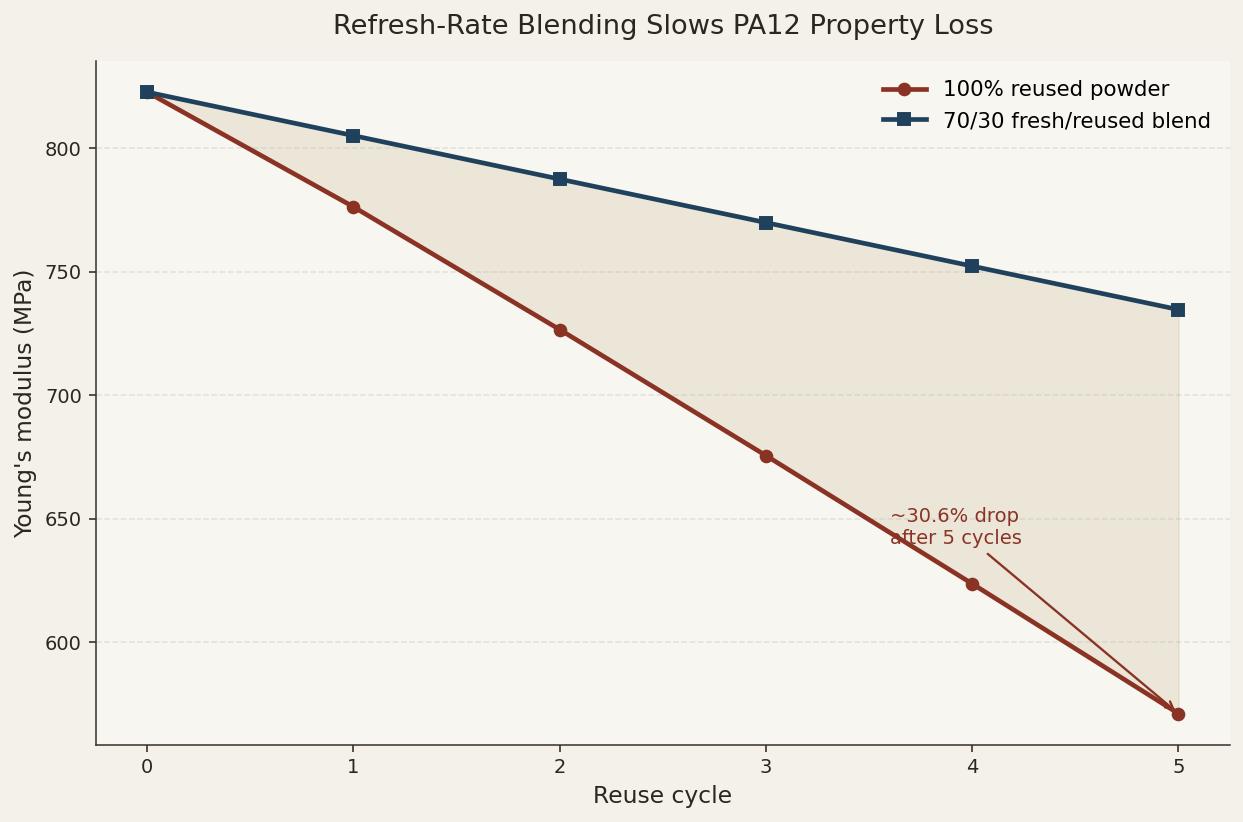 Image 2: Blending fresh powder into aged stock flattens the property drop that comes from repeated thermal cycling.
What makes this tractable at all is that the aging process is more predictable than it first appears. ACS Omega’s thermal-history mapping work shows that a powder bed’s actual thermal exposure varies by location and layer, information that, tracked over time, lets a shop estimate an aggregate “age” for its powder stock rather than guessing at when to discard it. Combined with periodic mechanical testing of witness coupons, that turns powder management from an art into something closer to a maintenance schedule.
The economics matter here as much as the chemistry. Discarding 80 percent of a build’s powder after every run would make SLS considerably more expensive than it already is, and would waste a material that, chemically, is barely used up on its first pass through the machine. Refresh-rate blending is what lets SLS shops treat that unsintered powder as inventory rather than scrap, and the research on aging kinetics is what makes it possible to do that with some confidence instead of trial and error. It’s not a glamorous piece of the additive manufacturing story, but it’s the kind of quietly solved problem that keeps a production process affordable enough to actually run at scale.