
A decade ago, an engineer who wanted to fly a 3D-printed bracket had almost no common rulebook to point to. Each qualification effort was built from scratch, one company’s internal process specification standing in for what should have been shared, external ground truth. That gap between “we can print it” and “we can certify it” is the real story of additive manufacturing standards, and it has been closing steadily rather than all at once.
The first real foothold came with ISO/ASTM 52900, which gave the field a shared vocabulary before it could agree on much else. Early adopters in aerospace and medical devices had been qualifying parts against ad hoc internal documents, often written by whichever engineer had championed the technology at a given company. That approach worked well enough for one-off brackets but collapsed the moment a part needed to move between a supplier and a prime contractor who used different terms for the same process. What followed was a slower, harder push toward standards that actually governed how a part gets made, not just what to call it. ISO/ASTM 52920:2023 is where that shift became concrete: a standard specifying process control, material handling, build monitoring, and final inspection requirements for an entire production site, independent of material or machine. It reads less like a checklist and more like the accumulated memory of every qualification program that ran into a problem nobody had documented yet.
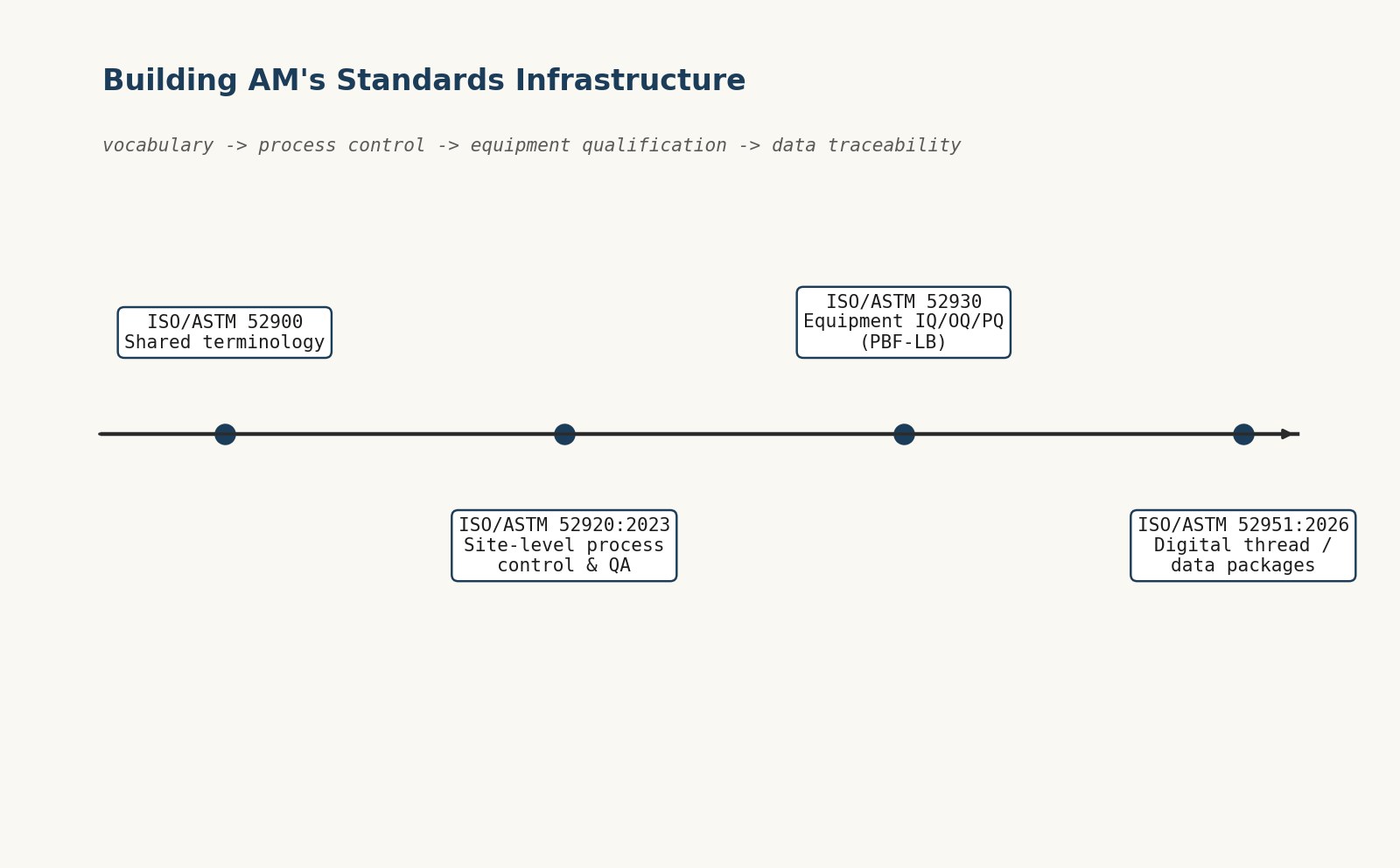 Each generation of AM standards built on the gap the previous one left open.
Powder bed fusion needed something more granular still, since a machine that behaves correctly on installation day can drift over years of use. ISO/ASTM 52930 borrows a framework long familiar in pharmaceutical manufacturing, installation, operational, and performance qualification, and adapts it to laser powder bed fusion equipment specifically. That borrowing is itself telling. Rather than inventing a qualification philosophy from nothing, the AM standards effort has repeatedly reached into more mature industries and translated what already worked, which is a large part of why the pace of adoption has accelerated even as the technology itself keeps changing underneath it.
The most recent development addresses a problem that qualification alone can’t solve: keeping a coherent record of a part’s history once dozens of files, from CAD models to build logs to inspection reports, are scattered across different systems. ISO/ASTM 52951:2026 is the first standard to harmonize the methods and data models for managing that information, formalizing what the industry has started calling a digital thread. It’s scoped initially around metal powder bed fusion but written to extend to other processes, and it exists specifically so a designer, a manufacturer, and a certifying authority can trace the same part through a shared structure instead of three incompatible spreadsheets. NASA’s own work on establishing a digital thread for additively manufactured hardware makes the underlying motivation explicit: traceability isn’t paperwork bolted onto qualification, it’s the mechanism that lets a regulator trust a part they never watched get built.
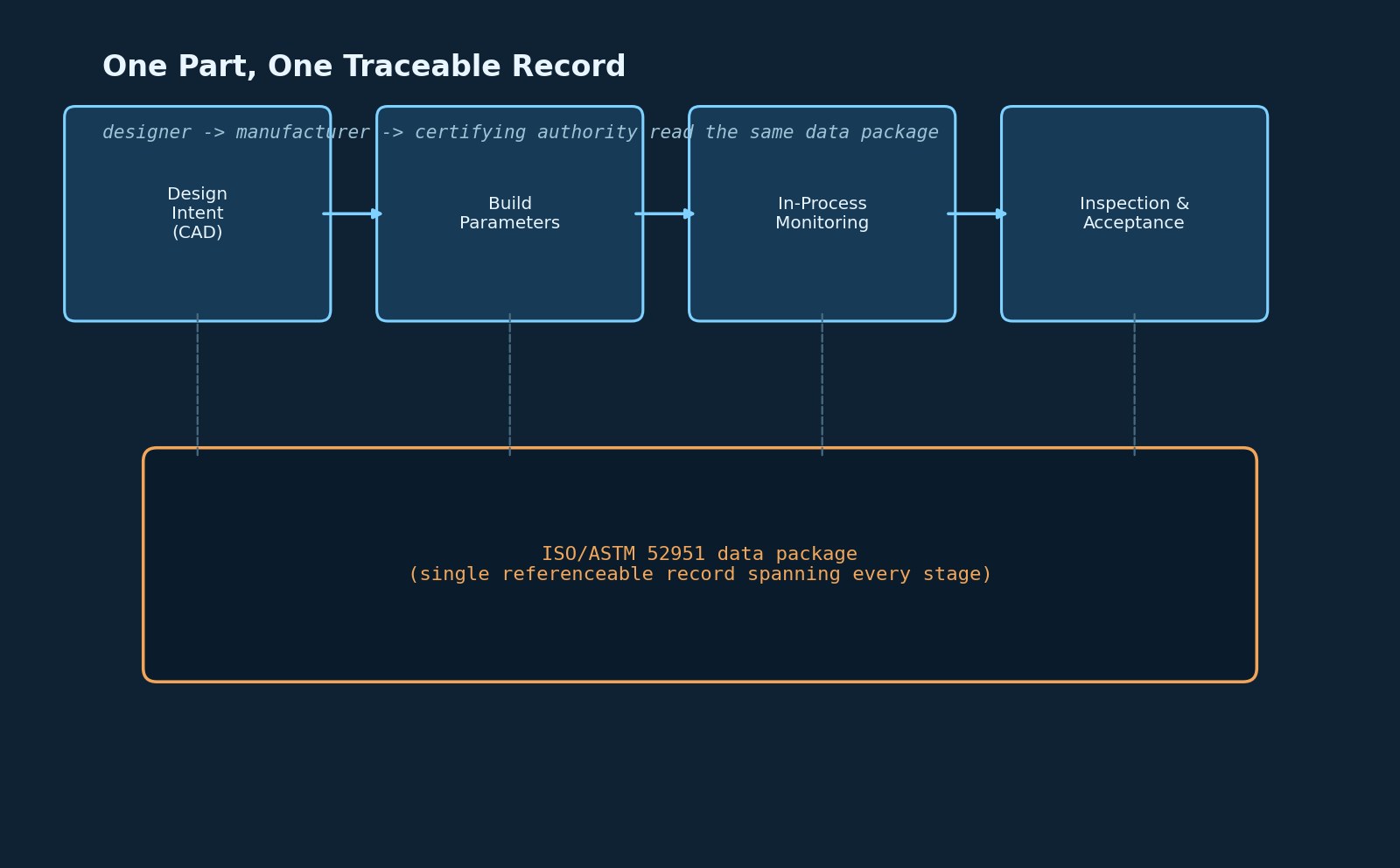 A single ISO/ASTM 52951 data package now spans every stage a part passes through, from design to acceptance.
What’s notable, looking at this progression as a whole, is how much of it has been about connecting pieces that already existed rather than starting over. Process control standards gave qualification something concrete to inspect against. Equipment qualification protocols gave that inspection a repeatable rhythm. Data standards are now giving the whole chain a common language to record itself in. None of these pieces alone would have been enough to move AM from prototyping curiosity to production method in regulated industries, but together they form something closer to the standards infrastructure that traditional manufacturing spent generations building.
There’s still real work ahead, particularly in harmonizing regional variations and extending data standards beyond metal powder bed fusion to polymer and ceramic processes. But the trajectory is unusually legible for a field this young. A technology that once relied on tribal knowledge inside individual companies is now accumulating the kind of shared, auditable infrastructure that lets a part’s history travel with it, which is precisely what has to happen before “3D-printed” stops sounding like a caveat and starts sounding like just another manufacturing method.