
Support structures are frequently treated in practitioner literature as a slicing-stage afterthought, a scaffold generated automatically once a geometry is deemed to contain unsupported overhangs. This framing understates their function. Across powder bed fusion, material extrusion, and vat photopolymerization, supports perform a load-bearing and thermal-management role that is inseparable from the physics of layer-wise solidification itself. Their necessity, geometry, and removal cost are direct consequences of how each process manages heat extraction, viscoelastic transition, and interlayer bonding during build. A rigorous treatment of support strategy therefore requires examining the underlying mechanism in each process family rather than applying a single overhang-angle heuristic across all of them.
Mechanistic Origins by Process Family
In metal powder bed fusion (L-PBF) and electron beam melting (EBM), the dominant justification for support is thermal, not purely gravitational. Loose powder beneath an overhang has thermal conductivity roughly one to two orders of magnitude lower than the solid metal above it, so heat generated by the energy source cannot conduct away as efficiently as it would through a solid-backed region. The result is a locally elevated and prolonged thermal history, which raises the magnitude of thermal gradients and the resulting residual stress accumulated through repeated heating and cooling cycles. This mechanism is documented in a numerical investigation of support structure designs for overhangs in powder bed electron beam additive manufacturing, where retained heat in the region above the powder substrate was directly linked to elevated residual stress and distortion. Complementary process-parameter studies have shown that the direction and geometry of an overhang measurably changes the thermal decay profile of Ti-6Al-4V builds, altering both the peak temperature retained and the rate of cooling beneath it. Supports in this context function primarily as an engineered heat sink: a physical conduction path back to the build plate that shortens the thermal time constant of the overhanging region and constrains it mechanically while it is most compliant.
In material extrusion (FDM/FFF), the operative mechanism is different in kind. Each deposited road of molten polymer must retain sufficient thermal energy to bond with the layer beneath it, while simultaneously cooling fast enough to resist gravitational sag before the next layer is deposited on top. This is fundamentally a race between viscoelastic solidification and gravity: material printed over open air, without a layer to fuse against, has nothing to arrest deformation, and sags or curls in proportion to how long it remains above its solidification temperature. The commonly cited 45-degree overhang threshold is a geometric proxy for this kinetic constraint, corresponding to the point at which a new layer retains roughly half its supporting contact area from the layer below - typically sufficient contact for adhesion and dimensional stability without external support.
Vat photopolymerization (SLA/DLP) supports serve a third, distinct function: anchoring rather than heat management. Because each layer cures directly against the one beneath it (or the build plate, for the first layers), regions with insufficient cross-sectional area or poor mechanical continuity to the rest of the part are vulnerable to drifting, delaminating, or curling during the repeated peel-and-recoat cycle between layers, independent of whether the region is technically an “overhang” in the gravitational sense. Supports in SLA are therefore best understood as temporary structural ties that hold a curing region in a fixed position relative to the build platform until it has enough cured mass of its own to remain dimensionally stable.
Material-Process-Property Relationships and Root-Cause Failure Analysis
The presence, density, and placement of supports measurably affects final part properties, not merely surface cosmetics. In metal AM, insufficiently supported overhangs that develop excess residual stress are a documented root cause of interlayer cracking, delamination from the build plate, and post-build distortion once the part is stress-relieved or removed from the plate. Support optimization strategies that account for thermo-mechanical constraints alongside pure geometric accessibility have been shown to reduce both support volume and resulting distortion simultaneously. A recent critical review of support structure design methodologies further categorizes failure modes across processes into recoater interference, part-support fusion defects, and support-induced surface degradation, arguing that support design should be treated as a first-class part of design-for-additive-manufacturing rather than a downstream slicer setting. In polymer processes, the analogous root-cause chain runs through localized overheating or underheating at contact points: excessive support density increases thermal mass and slows local cooling, while sparse supports increase the risk of sag propagating into dimensional error on the finished surface.
The Full Process Chain: Pre-Process, In-Process, Post-Process, and Validation
A complete accounting of support strategy spans four stages. At the pre-process stage, orientation selection and support generation determine which surfaces will require scaffolding at all; algorithmic approaches increasingly incorporate thermal simulation directly into support placement rather than applying uniform angle thresholds. During the in-process (build) stage, supports actively participate in the thermal and mechanical behavior described above, and machine-level factors compound the effect: on powder bed systems, tall or dense support structures increase the risk of recoater blade interference or collision if distortion exceeds clearance tolerances, a failure mode that can terminate a build hours into a multi-day print. At the post-process stage, support removal itself introduces risk to the finished part, particularly in metal AM where wire-EDM or machining is often required and can leave witness marks or locally altered surface properties; in polymer processes, mechanical removal risks fracturing thin, support-adjacent features. Finally, validation, typically via dimensional inspection or computed tomography for internal or safety-critical geometries, is where undetected support-related distortion or residual stress ultimately surfaces - which is why the ISO/ASTM 52900:2021 vocabulary standard for additive manufacturing explicitly frames support structures as a defined process element rather than an implementation detail left to individual machine vendors.
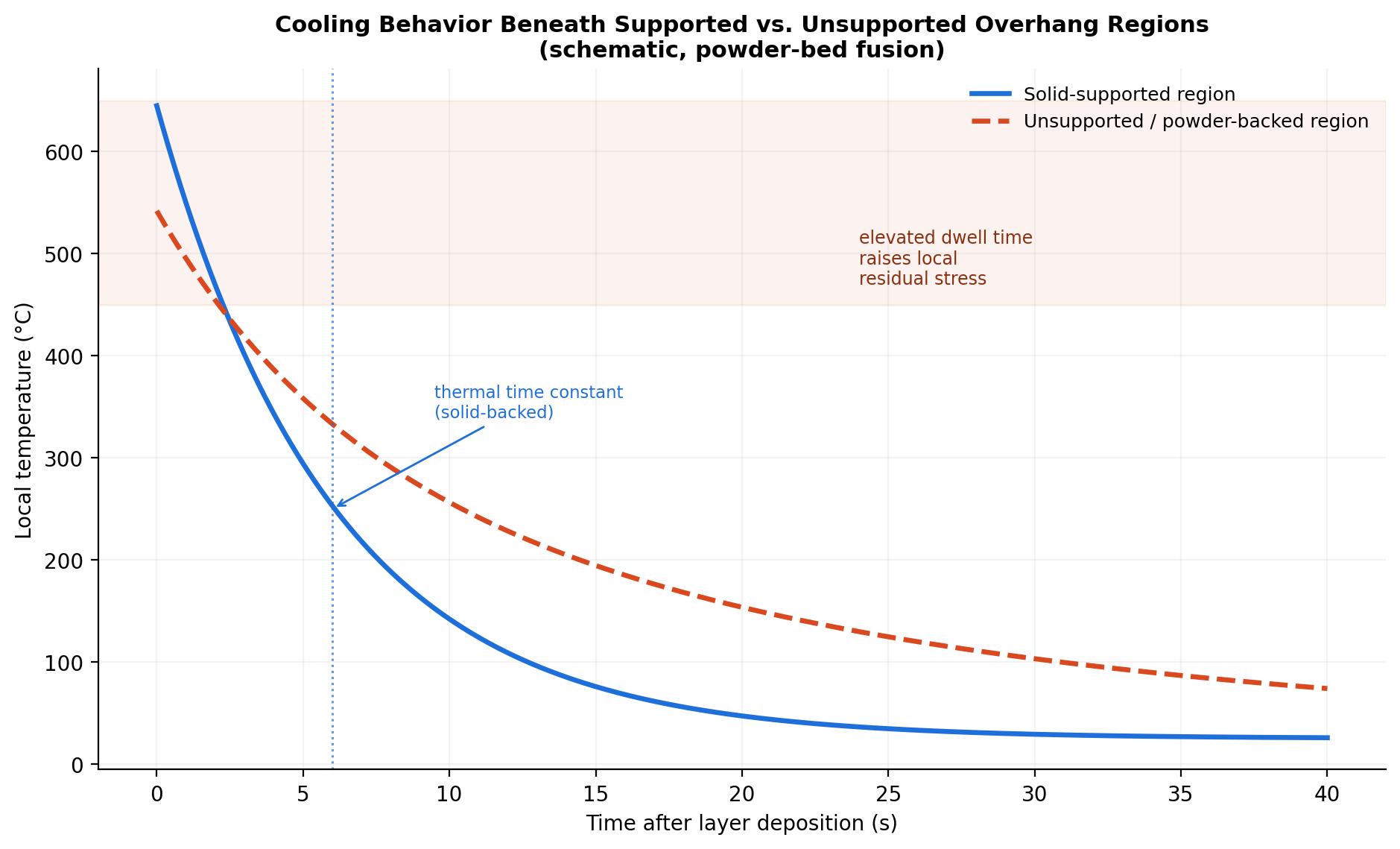 In powder bed fusion, a solid-backed (supported) region conducts heat away with a substantially shorter thermal time constant than a powder-backed (unsupported) region of equivalent geometry. The prolonged dwell time in the unsupported case sustains the material at elevated temperature for longer, which is mechanistically linked to increased local residual stress accumulation and a higher risk of distortion once the part is separated from the build plate.
Advanced Discussion: Industry and System-Level Implications
At an industrial scale, support strategy is inseparable from cost and throughput. Support volume consumes machine time, feedstock, and in metal AM, energy input proportional to the mass fused - all of which is discarded material with no function beyond the build itself. Recent work applying machine learning to support and process-parameter co-design reports that data-driven approaches can identify support configurations that reduce both volume and distortion risk simultaneously, compared to rule-based angle thresholds applied uniformly across a geometry. This matters most at production scale, where support strategy decisions are amortized across hundreds or thousands of parts and small percentage reductions in support volume translate directly into machine-hour and material-cost savings. System-level reliability considerations compound this: ongoing review work on overhang fabrication in laser powder bed fusion highlights recoater collision risk and inconsistent melt pool behavior at overhang boundaries as persistent open challenges, rather than solved problems, even in mature commercial systems.
Future Direction
The trajectory across all three process families points toward support strategies that are generated jointly with topology and thermal simulation rather than applied after geometry is finalized. In metal AM, this means support placement algorithms that treat thermal history as a first-class optimization objective alongside part accessibility and material savings. In polymer processes, it increasingly means design tools that surface self-supporting alternatives - chamfers, splits, bridging-compatible geometry - before a part ever reaches the slicer, shifting support minimization from a post-hoc slicer setting back to an upstream design decision. The common thread is that support structures, properly understood, are a diagnostic: a geometry that requires extensive support has not yet been reconciled with the thermal and kinetic constraints of the process building it.
Conclusion
Support structures cannot be reduced to a single overhang-angle rule applied uniformly across additive manufacturing processes. Their necessity, geometry, and cost are governed by distinct physical mechanisms in each process family: residual-stress-driven thermal management in powder bed fusion, a kinetic race between solidification and gravity in material extrusion, and mechanical anchoring during layer-wise curing in vat photopolymerization. Treating support design as a process-aware, thermally informed decision, rather than a default slicer behavior, is what separates parts that require extensive rework from parts that emerge close to finished - and it is the direction in which both academic support-optimization research and industrial DfAM practice are converging.