
 A part can look finished the moment it clears the vat. Chemically, it usually isn’t.
Pull a part off an SLA or DLP printer and it already has its final shape. It is solid enough to handle, dimensionally accurate, and by most visual measures, done. None of that means the chemistry is finished. During printing, each layer receives just enough UV exposure to gel and bond to the layer beneath it, which typically leaves the polymer network at somewhere between 50 and 85 percent conversion, according to Liqcreate’s technical guidance on post-curing. The rest of the reactive monomer is still sitting in the part, uncrosslinked, waiting for enough energy to finish the reaction it already started.
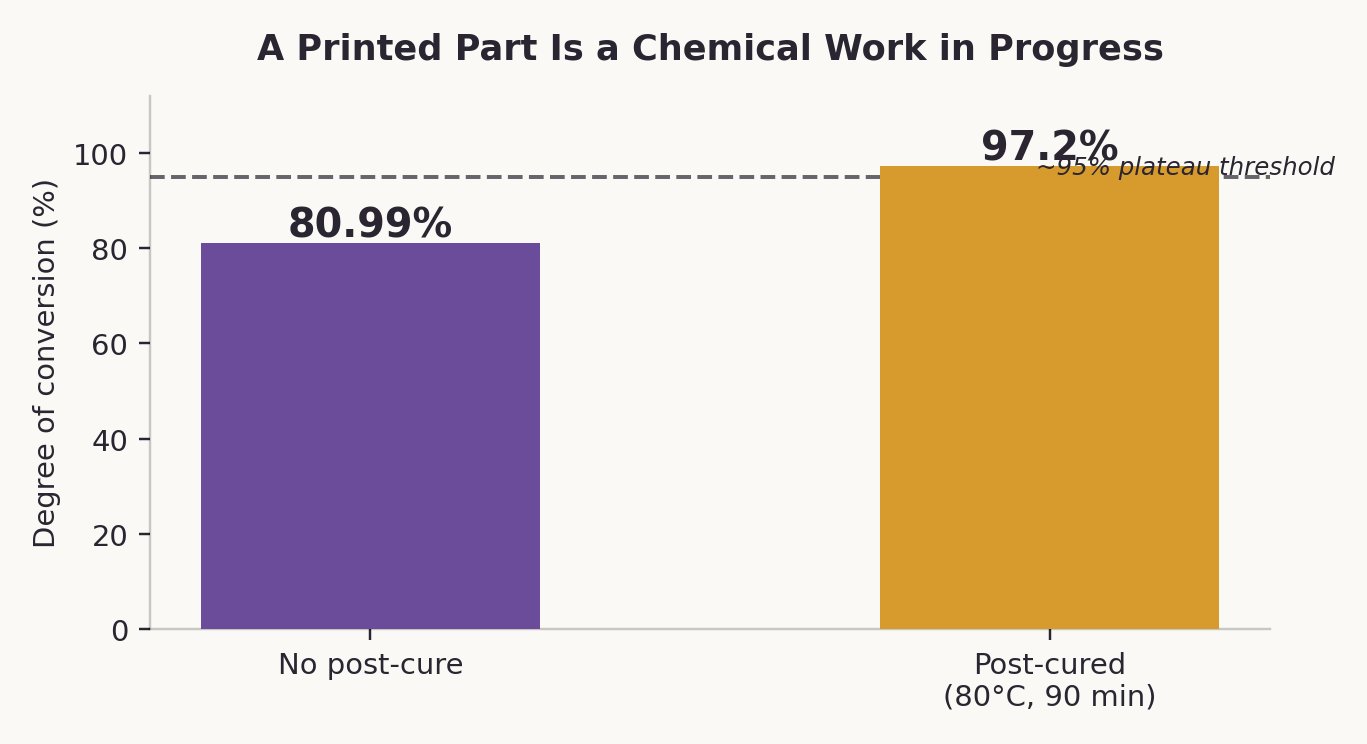
The mechanism is photopolymerization, not drying or cooling. A photoinitiator molecule absorbs a UV photon and splits into reactive species that go on to link monomer and oligomer chains into a continuous three-dimensional network, as described in 3DMag’s guide to resin curing. Every additional photon a still-liquid pocket of resin absorbs pulls a few more chains into that network. Post-curing exposes the part to more UV, usually with added heat, so the reaction that print exposure only started can run closer to completion. The industry shorthand for tracking this is degree of conversion, the fraction of reactive groups that have actually formed bonds. A 2025 study in Scientific Reports measured a Clear V4 resin at 80.99 percent conversion straight off a Form 2 printer, rising to 97.20 percent after post-curing at 80°C for 90 minutes, according to Cheadle et al. That last stretch, from roughly 80 to 97 percent, is where most of a part’s usable strength actually comes from.
Heat is doing real chemical work in that stretch, not just accelerating something that would happen anyway at room temperature. Raising the temperature increases chain mobility inside the still-forming network, which lets trapped, unreacted monomer diffuse far enough to find a bonding site before the network locks around it. A dental-resin study comparing post-cure units found conversion climbing from a 63.1 percent baseline to 69.6 percent after 45 minutes in a manufacturer-recommended UV unit, with cure time itself producing a statistically significant jump over just 15 minutes, according to Kirby et al. in Polymers Different resin, different equipment, same underlying kinetics: conversion rises with both time and temperature until the remaining unreacted monomer becomes too immobilized in its own hardening matrix to reach a bonding partner. Past that point, more exposure buys progressively less conversion.
 Post-cure and build orientation compound. Neither one alone explains a part’s final strength.
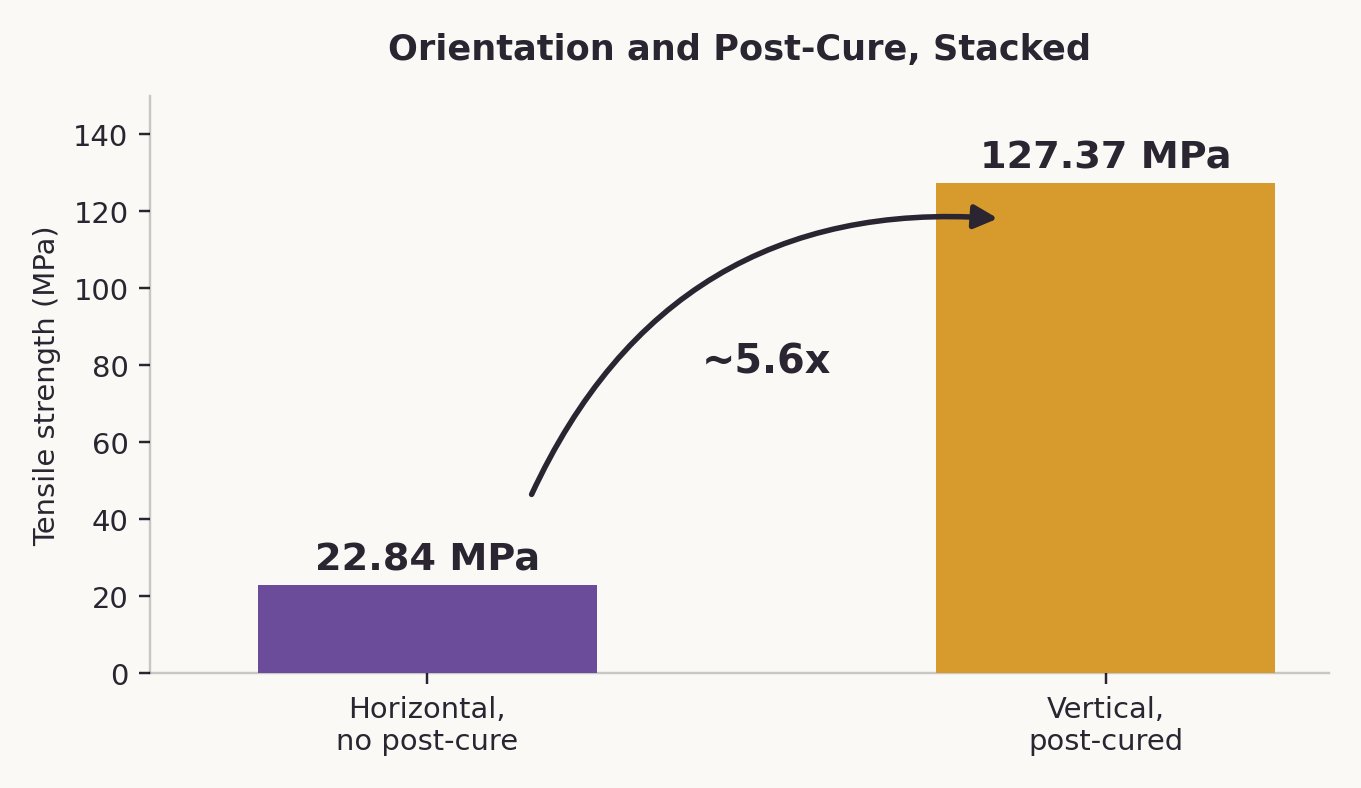
The mechanical payoff of closing that conversion gap is not subtle. In the same Scientific Reports dataset, a horizontally built specimen pulled straight off the printer with no post-cure measured 22.84 MPa in tensile testing. A vertically built specimen, post-cured at 80°C, measured 127.37 MPa, roughly five and a half times higher, per Cheadle et al. Post-curing also did something orientation alone could not: it largely erased the anisotropy between horizontally and vertically printed specimens, closing an elongation gap that ran from 84 percent to 64 percent in the green state down to a difference the study no longer found statistically significant. A denser, more fully crosslinked network resists deformation more evenly regardless of which direction the layers ran, because there are simply fewer weak, under-bonded regions left for a crack or a slip plane to exploit.
None of this means more cure is always better. Conversion approaches an asymptote, per the resin’s own chemistry and the accessible bonding sites remaining in the network, and pushing well past that point mostly adds side effects: the same Scientific Reports study recorded yellowing that climbed from a b* value of 3.60 in an untreated vertical sample to 10.38 after 90 minutes at 80°C, and 3DMag’s guide notes that continued UV exposure past a resin’s tolerance increases shrinkage, dimensional deviation, and brittleness rather than strength. The mechanism holds cleanly up to the point where nearly all accessible monomer has reacted; past that, the energy still going into the part has nowhere productive left to go. That is also why total cure time alone is a poor control variable. Wavelength has to match what the photoinitiator actually absorbs, irradiance at the part’s surface matters more than a lamp’s rated wattage, and a translucent resin heats and cures differently through its cross-section than an opaque one. Treating post-cure as a fixed number of minutes, instead of as a chemical reaction with its own completion curve, is the most common way a genuinely strong resin gets sold short.