
A printed ceramic part starts life as a loose arrangement of grains held together by almost nothing. In binder jetting, a polymer binder wicks between powder particles wherever the printhead deposits it. In vat photopolymerization, a UV-curable resin locks ceramic particles into a solid green shape one exposed layer at a time. Neither process applies the kind of mechanical force that presses powder into a dense compact, and that absence is the root of a problem every printed ceramic has to overcome before it can be called finished.
Green density, the fraction of theoretical solid density present right after printing, sets a hard ceiling on everything downstream. Sintering can shrink pores and pull grains together through diffusion, but it cannot conjure mass that was never packed in. A recent literature review of binder jetting density traces this directly to how loosely powder settles in the build box: without applied stress, particles bridge and arch around each other instead of nesting tightly, leaving green densities well below what a pressed or cast ceramic would achieve. The fix isn’t exotic. It’s mechanical, and it happens after printing but before firing.
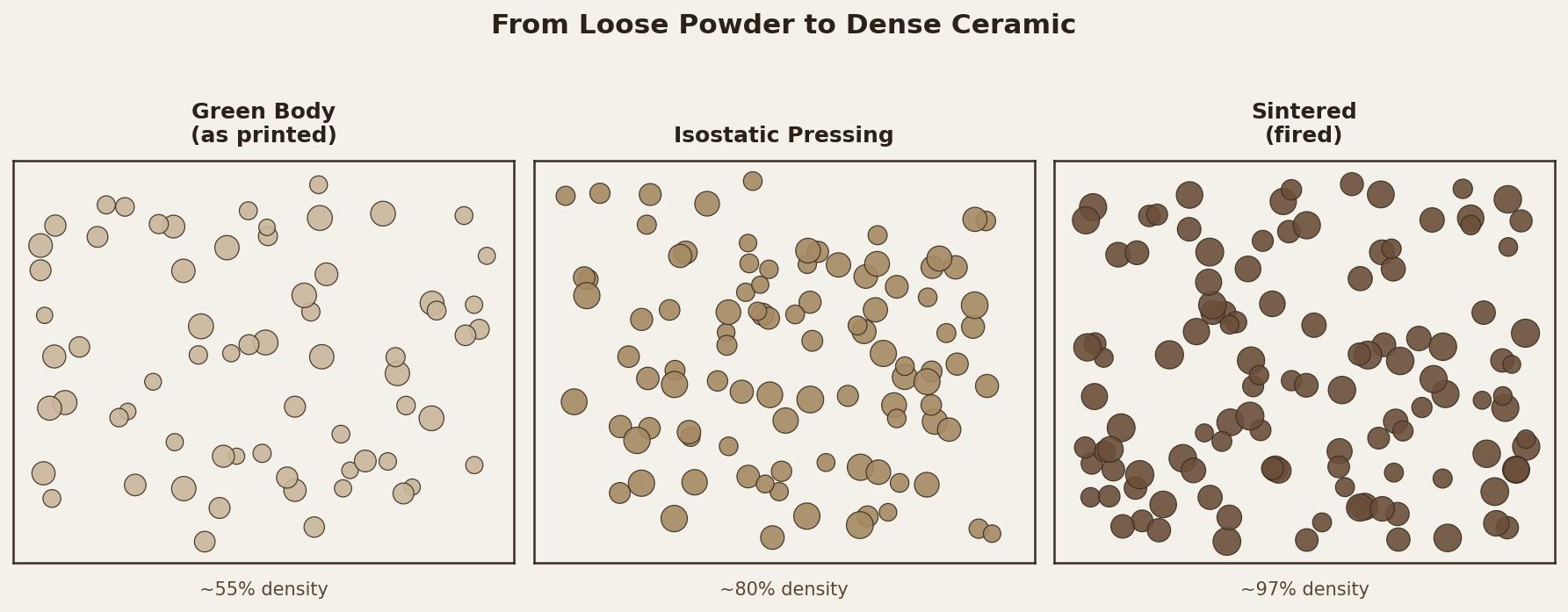 Packing density climbs in stages: as-printed, after isostatic pressing, and after firing.
Cold isostatic pressing applies uniform hydrostatic pressure to the green body from every direction at once, collapsing the arches that formed during printing and forcing particles into closer contact. The effect on final density is large. Reported gains push sintered density from around 65% up past 94% for some ceramic systems once cold isostatic pressing is added to the process chain, and warm isostatic pressing has taken aluminum oxide parts from roughly 34% green density to better than 99% dense after firing. These numbers matter because ceramic strength scales steeply with residual porosity; a part sintered from a poorly packed green body will fracture at a fraction of the stress a fully dense one can carry, because pores concentrate stress and act as crack initiation sites under load.
Vat photopolymerization takes a different route to the same problem and, in some respects, an easier one. Because the ceramic particles are suspended in a liquid resin rather than dry-packed as powder, the slurry’s solids loading, particle size distribution, and dispersant chemistry can be tuned before a single layer is cured. A 2025 study on photosensitive resins for alumina printing found that resin composition alone shifted post-sintering porosity from over 40% down to the low teens, purely by changing how tightly particles pack in suspension and how cleanly the polymer burns out during debinding. That debinding step deserves its own attention: heat the green body too fast and trapped binder gas creates internal cracks before the ceramic ever reaches sintering temperature, undoing whatever packing advantage the slurry achieved.
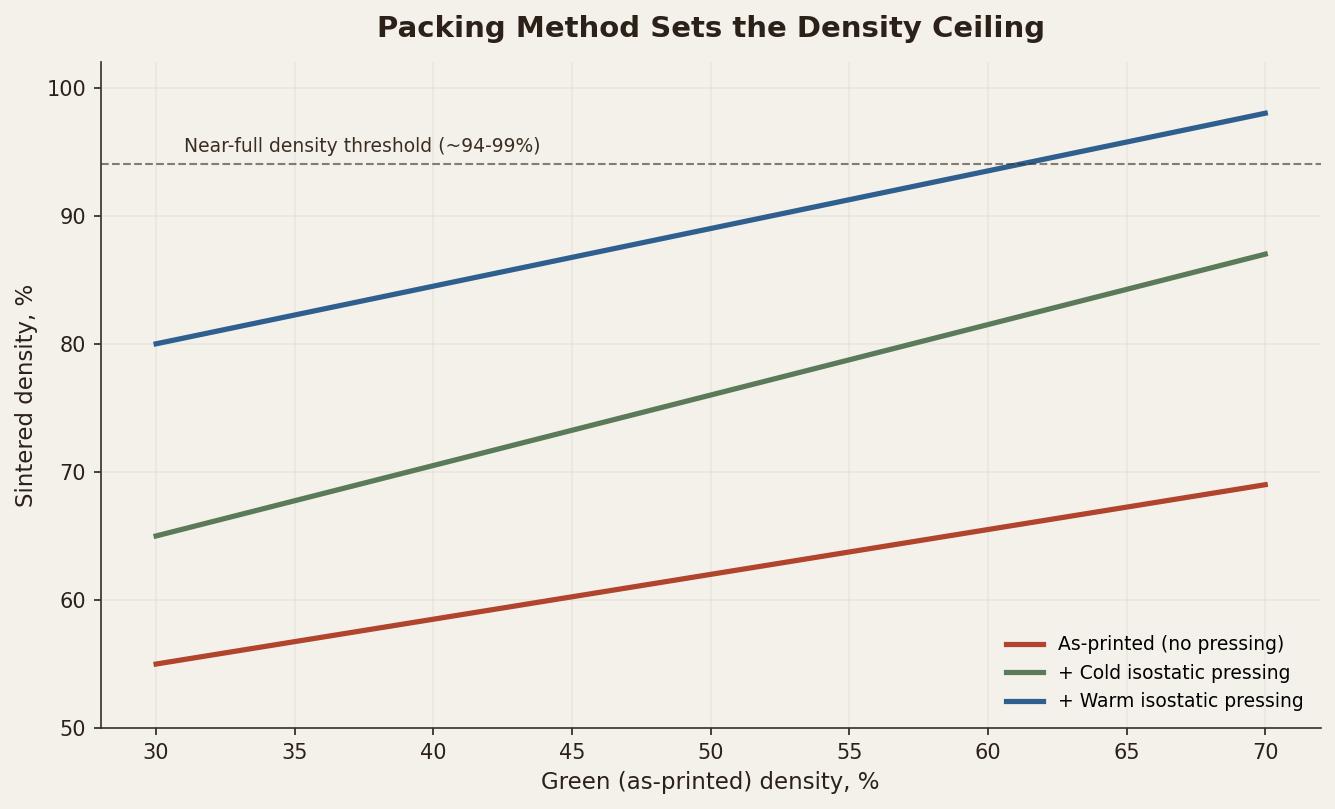 Isostatic pressing shifts the entire density curve upward before a part ever reaches the furnace.
Both process families converge on the same physical logic once particles are in contact and heat is applied. Sintering proceeds through solid-state diffusion, atoms migrating along grain boundaries and across pore surfaces toward lower-energy configurations, and that migration only closes pores that are small enough and close enough to begin with. This is why the packing step upstream matters more than sintering temperature or dwell time; you can compensate for a mediocre furnace schedule, but you cannot fully compensate for a green body that started 30 percentage points below full density. A broader review of binder-jetted advanced ceramics frames this as the field’s central engineering problem for 2025 and beyond: not whether printed ceramics can reach the densities of conventionally formed parts, but which combination of powder chemistry, packing method, and thermal schedule gets there most reliably for a given geometry.
The practical upshot for anyone specifying printed ceramic components is that density is now a controllable output, not a fixed limitation of the process. A 2025 review of vat photopolymerization for advanced ceramics notes that near-fully-dense alumina and zirconia parts are routinely reported in current literature, a marked shift from a decade ago when porosity was treated as an unavoidable tax on printing over casting. What’s left is largely a matching problem: pairing the right densification strategy to the ceramic system and part geometry in front of you, rather than accepting whatever density the printer happens to deliver.