
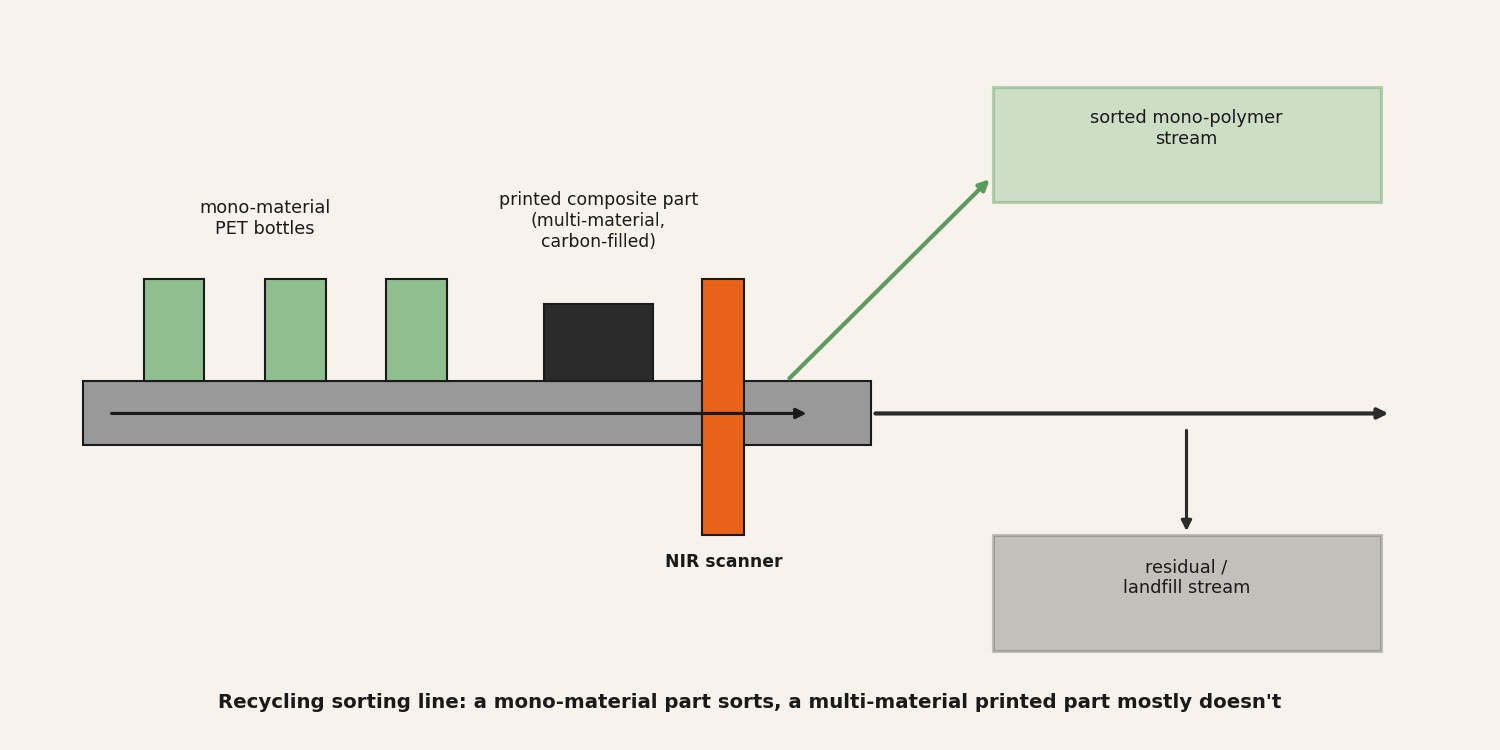
 A part built from one material sorts. A part built from several, on purpose, mostly doesn’t.
Additive manufacturing’s sustainability case has always rested on the production side of the ledger. Formlabs puts it plainly: printing “uses only the necessary material,” against subtractive processes that remove stock to get to a shape, and its own SLS process reclaims unused powder between batches. Add on-demand production, which trims the inventory a manufacturer has to build and eventually discard, and the pitch writes itself. None of that is wrong. It is also only half the balance sheet, because it stops at the moment the part leaves the machine and says almost nothing about what happens once that part is done being useful. That second half turns out to run on entirely different economics, and additive manufacturing’s own selling points work against it.
Most municipal and industrial recycling streams sort plastic with near-infrared spectroscopy. A sensor bounces infrared light off each item moving down a conveyor, reads the wavelengths it reflects back, and matches the pattern to a known polymer before an air jet diverts it into the right stream. It’s fast and cheap at scale, and it depends entirely on an item being one identifiable material. Meyer Europe notes that consumer packaging already strains this with layered PET, HDPE, and PP combined in a single item, since “different polymers have incompatible properties” that “create structurally weak materials with poor mechanical properties” if melted together unsorted. Carbon black, meanwhile, absorbs the infrared wavelengths NIR depends on, which is why the industry calls black plastic recycling’s blind spot: the sensor simply can’t see it. A carbon-fiber-filled printed part is, by the two things that make it a good engineering choice, close to worst-case for this system. It is deliberately multi-material by design, and its reinforcement is frequently black.
Assume a part clears sorting and gets shredded back into feedstock anyway. Filament-based recycling still runs into a hard ceiling. A 2023 review in Polymers on recycling fused filament fabrication composites found that reprocessing degrades polymer chains through scission, and that PLA specifically “could only be reprocessed two times, as the third printing cycle failed.” Reinforcing fillers make this worse, not better: they act as pinning points that restrict chain mobility, promote unwanted crystallization, and in some polymers catalyze hydrolytic degradation. Fibers fare no better mechanically, breaking on impact with processing equipment until their aspect ratio drops too low to transfer load into the matrix. The same review puts current mixed-waste sorting technology at 60 to 65 percent purity for a single-polymer output stream, well short of what a closed loop needs to run indefinitely.
 Recovering carbon fiber from a cured composite works chemically. Getting enough of it to one facility is the part nobody has solved.
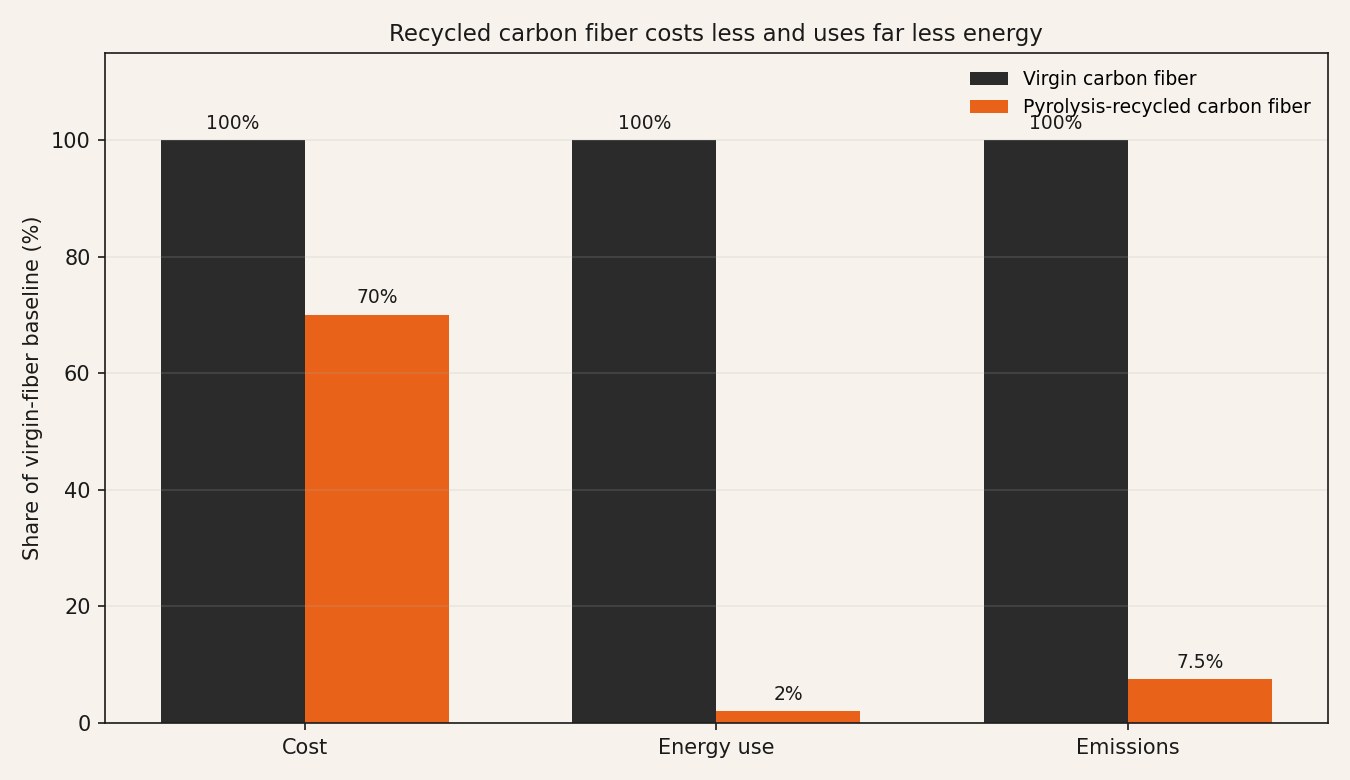
Carbon fiber composites specifically don’t recycle by shredding at all, because a cured thermoset matrix can’t be remelted the way a thermoplastic can. The fiber has to be recovered instead, and pyrolysis is the leading method: heat the composite without oxygen to break down the resin, then apply high-temperature oxidation to burn off the char left clinging to the fibers. ASME reports that fiber recovered this way keeps enough strength to reuse, costs roughly 70 percent of virgin fiber, and needs 98 percent less energy while cutting emissions 90 to 95 percent. Those are genuinely strong numbers. They are also numbers built around aerospace and automotive waste streams, where a single manufacturer generates enough scrap composite to fill a pyrolysis furnace on a predictable schedule. A print farm’s or a job shop’s scattered, low-volume composite waste doesn’t look anything like that, and nobody has built the collection logic to aggregate it into something a furnace operator would bother running.
Regulation hasn’t closed that gap either. The EU’s Ecodesign for Sustainable Products Regulation, which the European Parliament describes as requiring products to be “easier to repair, upgrade, recycle,” currently names textiles, furniture, steel, and chemicals among its priority categories. Composites and printed parts appear nowhere on that list yet. Until a rule forces a designer to plan for what a fiber-reinforced bracket becomes after decommissioning, that question stays optional, and optional questions lose to ones with a deadline attached.
None of this is a materials-science problem waiting on a better polymer or a smarter sensor. The chemistry to recover carbon fiber at a fraction of virgin cost already exists, and NIR sorting already works extremely well for the mono-material waste it was built around. What’s missing is volume in the right place: a furnace that runs on aggregated composite scrap, a sorting line built to route multi-material items instead of rejecting them, a regulation that assigns the cost of end-of-life to the part’s design rather than to whoever’s holding it when the machine that made it is long gone. Additive manufacturing earned its efficient-at-the-machine reputation honestly. Efficient-after-the-machine is a different ledger, running on different economics, and right now almost nobody is paying into it.