
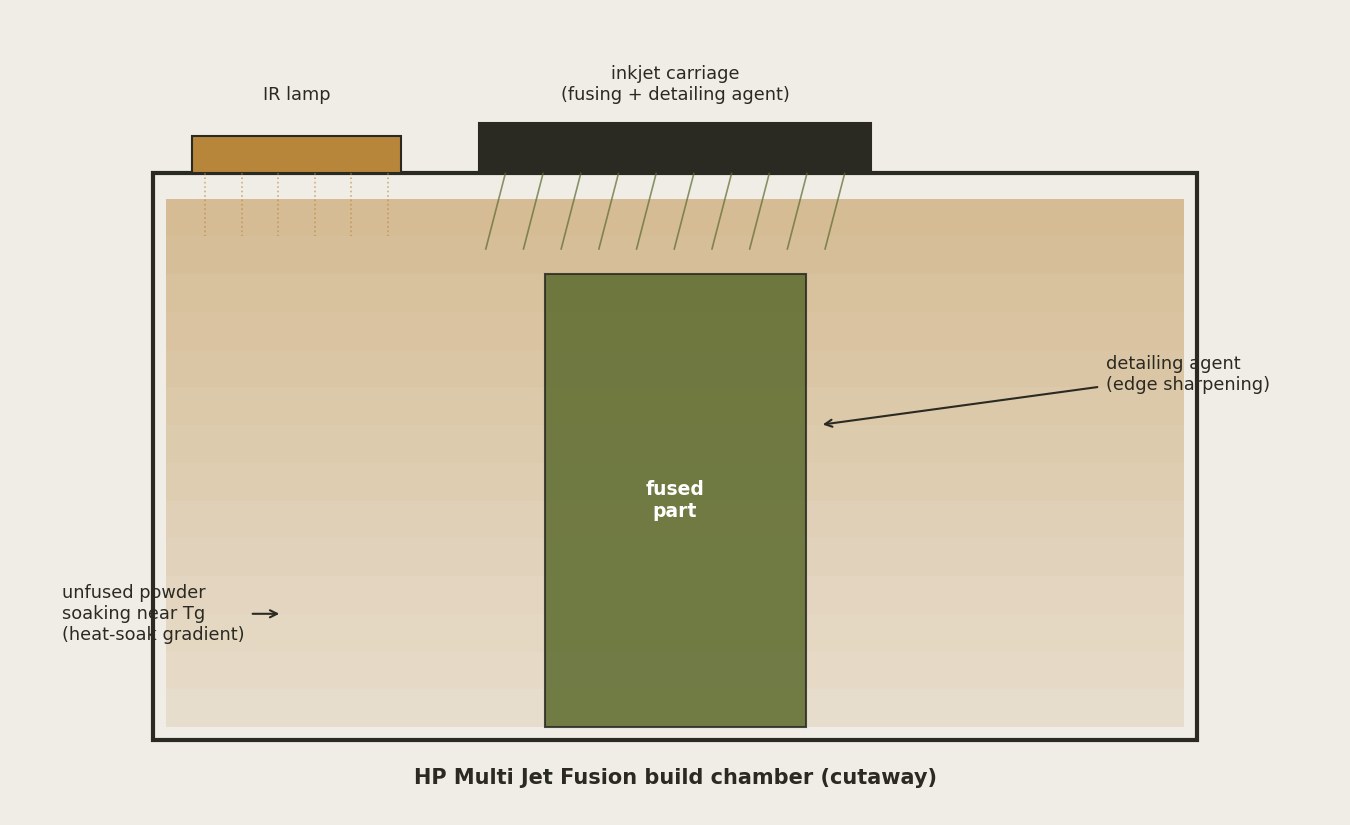
 How a Multi Jet Fusion build chamber distributes heat: fused layers absorb energy from the fusing agent, while the surrounding powder soaks in ambient heat for the length of the entire build.
A Multi Jet Fusion machine builds a part the way a pipe carries pressure: everything downstream of the source feels some fraction of it, whether it was meant to or not. An inkjet array deposits a carbon-based fusing agent onto the powder bed in the shape of the current layer, then a detailing agent along the part’s edges to sharpen the boundary and limit heat bleed. An infrared lamp passes overhead, and the fusing agent absorbs that radiation far more efficiently than bare nylon powder does, driving the coated region past its melt temperature while the untouched powder around it stays just below. That temperature gap, not a physical barrier, is what holds the part’s shape. The surrounding powder is doing real structural work as a support medium, which is why Multi Jet Fusion needs no scaffolding the way FDM or SLA does.
The catch is that “just below melt temperature” is still hot. A build can run for hours, and every particle of PA12 sitting in the bed, fused or not, spends that whole time soaking near its glass transition point. Heat drives oxidation and chain scission whether or not the fusing agent ever touches a given grain. So when the build finishes, the operator isn’t holding two categories of powder, virgin and used. They’re holding a spectrum of thermal histories, and only the top few millimeters ever got cold fast enough to matter.
That is the actual problem a refresh ratio solves. Shops running MJF routinely blend a majority of reused powder back into a job, with practical mixes running around 80 percent reused material to 20 percent virgin, and HP’s own high-reusability grade is built around sustaining up to 80 percent reuse without a mandatory full dump. The assumption behind any refresh ratio is that aged powder degrades enough to need dilution.
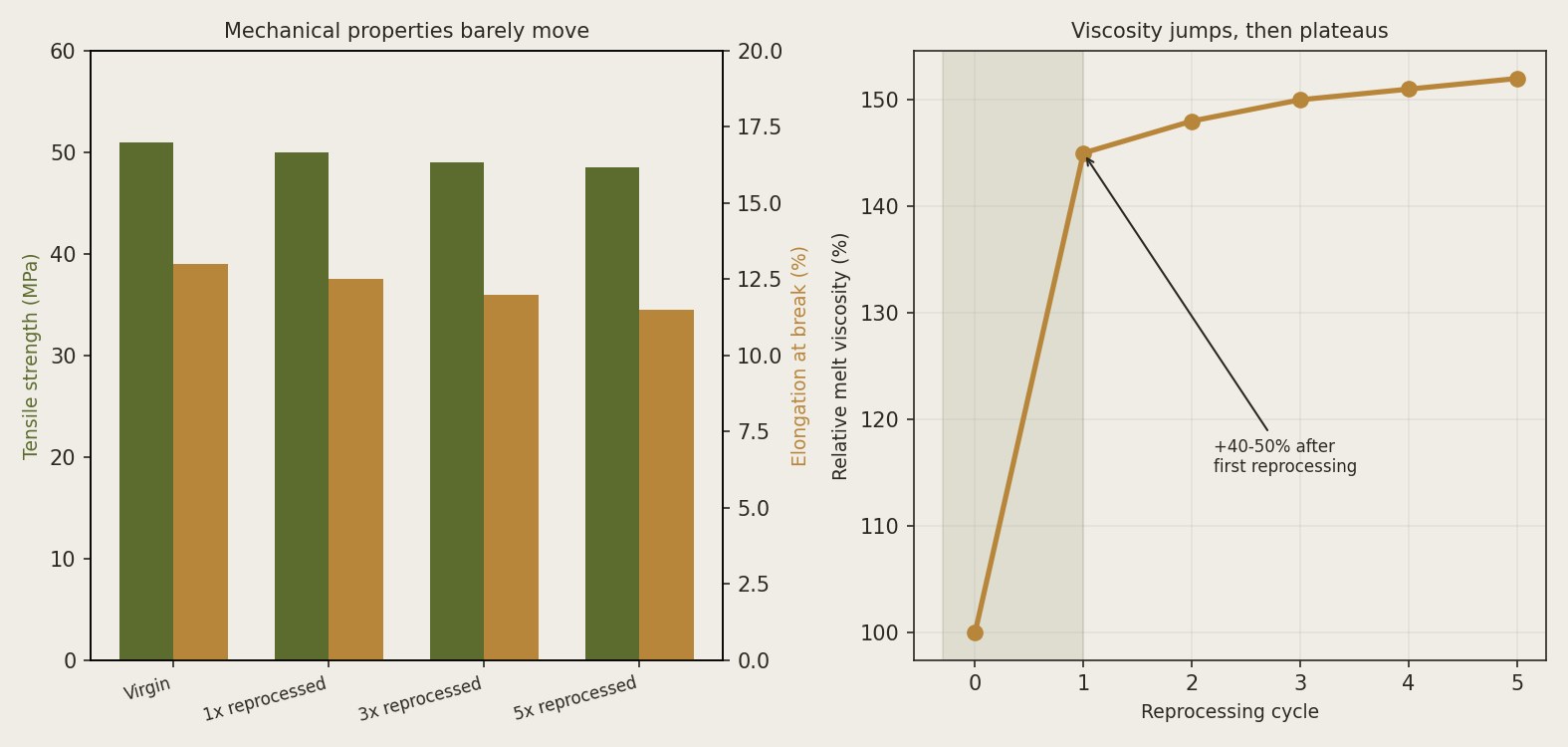 Mechanical properties barely move between virgin and heavily reprocessed powder, even as melt viscosity climbs after the first reprocessing pass and stays up.
That assumption turns out to be only half right. A study that built and tested PA12 across five full reprocessing cycles, mixing virgin and aged powder in ratios from 0/100 to 100/0, found exactly the chemistry you would expect: melt viscosity climbed 40 to 50 percent after the first reprocessing pass, and molecular weight shifted with it, both clear signs of thermal degradation (Analysis of material aging and the influence on the mechanical properties of polyamide 12 in the Multi Jet Fusion process). But tensile strength held flat near 45 to 53 MPa across every aging state and every mixing ratio, elongation at break stayed in a tight 9 to 15 percent band with no trend, and impact resistance showed scatter but no decline. The chemistry aged. The finished part, on a test frame, did not, a split the same study notes runs opposite to what powder aging typically does in laser sintering.
Put a coupon from a fresh build next to one printed from heavily reused powder and a tensile tester will not tell you which is which. What it will tell you is that MJF parts are already anisotropic before powder age enters the picture: measured tensile strength runs 48 to 52 MPa and elongation 15 to 22 percent depending on orientation, well short of injection-molded PA12’s elongation past 50 percent. Layer orientation, not the refresh ratio on the powder hopper, is the variable actually setting the ductility ceiling.
None of this is visible on the part itself. PA12 comes out of an MJF machine a uniform gray regardless of how many times that batch has been through the chamber, so there is no color cue warning an operator that a bin is nearing its practical limit. The refresh ratio, in other words, is not protecting the numbers a tensile test would catch. It is protecting something upstream of mechanical performance entirely: particle size distribution and powder flowability, the properties that determine whether a recoater blade can lay down a clean, dense layer at all. Push viscosity and molecular weight far enough with too little virgin powder folded back in, and the failure shows up first as poor spreading and porosity, not as a tensile number sliding down a chart. That is where this mechanism’s limit actually sits, and it is a layer-quality problem long before it becomes a materials-science one.