
Additive manufacturing is routinely marketed as inherently sustainable: build only what is needed, waste little material, and - in principle - feed a part back into the machine as feedstock for the next one. The last claim is the least settled. Whether a thermoplastic can be reprocessed through repeated extrusion-and-print cycles without losing the mechanical performance that made it useful in the first place depends on polymer chemistry that does not care about the circular-economy narrative built on top of it.
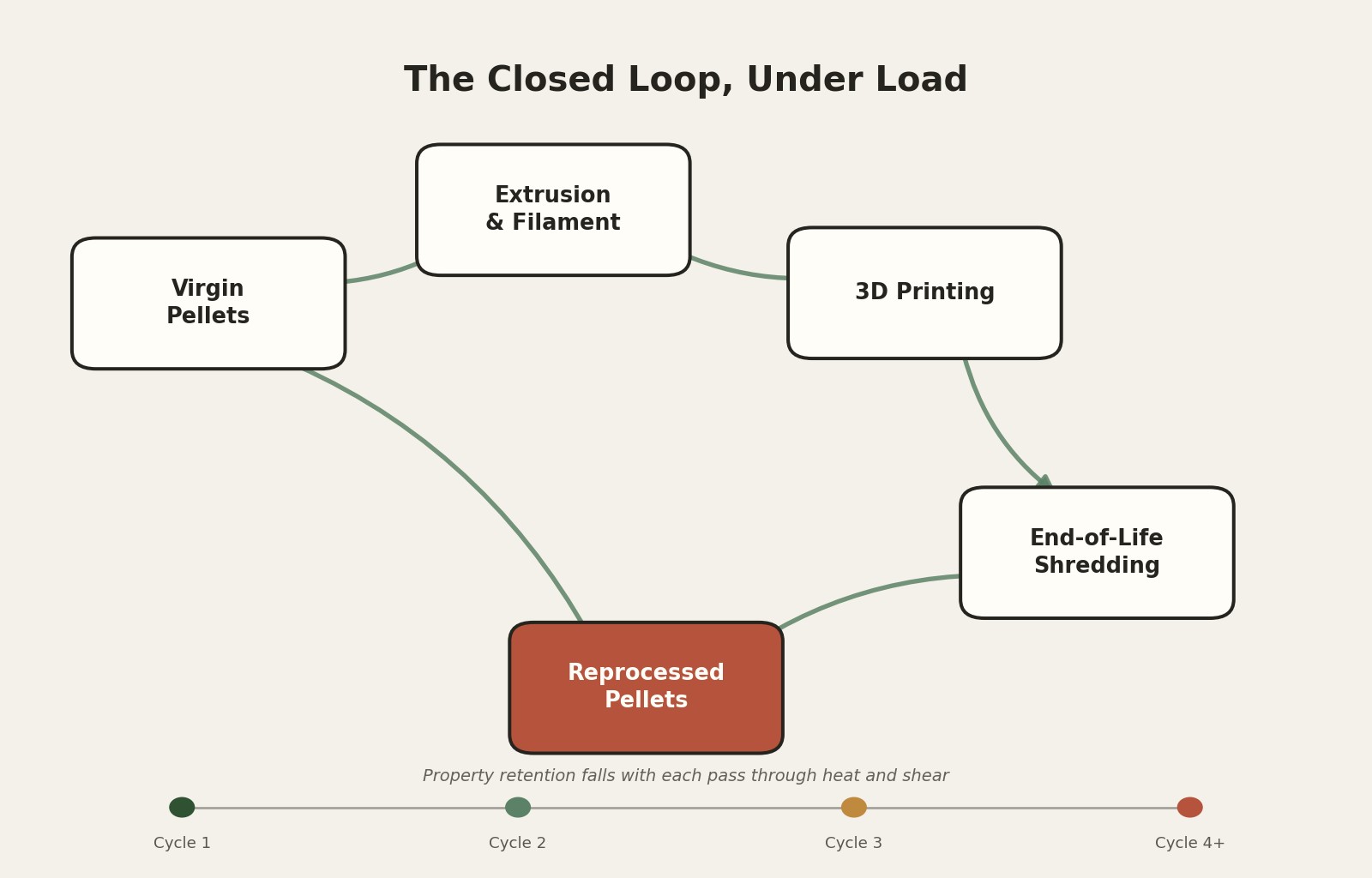 Recycled thermoplastic feedstock moves through a shortened loop compared to virgin material, but each pass through heat and shear extracts a cost the loop diagram alone doesn’t show.
The mechanism is straightforward thermomechanical degradation. Every extrusion and printing cycle exposes a polymer to heat and shear stress, and for polylactic acid - the most common desktop filament - this drives chain scission: covalent bonds along the polymer backbone break, molecular weight falls, and the material’s viscosity and crystallinity shift as a result. A study tracking recycled PLA through successive fused filament fabrication cycles found measurable reductions in molecular weight alongside increased crystallinity, changes that trace directly to tensile strength and impact performance (PMC, 2022). The practical consequence is a hard ceiling on how many times a given batch of material can be reprocessed. Multiple studies converge on a similar number: common desktop thermoplastics such as PLA, ABS, and PA12 typically lose meaningful structural integrity after only one to three recycling cycles, a pattern found consistently enough across resin chemistries that it now reads as a property of thermoplastic reprocessing generally, not a quirk of any one material (ScienceDirect, 2023).
Not every polymer degrades at the same rate, and that variation matters more than the average. Recycled polycarbonate processed through FDM has been shown to retain 88 to 98 percent of virgin-material mechanical properties while cutting carbon footprint by roughly 70 percent and cost by up to 88 percent relative to virgin PC (ScienceDirect, 2025). That gap between PC’s near-parity performance and PLA’s rapid falloff after a handful of cycles means “recyclability” cannot be treated as a single property of additive manufacturing - it is a property of each resin’s specific chain chemistry, and any sustainability claim that doesn’t name the polymer is incomplete.
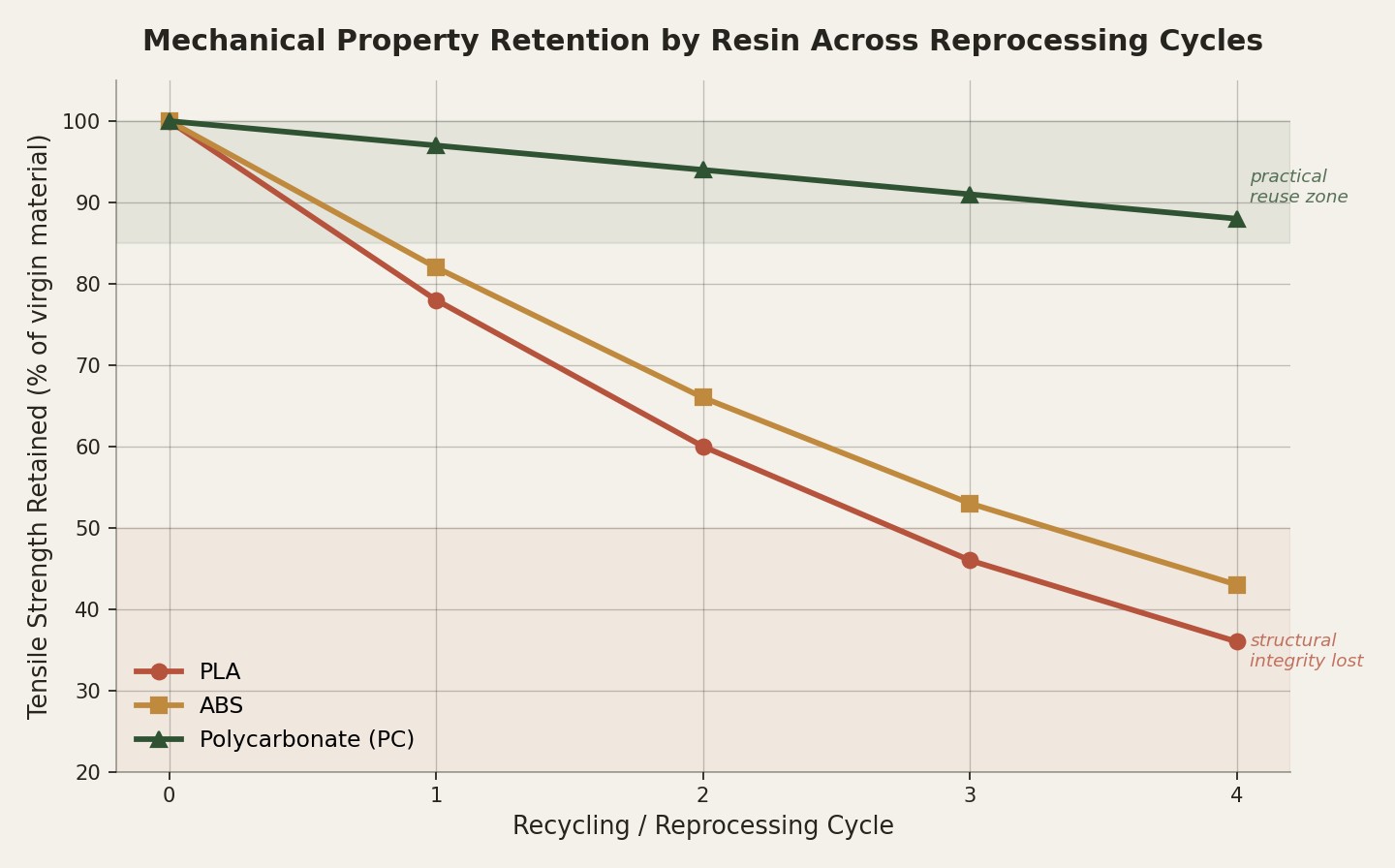 Mechanical property retention diverges sharply by resin: PC holds close to virgin-grade strength across cycles where PLA and ABS fall off within one to three passes, reflecting differences in chain scission susceptibility under repeated thermal-shear loading.
The systems-level implication favors decentralization over centralized recycling infrastructure. Distributed recycling by additive manufacturing - shredding and re-extruding waste plastic at or near the point of use rather than shipping it to a centralized reprocessing facility - has drawn research attention precisely because it shortens the loop to the number of cycles a given polymer can actually tolerate, and lets a community-scale operation match material batches to specific print jobs rather than blending an unknown recycling history into a single feedstock stream (PMC, 2023). That approach trades the economies of scale in traditional recycling for tighter control over material provenance, which turns out to be the more valuable property when the whole benefit of the loop depends on knowing how many times a given batch has already been through it.
None of this makes recycled feedstock a poor choice; it makes it a bounded one. The honest framing is closer to cascading than circular: PLA moves from precision parts toward less demanding printed goods across its viable cycles before the polymer chain degrades too far to be useful, while PC-type resins can sustain something closer to genuine reuse. Standardizing how recycled feedstock is characterized and labeled - cycle count, resin history, verified property retention - would let designers specify recycled material with the same confidence they specify virgin grades, which is the step still missing before circularity becomes a design input rather than a marketing claim.