
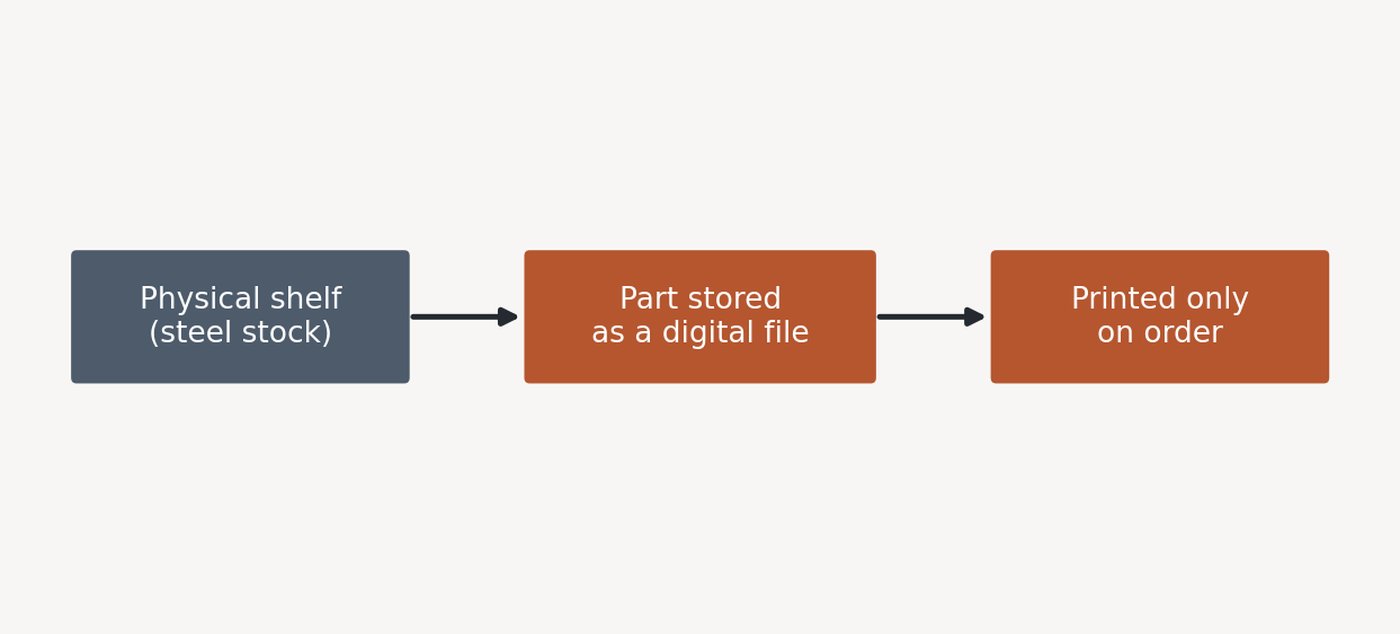
 A shelf of parts costs money every day it sits there. A file costs almost nothing until the day someone actually needs it.
A spare parts warehouse is a bet against time. You buy the bracket, the gasket, the impeller today, on the wager that a machine somewhere will fail and need it years from now, and you pay to store it for every one of those years in between. Most of that bet loses. Slow-moving inventory is capital sitting on a shelf, and for a part that fails once a decade, the shelf is where most of its economic life is spent. Additive manufacturing offers a different bet: keep the part as a file, and only spend material and machine time the day it is actually needed.
Deutsche Bahn has been running that experiment since 2015, and the scale is no longer a pilot. The German rail operator has produced over 100,000 components across more than 700 part types, ranging from a plastic coat hook to fan wheels, lamp brackets, and protective housings for signal boxes, at its own printing operations in Nuremberg and Neumünster along with external service partners, according to Deutsche Bahn’s own account of the program. The company is explicit about why: parts with long lead times, or that are no longer available at all, can be produced fast enough to get a train back in service instead of sitting in a depot waiting on a supplier. What is being stored is a digital file, not a physical casting, and the company says that shift makes holding rarely needed components economically and ecologically viable in a way that a warehouse full of them was not.
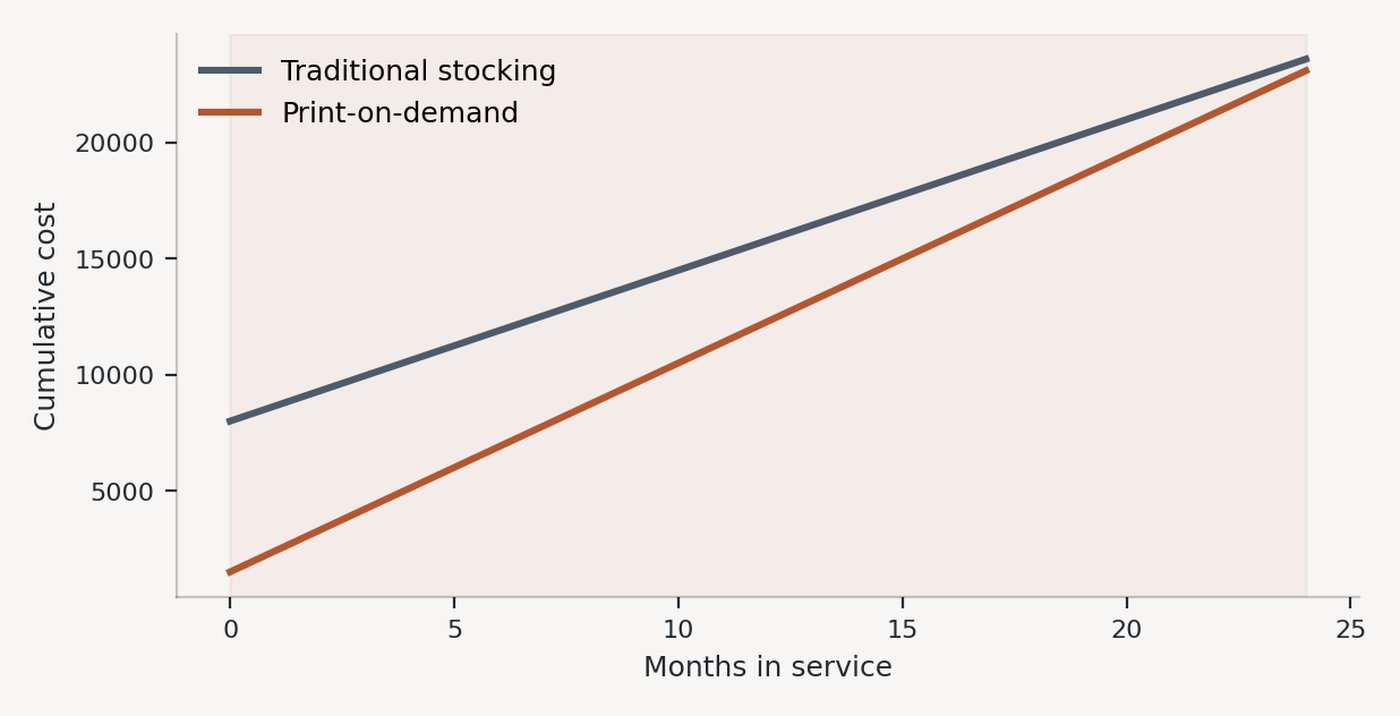 Stocking costs more upfront and keeps costing while a part sits on the shelf. Print-on-demand costs less to start and only adds up when a part actually gets made.
The economics only make sense for a specific slice of a parts catalog, and the failure modes matter as much as the successes. Arthur D. Little’s analysis of the transition describes a petrochemical firm that saved roughly $7,688 in its first year by printing a single blade used once annually, rather than buying it against a supplier’s ten-unit minimum order, a classic case of a low-volume part locking up capital it never needed to. The same analysis is direct about what does not translate: reverse-engineering a legacy part well enough to trust it, qualifying a material for extreme service conditions, and clearing OEM intellectual property and regulatory hurdles are real costs that can offset per-part savings before a single unit ships. A digital warehouse still has to be stocked with something, and building a trustworthy file of a forty-year-old part is not free.
Qualification is the bottleneck that decides which industries move first, and defense procurement is where that bottleneck is getting worked through most visibly. In 2023, NAVSEA approved a metal-printed drain strainer orifice assembly, a steam system component, for installation aboard the aircraft carrier USS Harry S. Truman, the first metal additively manufactured part cleared for that kind of shipboard service after material evaluation, welding, shock, vibration, and hydrostatic testing, as 3D Printing Industry reported at the time. Rear Admiral Lorin Selby framed the approval as a step toward making parts on demand rather than shipping them across an ocean, and the Navy’s own engineers noted that the point of the exercise was less about one part and more about establishing a specification path other components could follow. That is the real product of a program like this: not a strainer, but a repeatable qualification process that turns the next hundred parts into a faster decision.
None of this replaces bulk manufacturing, and it should not. A part with steady, predictable demand still belongs on an assembly line where unit economics beat any printer. What is changing is the long, thin tail of a maintenance catalog: the part that fails rarely enough that stocking it was always a loss, and expensive enough in downtime that not having it was worse. For that tail, the warehouse is becoming a server, and the shelf becomes a print queue. The manufacturers moving first are not the ones with the most printers. They are the ones willing to do the unglamorous work of qualifying which parts belong in the file cabinet and which still belong on the shelf.