
Metal additive manufacturing is often discussed as a single technology, but the three dominant processes — laser powder bed fusion (L-PBF), directed energy deposition (DED), and binder jetting — arrive at a fully dense part through unrelated physical routes, and the differences are not cosmetic. Each trades resolution, build rate, residual stress, and capital cost against one another in ways that determine which parts a given process can realistically produce, and mixing up the three in casual comparison obscures decisions that should be made early in a part’s design.
L-PBF spreads a thin layer of metal powder, typically 20-60 micrometers, across a build plate and selectively melts it with a scanning laser, repeating the cycle tens of thousands of times to build a part layer by layer. Because melting and rapid solidification occur nearly simultaneously within a submillimeter melt pool, cooling rates can exceed 10^5-10^6 K/s, producing fine, often metastable microstructures but also steep thermal gradients that drive residual stress and part distortion if left unmanaged. DED instead delivers metal as wire or powder through a nozzle into a melt pool created by a laser, arc, or electron beam, depositing material directly onto a surface rather than through a powder bed. The larger melt pool and lower surface-area-to-volume ratio give DED much higher deposition rates and the ability to build large-scale features or repair worn components, at the cost of coarser resolution and rougher as-built surfaces than L-PBF can achieve, as detailed in a recent head-to-head comparison of L-PBF and DED. Binder jetting departs from both by avoiding melting during the build entirely: an inkjet-style printhead selectively deposits liquid binder into a metal powder bed to form a “green” part, which is later sintered at high temperature to achieve density.
The sintering step is where binder jetting’s defining tradeoff appears. Green parts typically reach only 40-60% of theoretical density, and densification during sintering is driven by reduction in surface energy, with volumetric strain rate governed by porosity-dependent viscosity and grain size, as characterized in a study of supersolidus liquid phase sintering of binder-jetted steel. Linear shrinkage during sintering can reach roughly 25%, and because shrinkage is not perfectly isotropic — interlayer gaps accumulate unevenly with build height — predicting final part dimensions requires modeling anisotropic densification rather than assuming uniform contraction across every axis. This is the central engineering challenge of binder jetting: the process avoids the thermal distortion problems of laser-based methods, but shifts the accuracy burden downstream into a sintering-shrinkage compensation problem instead, one that must be solved computationally before the first part is ever printed.
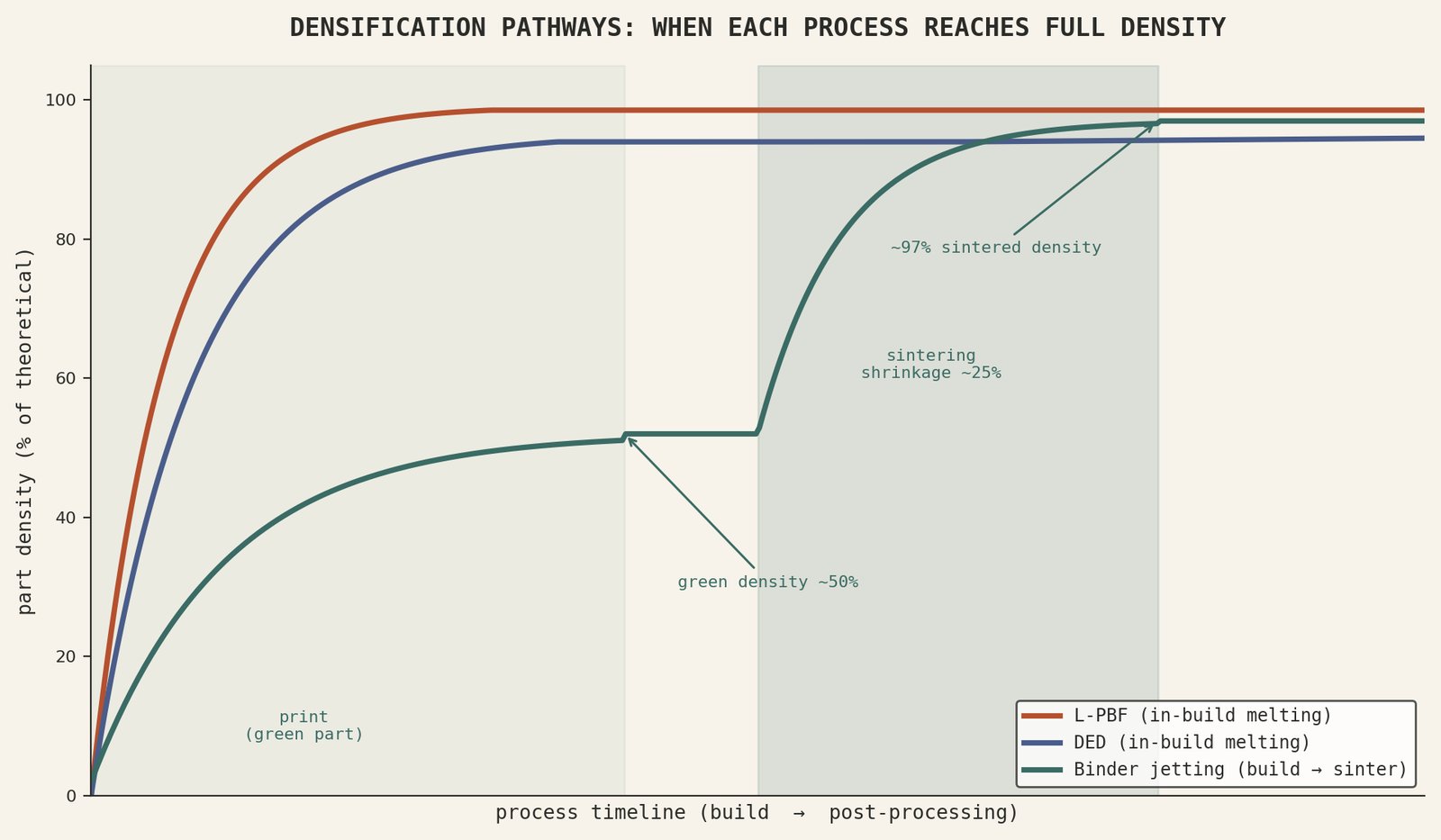 L-PBF and DED reach near-full density within the build itself, while binder jetting’s green part plateaus around 50% density and only closes the gap during a separate sintering step, with roughly 25% linear shrinkage along the way.
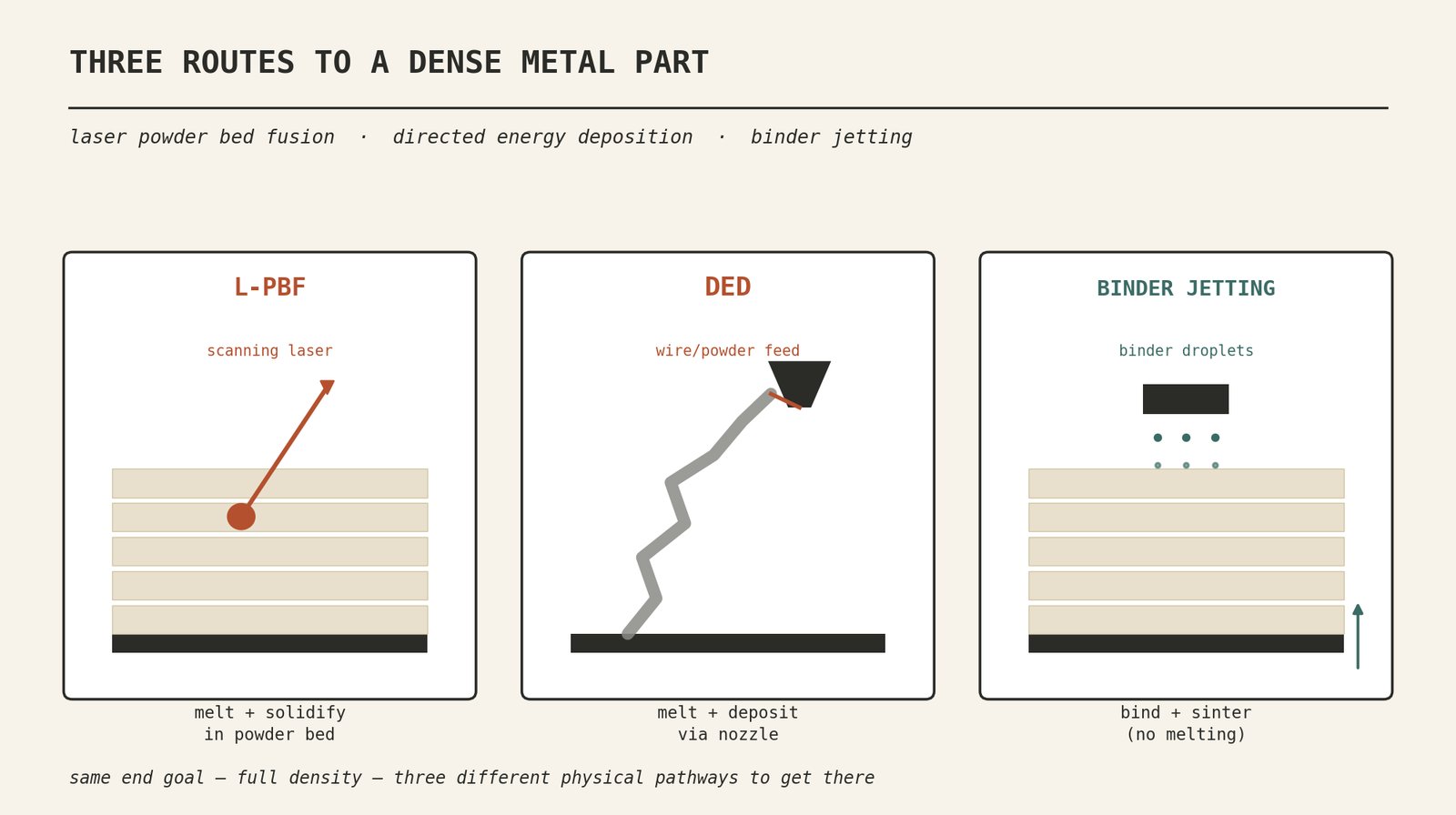 The three processes diverge at the build-mechanism level before densification ever enters the picture: L-PBF and binder jetting both spread and selectively address a powder bed, while DED delivers feedstock directly through a nozzle onto the growing part — the geometry of material delivery is what ultimately dictates each process’s resolution and scale.
These physical differences map onto where each process earns its capital cost. Because build size, feature resolution, and post-processing burden differ so sharply, direct process-cost comparisons show that L-PBF’s per-part cost is dominated by machine time and support removal, DED’s by feedstock and finishing allowances for its rougher near-net shape, and binder jetting’s by furnace cycles and shrinkage-compensated tooling, a distinction quantified in recent cost-modelling work comparing PBF and DED. Non-powder-bed approaches such as DED are increasingly favored where large scale or feature repair matters more than fine resolution, while powder-bed methods retain the accuracy needed for complex, small-to-mid-size components — a division examined in a recent review of non-powder-bed metal additive techniques. Binder jetting occupies a third niche again, favored where geometric complexity and moderate-to-high volume matter more than the finest achievable feature resolution.
None of the three processes is converging toward the others; if anything, the field is stratifying further as machine builders specialize hybrid systems — DED heads mounted on machining centers for repair and cladding, or binder-jetting lines paired with dedicated sintering furnaces tuned for specific alloys and part geometries. The practical consequence for a design engineer is that the process decision has to happen before the part is finalized, not after: geometry, tolerance requirements, and production volume dictate which of the three physical pathways to density is viable, and each pathway imposes its own downstream design rules on wall thickness, overhangs, and achievable tolerance.