
Open a generative design tool, type in a bounding box, a load case, and a couple of mounting holes, and a few minutes later you get back something that looks like a bone or a bit of coral. That resemblance isn’t decoration. It’s a side effect of how the software actually works, and it’s worth understanding before you trust one of these parts on a real machine.
Most people assume “generative” means the software is creatively exploring shapes the way a sculptor might. What it’s actually doing is closer to erosion in reverse. The tool starts with a dense block of material filling your design space and then, generation by generation, removes the material that isn’t carrying meaningful load, guided by an algorithm called topology optimization. A recent review in The International Journal of Advanced Manufacturing Technology traces this back to a simple optimization problem: distribute a fixed amount of material through a volume so that stiffness is maximized and stress is minimized, subject to whatever forces you’ve told it to expect. The organic, load-following shapes fall out of the math. Nobody drew them.
That distinction matters because it explains why generative design leans so heavily on additive manufacturing specifically. A milling machine or an injection mold can’t reproduce the internal cavities and curved struts that fall out of an unconstrained optimization, so for decades this kind of result was treated as a theoretical curiosity rather than something you could actually build. A review in Chinese Journal of Aeronautics makes the point plainly: additive manufacturing is what turned topology optimization from an academic exercise into a design tool, because layer-by-layer fabrication doesn’t care whether a shape is convex or has an internal void, only whether each layer has enough support beneath it.
That last clause is where the real engineering work hides, and it’s the part hobbyists and students tend to skip past. Raw, unconstrained topology optimization will happily hand you a part with a 70-degree overhang hanging in midair or a wall thinner than your printer’s nozzle can extrude. So modern tools bolt manufacturing constraints directly into the optimization loop rather than fixing the geometry afterward. Research on length-scale and overhang constraints shows how this works mechanically: a minimum feature size filter prevents the algorithm from proposing struts too thin to print reliably, while an overhang penalty discourages unsupported geometry before the shape is even finalized, rather than flagging it after the fact in a slicer. Think of it the way a good recipe accounts for your oven’s quirks instead of handing you a method that only works in a lab. The optimizer isn’t just solving physics anymore, it’s solving physics constrained by what your particular process can actually deposit.
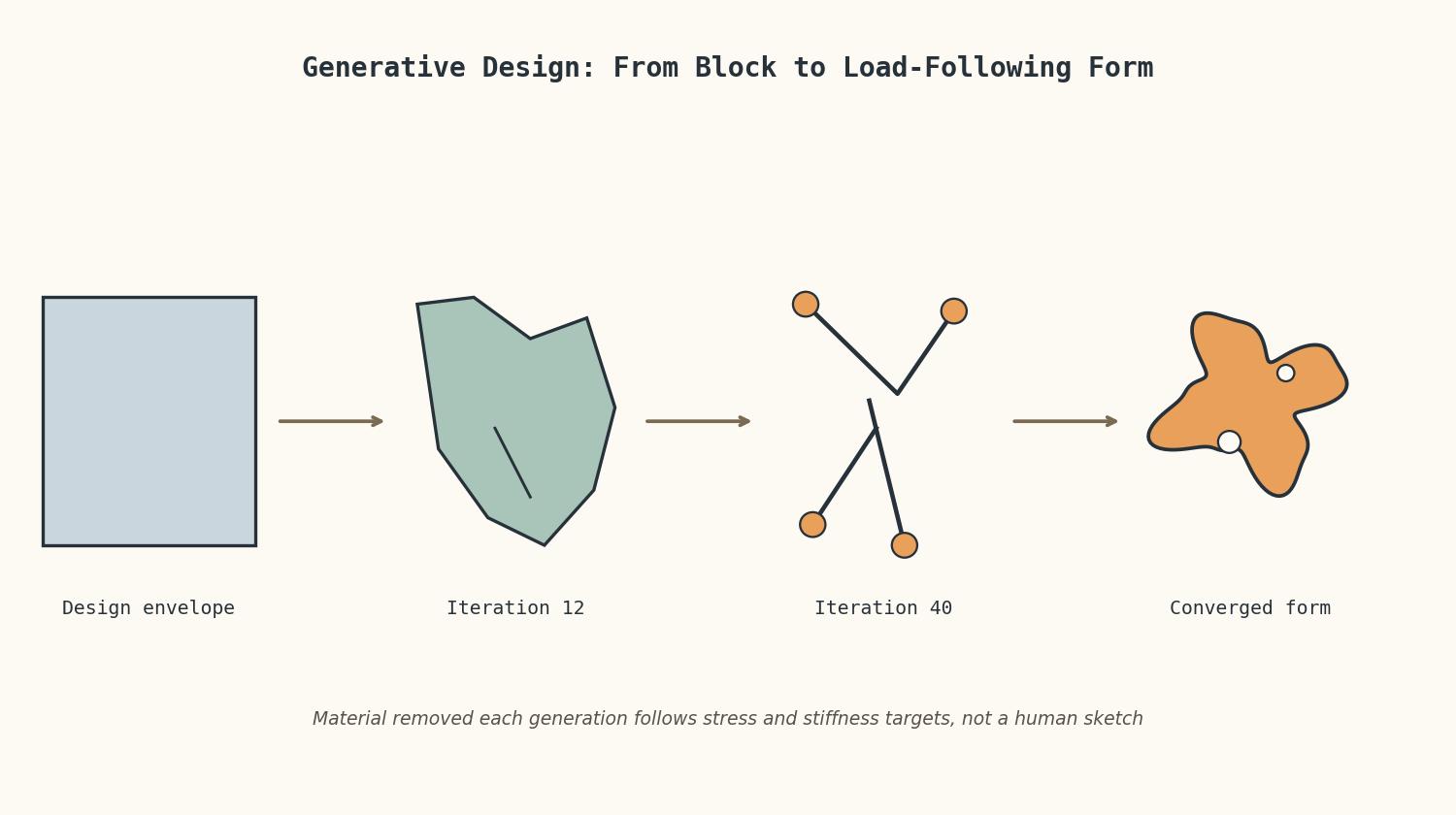 Image 1: A generative design workflow showing a solid design envelope progressively eroded into a load-following lattice structure across optimization iterations.
This is also why two engineers running the “same” generative design job on the same part can get meaningfully different results. Mesh resolution, the chosen optimization algorithm (density-based methods and level-set methods handle the boundary between solid and void quite differently), and which manufacturing constraints get toggled on all shape the final geometry, sometimes dramatically. A broader survey of the field in the International Journal for Simulation and Multidisciplinary Design Optimization notes that this sensitivity is a known open problem, not a bug specific to any one tool, and it’s part of why generative outputs still get validated with conventional finite element analysis before anyone trusts them on a real part.
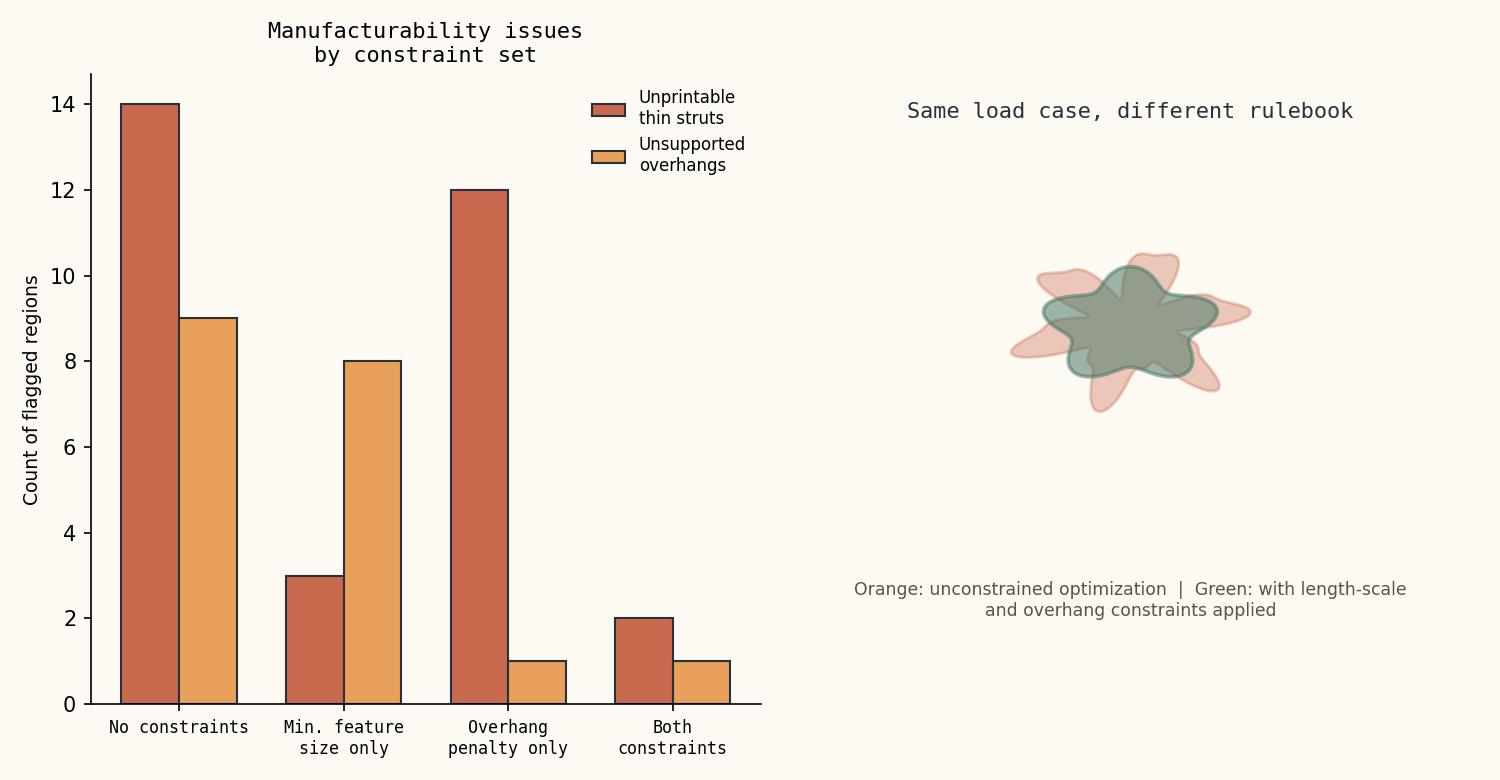 Image 2: A comparison chart showing how minimum feature size and overhang-angle constraints reshape the same optimization problem’s final geometry.
None of this makes generative design a black box you should distrust wholesale. It means the organic shape on your screen is an argument, not a guess, built from a load case, a material model, and a manufacturing rulebook you can actually inspect and adjust. Next time one of these designs looks strange to you, it’s worth asking which constraint produced that particular curve. Usually there’s a good answer, and finding it teaches you more about your printer’s real limits than any spec sheet will.