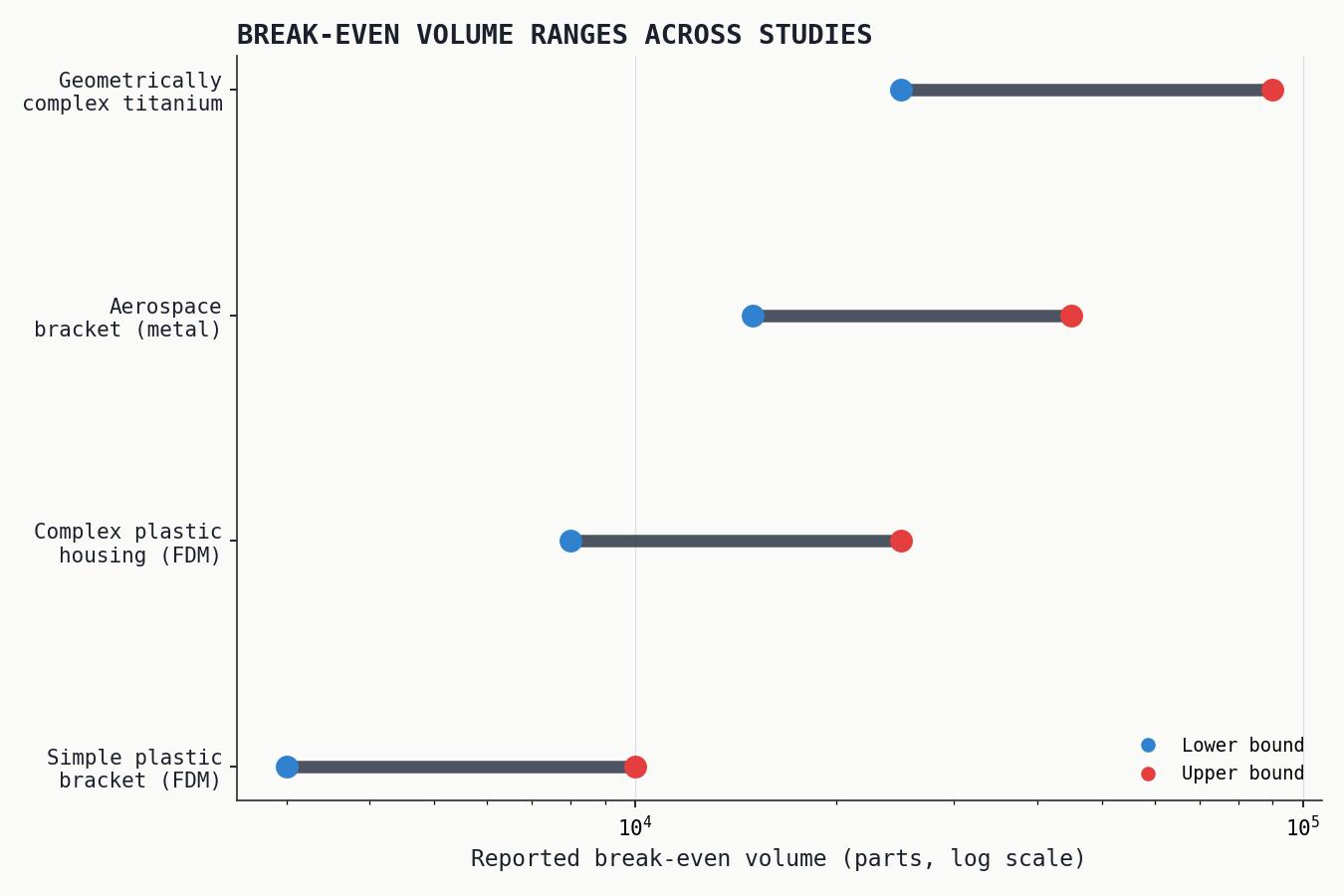
Every manufacturing engineer eventually runs the same calculation: at what quantity does it stop making sense to print a part and start making sense to tool up for it. That number isn’t fixed. It moves with part geometry, material, labor rates, and how much a company values flexibility over unit cost. But the shape of the calculation is now well understood, and it’s reshaping where additive manufacturing actually gets deployed on factory floors.
The clearest recent data point comes from a 2023 study in Polymer Engineering and Science, where Kazmer and colleagues directly compared injection molding against material extrusion 3D printing using production-representative machines and a controlled energy-consumption protocol. Their break-even point for cost, once mold amortization is factored in, landed around 79,000 parts using cold-runner tooling. Below that volume, printing wins on total cost even though its per-part material and labor costs are individually higher. Above it, the economics flip hard, because a mold’s fixed cost gets spread across enough units that its contribution per part shrinks toward zero. Printing carries no such curve. Its cost per part stays roughly flat whether you make ten units or ten thousand, since there’s no tool wearing in and no setup to amortize.
That flatness is the whole strategic case for AM, and it’s also its ceiling. Douglas Thomas’s supply chain analysis for NIST, still one of the most cited economic treatments of the technology, frames this as a tradeoff between centralized, high-volume efficiency and distributed, low-volume responsiveness. Traditional tooling wins the race to the bottom on unit cost at scale. Printing wins the race to first part, and it keeps winning every time a design changes, because there’s no new mold to cut. For a company running frequent design revisions, low-mix high-variety production, or spare parts for equipment that’s been in the field for twenty years, that flexibility is worth real money even when the sticker price per part looks worse on paper.
This is exactly why aerospace and dental have become the two industries where AM adoption runs well ahead of the general manufacturing base. Aerospace brackets are made in the hundreds, not the hundreds of thousands, and a design change that would mean re-cutting a mold instead means reslicing a file. Dental aligners and surgical guides are, by definition, a batch size of one per patient. Both sectors sit so far on the low-volume, high-complexity side of the break-even line that the traditional tooling comparison barely applies. Automotive and consumer goods, by contrast, mostly live on the other side of that line, which is exactly why AM’s footprint there is still concentrated in jigs, fixtures, and prototypes rather than final production parts.
Where this gets genuinely interesting is in how inconsistent the published break-even numbers are once you widen the lens. A 2025 systematic review in the Rapid Prototyping Journal surveyed 255 studies on AM economic feasibility and found the field still lacks a single agreed cost model, largely because deposition rate, feedstock price, and post-processing burden vary so much by process and part. A crossover point measured in the tens of thousands for a simple plastic bracket looks nothing like the crossover for a geometrically complex titanium bracket, where machining waste and tooling complexity push the break-even for AM much higher. Complexity, not just volume, is doing real work in these models. A part that would need five-axis machining and custom fixturing to produce conventionally can favor printing even at volumes where a simple part would already have flipped to molding.
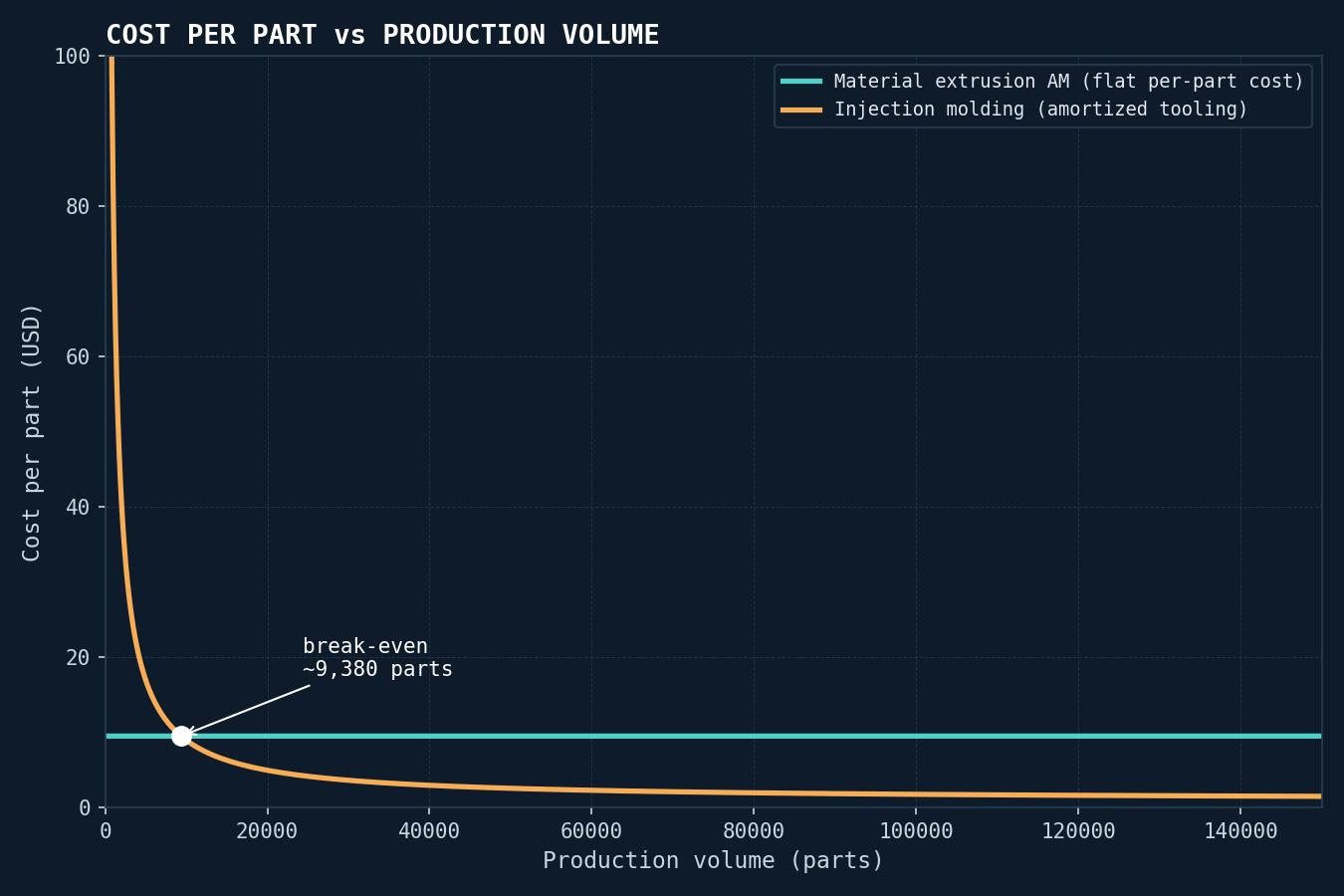
The practical upshot for production planners is that the break-even threshold isn’t a number to memorize, it’s a calculation to run per part, weighing geometry, expected volume, and how often the design will change. Companies that treat AM as strictly a prototyping tool are leaving money on the table on the low-volume, high-complexity side of that line. Companies that treat it as a wholesale replacement for tooled production are ignoring how badly the economics turn against them once volume climbs past that same line. The technology’s real commercial value sits precisely in knowing, part by part, which side you’re on, and being disciplined enough to route production accordingly rather than defaulting to whichever method the last job used.