
Hybrid manufacturing systems that combine directed-energy deposition (DED) with in-envelope milling on a single fixture have moved from research cells to production floors over the past several years. The appeal is straightforward: build near-net-shape geometry additively, then finish critical features without ever removing the part from the machine. What is less straightforward is what happens to the material in between — because the two processes leave behind very different, and interacting, residual stress states.
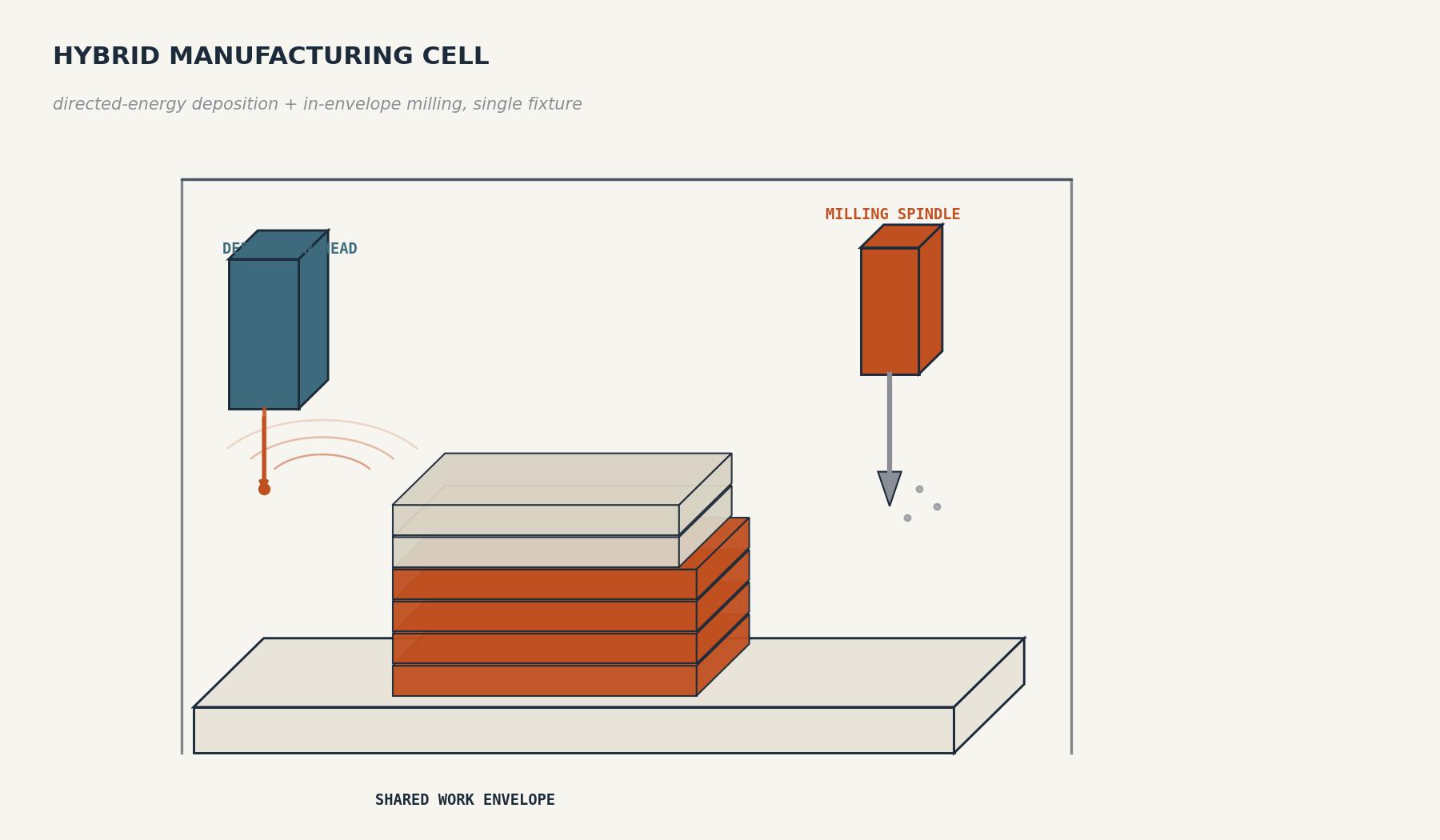 A single fixture, two processes: the deposition head builds near-net geometry while the spindle finishes features without disturbing part datum.
DED processes build up residual stress through repeated thermal cycling. Each new bead reheats the layers beneath it, and as the deposit cools it contracts against material that has already solidified and partially cooled, producing a longitudinal stress gradient that generally trends tensile near the surface and grows with build height as thermal cycles accumulate. A recent evolution-of-microstructure study on laser-DED Inconel 718 traced this buildup directly to the number and spacing of reheating cycles, showing that stress state is inseparable from the deposition sequence itself, not just the final geometry (Tandfonline, 2024). Left unmanaged, that tensile drift is what causes distortion, cracking at reentrant features, and dimensional walk during unconstrained cooling.
Interleaving machining passes between deposition stages changes this picture in a way that is easy to misread as purely beneficial. Milling a just-deposited layer does relieve some of the accumulated tensile stress by removing material and interrupting the thermal cycle, but the cutting action itself is not stress-neutral: plastic deformation at the tool-workpiece interface generates a thin near-surface layer of refined, low-angle grain boundaries under residual compression, distinct from the bulk stress state left by deposition. Because the substrate is often still warm from the previous deposition pass, thermal softening also measurably lowers the cutting forces required, which in turn changes how much plastic strain — and how much compressive stress — gets imparted at the surface (ScienceDirect, 2023). The net residual stress profile in a hybrid-built part is therefore not simply “AM stress minus what machining removes”; it is a superposition of a thermally driven bulk gradient and a mechanically driven surface layer, and the two do not scale the same way with process parameters.
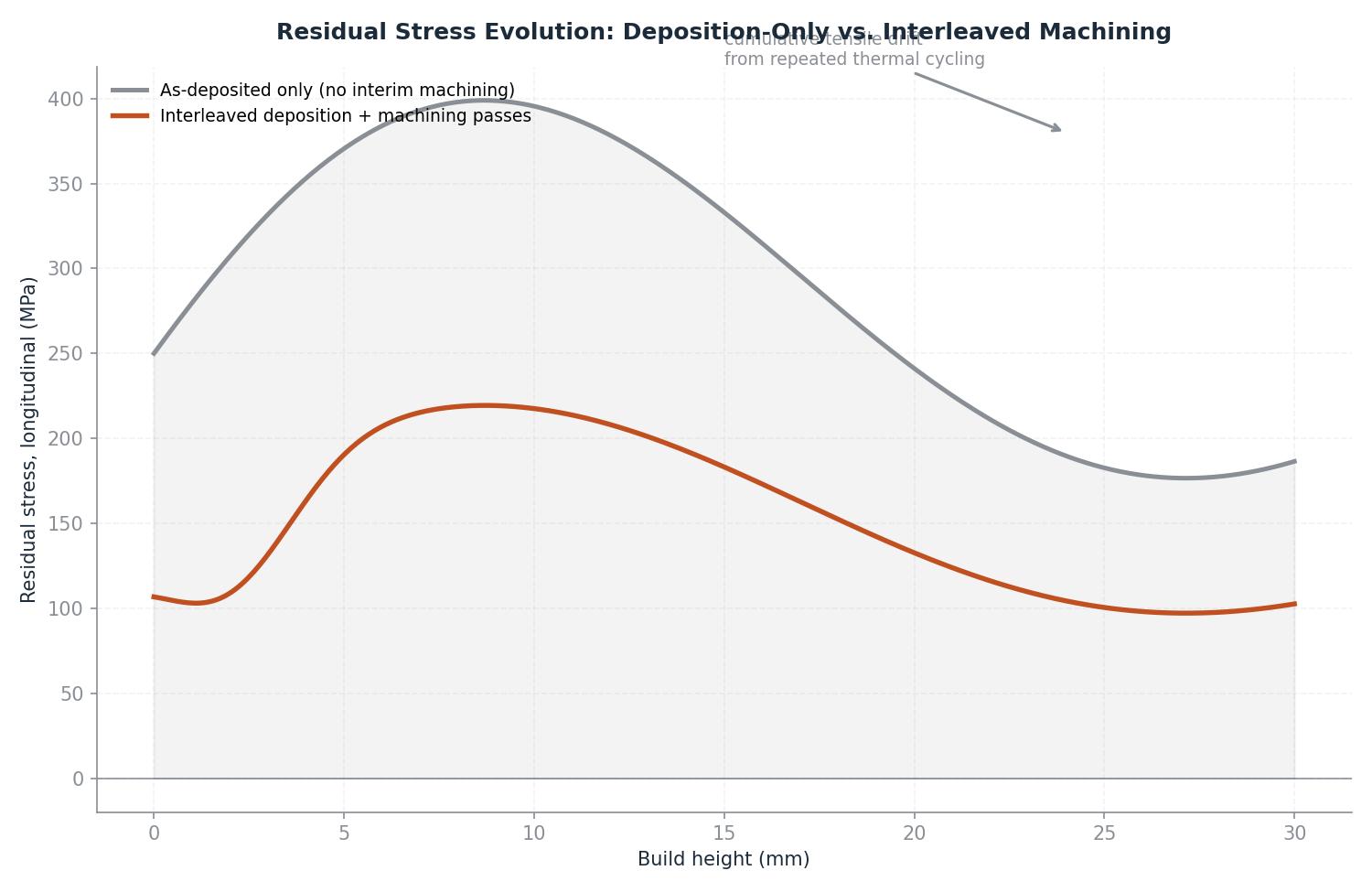 Interleaved machining introduces a shallow compressive layer at the surface while damping — but not eliminating — the tensile drift that accumulates through the bulk with build height.
This interaction matters most where it is least visible: in-process dimensional accuracy. A 2025 experimental study on hybrid additive-subtractive processing found that finish-machining passes measurably improved surface quality and closed tolerance gaps that pure deposition could not reach on its own, but also flagged that the timing of those passes relative to the thermal state of the part changed the outcome enough to warrant process-specific calibration rather than a fixed interleaving schedule (MDPI Materials / PMC, 2025). That finding lines up with a broader taxonomy of hybrid systems, which identifies process planning — deciding when to switch modes, not just whether to combine them — as the primary bottleneck limiting wider hybrid adoption, ahead of machine architecture or material compatibility (MDPI Machines, 2024).
The systems-level consequence is that hybrid manufacturing shifts engineering effort from part design toward process sequencing. A single-fixture strategy eliminates the dimensional error that comes from re-referencing a part between separate AM and CNC machines, which is the argument usually made for hybrid adoption. But it also means the machine’s toolpath planner is implicitly managing a stress budget that neither pure additive nor pure subtractive process planning was built to reason about. For applications where fatigue life depends on near-surface residual stress — repair welds on rotating components, for instance — that budget is arguably as important as the final geometry itself.
As deposition heads and multi-axis spindles continue to be packaged into single machines rather than adjacent cells, the process-planning question is likely to become the differentiator between vendors: not how precisely a machine can deposit or cut, but how well it can decide when to do each.