
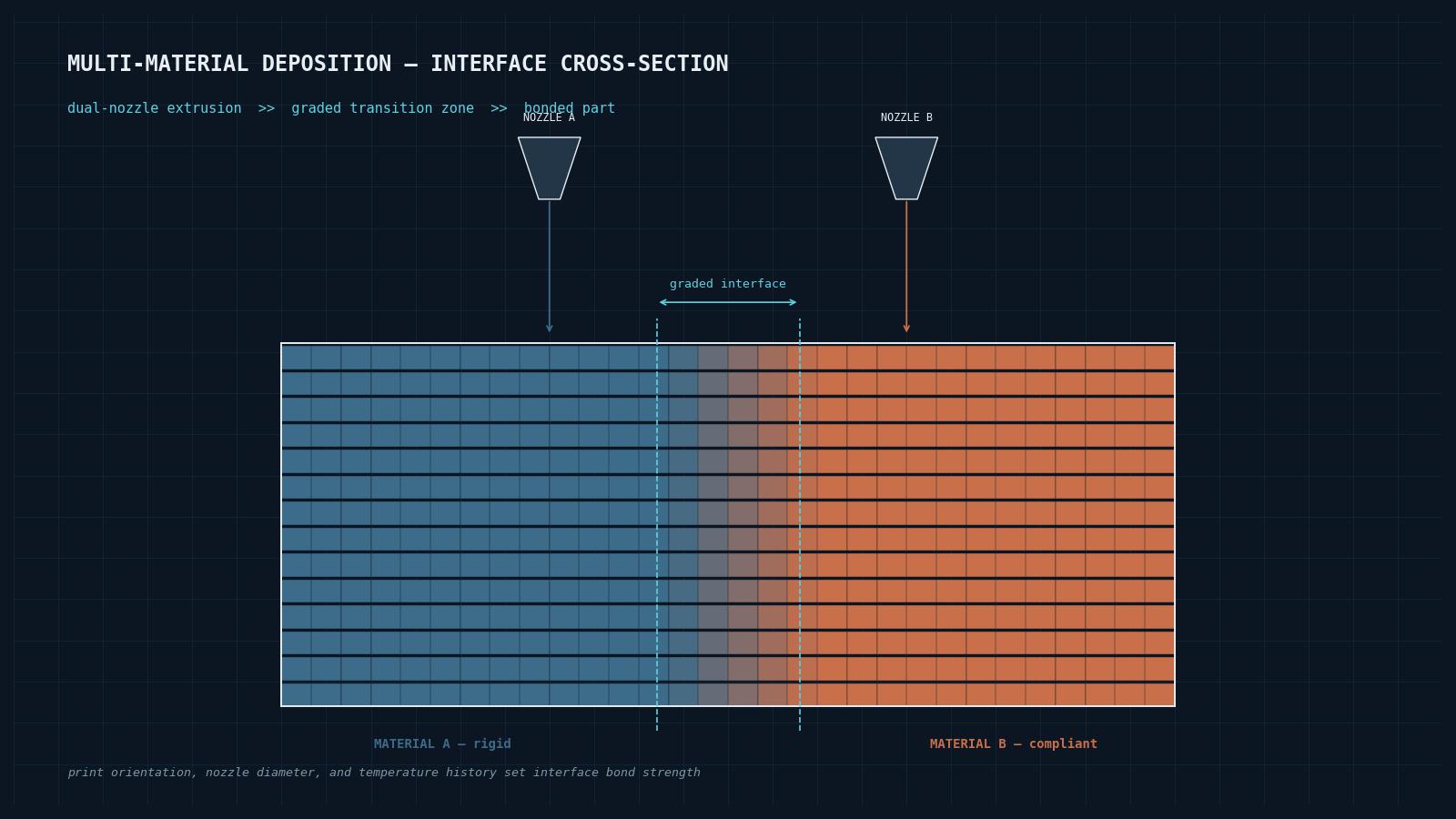
Print orientation, nozzle diameter, and temperature history — not material chemistry alone — set the strength of the bond between dissimilar materials in a single build.
Multi-material additive manufacturing lets a single build combine materials with different stiffness, color, conductivity, or damping behavior, something no single-material process can offer without post-assembly. The appeal is straightforward: a gripper printed with a rigid frame and a compliant fingertip, or a heat shield that grades from a ceramic outer layer to a metallic substrate, needs no fasteners, adhesives, or secondary joining step. The obstacle, consistently, is what happens at the boundary where the two materials meet.
Unlike a homogeneous print, where each layer bonds to chemically identical material below it, a multi-material interface asks two dissimilar polymers, metals, or a polymer against a metal, to fuse across a boundary where thermal expansion, surface energy, and crystallization behavior may differ substantially. In material extrusion, the dominant multi-material process for polymers, adhesion at this boundary depends less on chemistry alone than on interface geometry: research on multimaterial joints fabricated by material extrusion has found that increasing printing speed reduces the resulting bond strength, while a larger nozzle diameter improves it, because both control how much time the interface spends above the softening point of the weaker material and how deeply the two melts interpenetrate before solidifying. Print orientation compounds this: specimens printed “on edge,” so the interface runs parallel to the print direction rather than across it, have shown interfacial toughness increases of up to 389 percent over “flat” oriented specimens, because the geometry forces mechanical interlocking between the deposited beads rather than relying on a flat, easily delaminated plane.
A broader review of interface bonding across multi-material AM processes, not just extrusion but also powder bed and directed energy deposition routes used for dissimilar metals, identifies material pairing, temperature history, and interface geometry as the three variables that dominate bond quality regardless of process family. Temperature history matters because it governs whether the second material arrives at the interface hot enough to re-melt or diffuse into the first before both solidify; too cold and the boundary behaves like a mechanical contact rather than a bond, too hot and dilution can degrade the properties either material was chosen for in the first place.
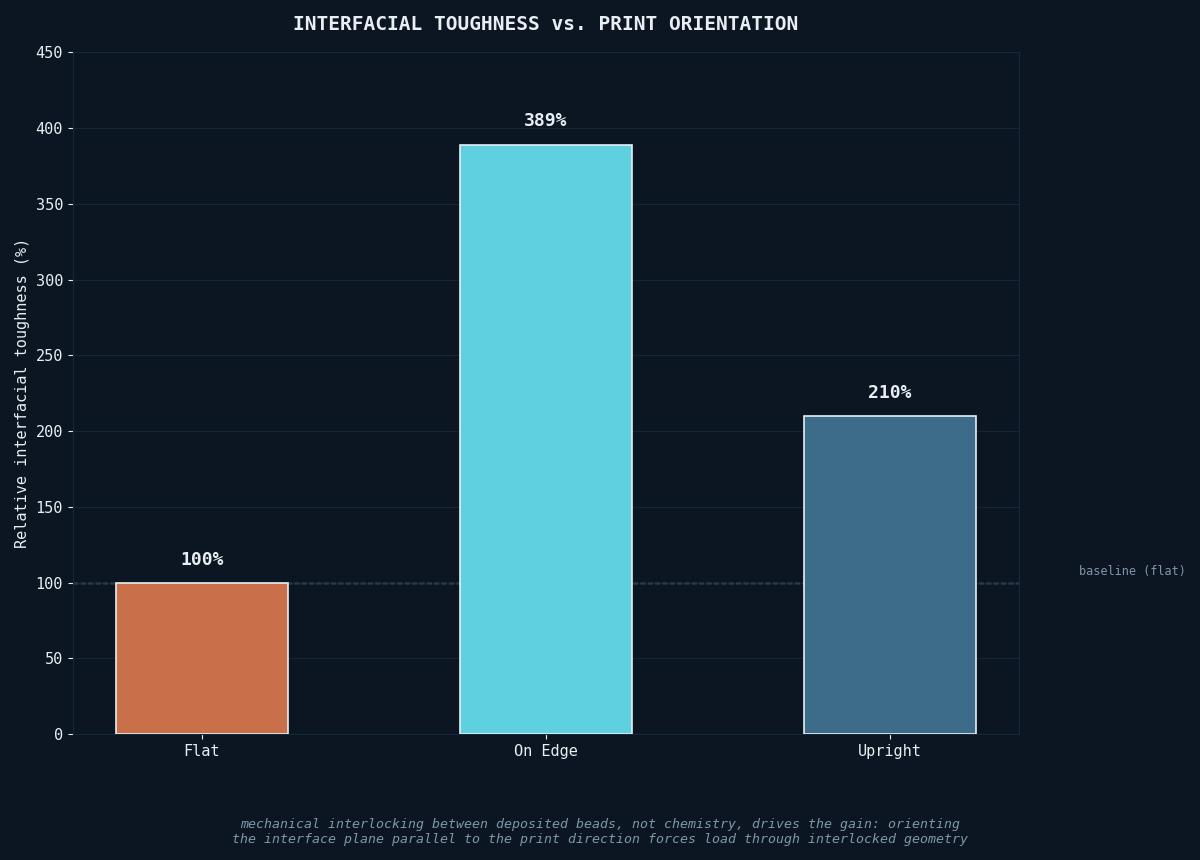
Orienting the interface plane parallel to the print direction forces load through interlocked bead geometry rather than across a flat, easily delaminated plane — a process choice, not a materials one.
These findings point toward a design implication rather than just a process one: because the interface is the weakest plane in a multi-material part, designers increasingly treat the transition itself as a feature to be engineered, not a byproduct of switching materials. Functionally graded material designs, where composition changes gradually across many thin steps rather than switching abruptly at a single plane, spread the property mismatch over a larger volume instead of concentrating it at one boundary; a recent bibliometric review of 3D-printed functionally graded materials notes this approach’s growing use in aerospace thermal-barrier and biomedical implant applications, where a gradual transition between a stiff structural material and a more compliant or thermally tolerant outer layer reduces the stress concentration a sharp interface would otherwise create. A systematic review of multi-material AM more broadly reaches a similar conclusion from the design side: as processes mature, the parts that succeed are the ones where the material transition is planned into the geometry rather than dropped in wherever the CAD model happens to change material assignment.
None of this makes multi-material printing a solved problem. Cross-contamination between print heads, limited material compatibility windows, and the added complexity of qualifying an interface rather than a single bulk material all continue to slow adoption outside of research settings and a handful of high-value aerospace and biomedical applications. But the direction of the work is consistent: interface strength in multi-material AM is not primarily a materials-chemistry problem to be solved by finding better-adhering pairs, it is a process-and-geometry problem, and one that print orientation, nozzle selection, and graded transitions can address directly. That reframing is what is starting to move multi-material printing from a laboratory demonstration toward parts that see real structural load.