
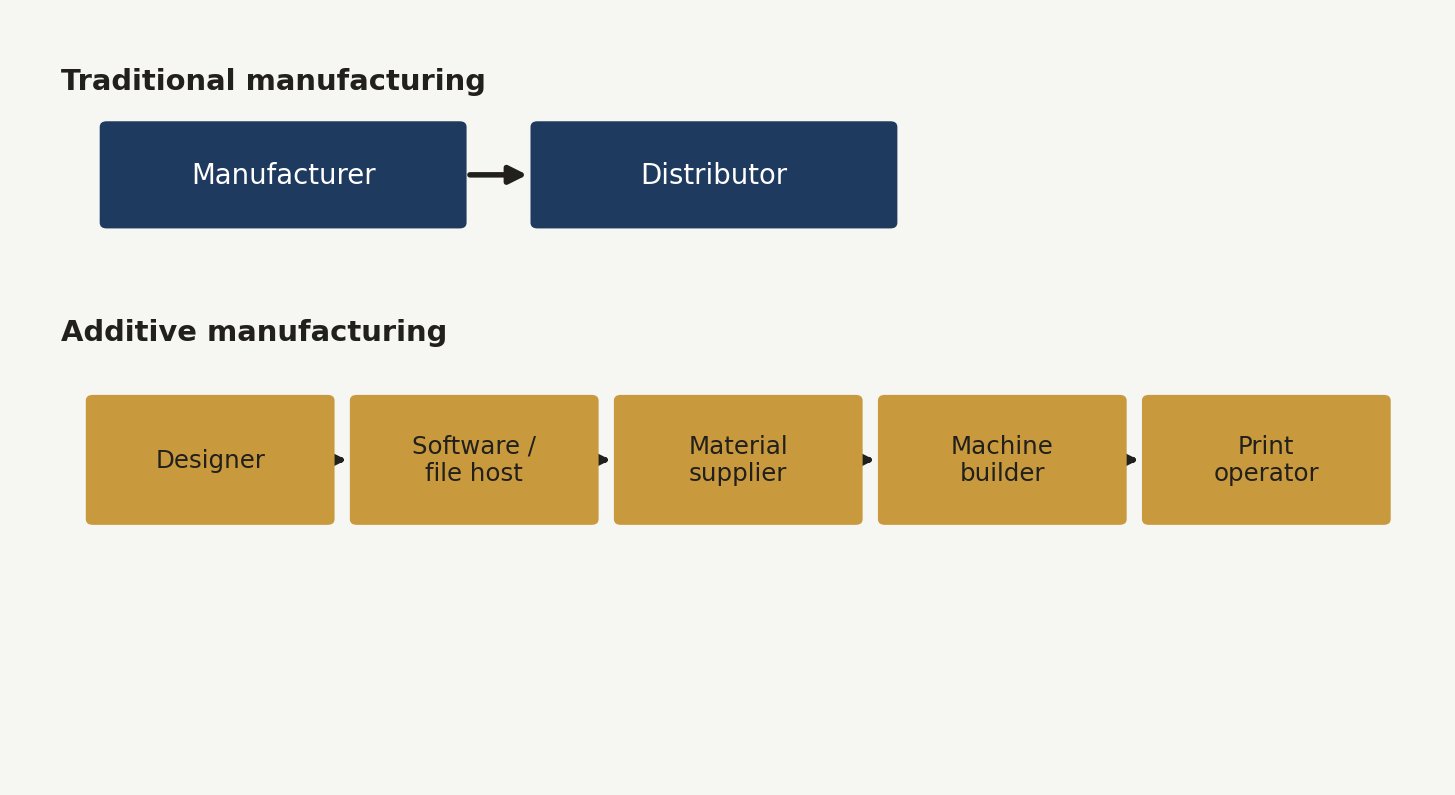
 Traditional product liability assumes one identifiable manufacturer. Additive manufacturing distributes that same duty of care across five parties who may never meet.
Product liability law was built around a simple assumption: a defective part has one manufacturer, and that manufacturer holds a duty of care from design through delivery. That assumption is what makes the whole system work economically. Insurers can price a policy, courts can assign damages, and a plaintiff knows who to sue. Additive manufacturing breaks the assumption without breaking the law that depends on it, and the industry is now paying the transaction cost of figuring out who’s actually on the hook.
The distribution problem is structural, not incidental. A 3D-printed part can pass through a designer who authored the CAD file, a software platform or file host that stored and transmitted it, a material supplier whose powder or resin lot has its own certification, a machine builder whose process parameters shape the microstructure, and a print operator or service bureau that actually ran the job. Any one of them can plausibly be named when a part fails, and Travelers’ analysis of manufacturing risk puts the core liability question bluntly: fault “would fall upon any of three possible parties: the product designer, the manufacturer who printed the product, or the raw material supplier,” before even counting the software and machine layers underneath.
What makes this more than a legal curiosity is that decentralization was supposed to be additive manufacturing’s selling point. Swiss Re’s research on how 3D printing reshapes insurance describes the same shift from the other direction: production moving out of centralized factories and onto distributed machines means “traceability and attribution of liability” gets harder precisely because “3DP processes blur the lines between design and production.” A logistics company printing a spare part shipboard eliminates the warehouse and freight steps that used to separate risk across several insured parties. That’s the efficiency case for the technology. It’s also why liability now concentrates on fewer, less clearly bounded actors instead of spreading across a long, well-understood supply chain the way it did before.
Aerospace shows what happens when this ambiguity meets real financial exposure. Insure24’s overview of AM insurance in aerospace notes that a single defective print batch could end up installed across an entire fleet, with liability exposure reaching into “hundreds of millions of pounds” once one component ships to every aircraft on the line. That same source flags a second-order risk most manufacturers haven’t priced in at all: retroactive decertification, where a regulator revokes approval for a printing process after the fact, “even if no failures have occurred,” simply because the qualification data no longer holds up.
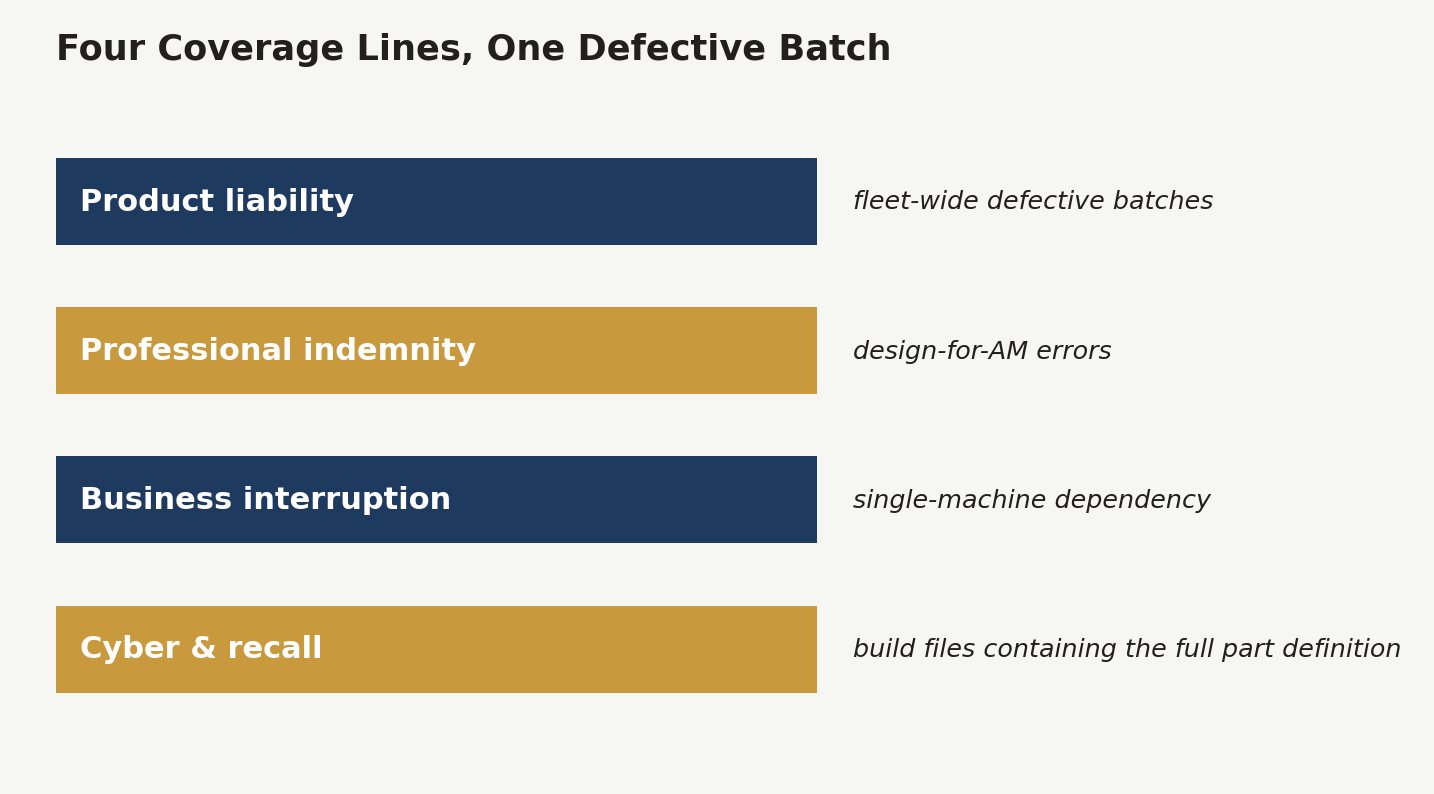 A defective print run rarely trips just one coverage line. Aerospace insurers now underwrite product liability, professional indemnity, business interruption, and cyber exposure as a connected set.
That single incident can trigger four separate coverage lines at once is the real underwriting headache. Product liability covers the fleet-wide defect itself. Professional indemnity covers the design-for-AM engineer whose orientation or lattice choice only manifests as a weakness after the part is built and tested. Business interruption covers the fact that one specialized machine, not a redundant production line, is often the entire bottleneck. And cyber and recall coverage exists because, as Insure24 puts it, “a single computer-aided design file contains the complete information needed to manufacture” the part in question, meaning a stolen or corrupted file is a manufacturing risk, not just a data breach.
The industry’s actual response so far hasn’t been to wait for case law to sort this out. Gathings Law’s overview of products liability in 3D printing points to what’s happening in practice instead: suppliers, designers, and print service providers are writing the allocation into contracts directly, because decentralized manufacturing “potentially blurring lines of responsibility” is exactly the kind of ambiguity a well-drafted agreement is supposed to close before a claim ever gets filed.
That’s the more interesting economic story here. Liability law moves slowly and by precedent; supply contracts move as fast as procurement teams need them to. A manufacturer choosing between an in-house print farm and a certified external service bureau isn’t just buying capacity or lead time anymore. It’s buying a counterparty willing to sign a contract that says, in writing, who eats the cost when a part fails in the field. Until courts settle whose duty of care actually governs a five-party production chain, that contractual clarity is worth more to a buyer than any per-part cost advantage additive manufacturing can offer.