
Ceramic additive manufacturing occupies an odd position in the field: the printing step is arguably the easy part. Vat photopolymerization — stereolithography and digital light processing adapted to ceramic-loaded resins — can resolve features at the scale of tens of microns, a precision conventional ceramic forming rarely offers. The part that leaves the printer, however, is not a ceramic. It is a polymer scaffold carrying ceramic powder, and everything that determines whether the final piece survives happens afterward, largely invisibly, in a furnace.
The process begins with a slurry: ceramic particles, often alumina or silicon nitride, dispersed at high solid loading (typically 40–60 vol%) in a photocurable resin. Solid loading is the central design variable, because it sets the ceiling on achievable density while working against printability — viscosity rises sharply as particle content increases, and the mismatch between resin and particle refractive index causes light scattering that degrades cure resolution. A recent review of alumina-based vat photopolymerization catalogs the countermeasures: refractive-index matching, bimodal particle grading to improve packing, and surface modification of the ceramic powder to improve dispersion and UV penetration, all aimed at pushing solid loading up without losing print fidelity (NCBI/PMC).
Printing only builds the green body. Two thermal steps follow: debinding, which burns or dissolves the polymer binder out of the part, and sintering, which drives densification of the remaining ceramic skeleton through diffusion at high temperature. Both are volumetric — the binder leaves from the outside in, and the ceramic grains consolidate and shrink roughly isotropically as porosity closes — which is why linear shrinkage in vat-photopolymerized ceramics commonly runs 15–20%. That shrinkage is not simply a scaling problem to be compensated in the CAD file; a recent study on silicon nitride structures found that the debinding and sintering schedule itself has to be tuned to the part’s geometry, since uneven binder removal or heating rate produces internal stress gradients that cracked or delaminated the more geometrically complex test pieces (PMC). A systematic review of defects in vat-photopolymerized ceramics frames this as the field’s core open problem: the same layer-wise curing that gives the process its resolution also creates anisotropic weak planes and residual stress concentrations that conventional pressed-and-fired ceramics don’t have to contend with (ScienceDirect).
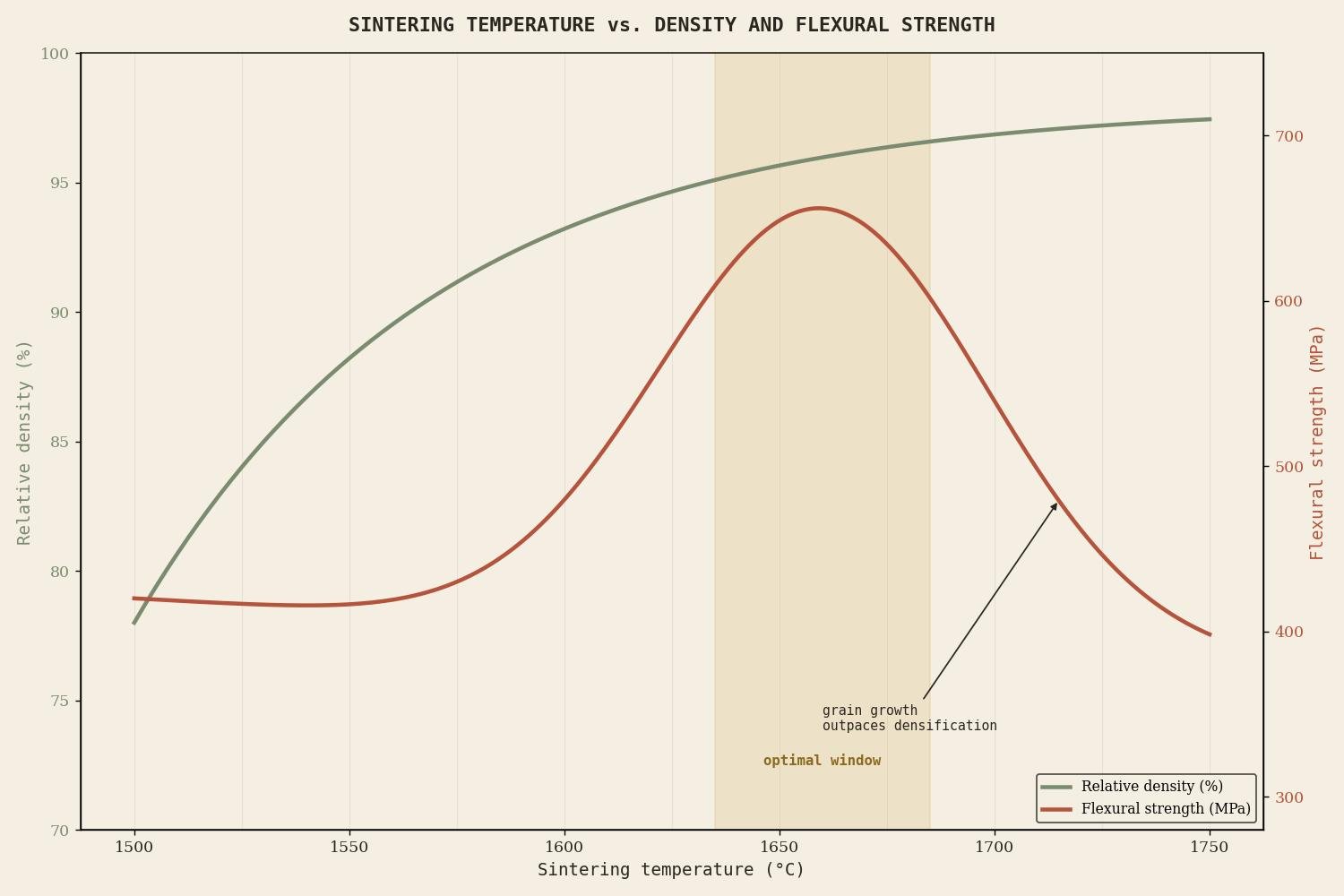 Figure 1: As sintering temperature rises, densification initially dominates and strength climbs with relative density; beyond a material-specific threshold, grain growth outpaces further pore closure and flexural strength falls even as density continues to edge upward — the narrow window that debinding/sintering schedules have to hit.
Sintering temperature is the lever that connects microstructure to mechanical performance, and the relationship is not monotonic. Work quantifying feature resolution and flexural strength as a function of sintering temperature found that relative density above roughly 95% is achievable with tight thermal control, but that strength peaks and then declines past an optimal temperature as grain growth begins to outrun the last stages of pore elimination — coarser grains provide larger crack-initiation sites even in a denser body (ScienceDirect). This narrow processing window is what makes ceramic AM difficult to industrialize: a schedule dialed in for one geometry and wall thickness does not transfer cleanly to another, because local heating and shrinkage rates depend on part shape.
The payoff for solving this is a class of parts — complex internal channels, lattice cores, graded-porosity structures — that conventional ceramic machining and pressing cannot produce economically. Dental restorations, RF and microwave ceramic components, and high-temperature aerospace insulators are the applications most often cited as near-term beneficiaries, precisely because they combine geometric complexity with tolerance for the process’s still-limited part size and build rate. What remains unresolved is less the printing physics than the process control: debinding and sintering profiles are still largely developed empirically per geometry, and closing that gap — through better in-situ shrinkage prediction and thermal simulation — is where the next practical gains in ceramic AM are likely to come from, rather than from further gains in print resolution itself.